

A Engineering Guide: Selecting the Right Mesh and Discharge Flow for Your Big Bag Feeding Station Flour Sifter
Post Date: 2026-06-25
Optimizing Flour Handling Through Proper System Design
In flour processing and powder handling operations, equipment performance depends not only on machine selection but also on proper system configuration. Two of the most important design considerations when integrating a Big Bag Feeding Station with a flour sifter are screen mesh selection and discharge flow control.
Choosing suitable screening specifications and material flow rates can help support efficient material handling, stable screening performance, and consistent downstream processing.
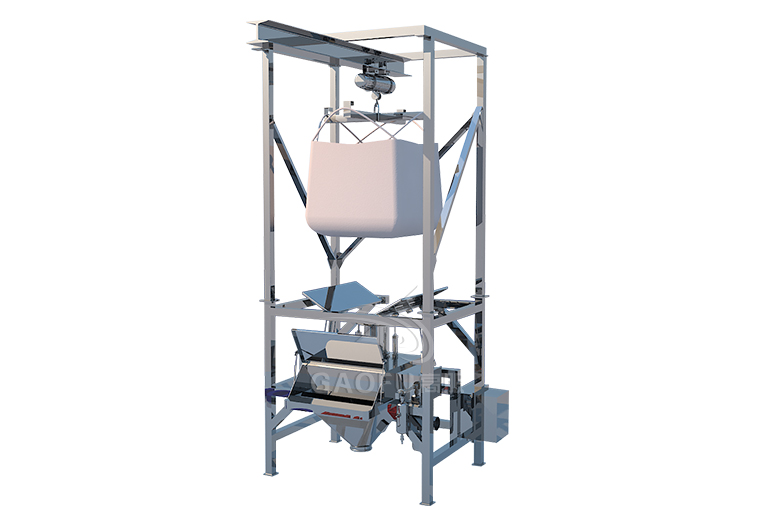
At Gaofu Machinery, we work with customers to evaluate material characteristics and production requirements when designing bulk powder feeding and screening systems.
Understanding the Big Bag Feeding Station Flour Sifter System
A typical system consists of:
- Big Bag Feeding Station
- Material receiving hopper
- Conveying equipment
- Flour sifter
- Downstream storage or processing equipment
The Big Bag Feeding Station unloads flour from jumbo bags (FIBCs), while the flour sifter screens the material before it enters subsequent production stages.
To achieve reliable operation, the feeding rate and screen specification should be considered together rather than as separate equipment selections.
Why Mesh Selection Matters
The screen mesh determines the particle size separation performed by the flour sifter.
Selecting an inappropriate mesh may result in:
- Reduced screening efficiency
- Excessive material retention
- Increased screen maintenance frequency
- Unnecessary product rejection
- Inconsistent material flow
The optimal mesh size depends on the production objective and material characteristics.
Common Screening Objectives
Foreign Particle Removal
When the primary goal is removing packaging debris, fibers, or foreign contaminants, a relatively coarse mesh may be sufficient.
Typical applications include:
- Incoming flour inspection
- Bulk ingredient receiving
- Pre-mixing preparation
Agglomerate Removal
For materials that tend to form lumps during storage or transportation, a medium mesh specification may help separate agglomerates while allowing acceptable product particles to pass.
Fine Classification
Some specialty food powders require tighter particle size control. In these applications, finer meshes may be selected to achieve the desired screening result.
The appropriate mesh size should be determined through material testing and process evaluation.
Factors Affecting Mesh Selection
Particle Size Distribution
Understanding the particle size range of the flour or powder is essential when selecting screen openings.
Material Moisture Content
Higher moisture levels can influence material flow behavior and screening performance.
Production Capacity Requirements
Finer mesh sizes generally provide smaller openings, which may influence throughput capacity depending on material characteristics.
Product Quality Specifications
Customer requirements for particle size consistency may affect screen selection decisions.
Material Flow Characteristics
Factors such as cohesiveness, bulk density, and flowability should be evaluated before finalizing mesh specifications.
Understanding Discharge Flow Control
In addition to mesh selection, discharge flow from the Big Bag Feeding Station plays a critical role in overall system performance.
The discharge rate influences:
- Screening efficiency
- Equipment loading
- Material transfer stability
- Downstream process consistency
An excessively high feed rate may overload the sifter, while a feed rate that is too low may reduce production efficiency.
Methods for Controlling Material Flow
Hopper Design
Proper hopper geometry can help encourage consistent material movement from the bulk bag to the conveying system.
Flow-Assistance Devices
Certain powders may require additional discharge assistance, such as:
- Bag massage systems
- Vibratory devices
- Fluidization solutions
The selection depends on material characteristics and operating requirements.
Conveying System Integration
The conveying equipment should be matched with the desired production capacity and material properties.
Common options include:
- Screw conveyors
- Vacuum conveyors
- Pneumatic conveying systems
- Tubular chain conveyors
Variable Speed Control
Adjustable feeding systems allow operators to modify material flow according to process requirements.
Balancing Mesh Size and Feed Rate
The most effective screening systems are designed by considering mesh size and discharge flow together.
For example:
Fine Mesh + Moderate Feed Rate
Suitable for applications requiring more precise screening and particle control.
Medium Mesh + Higher Feed Rate
Often used where throughput requirements are prioritized and particle size specifications are less restrictive.
Coarse Mesh + High Capacity Feeding
May be appropriate for preliminary screening or foreign material removal applications.
Actual performance depends on material characteristics, operating conditions, and equipment configuration.
Engineering Recommendations for Flour Applications
When designing a flour handling system, consider the following:
✓ Evaluate flour particle size distribution before selecting mesh specifications
✓ Conduct material testing when processing specialty powders
✓ Match feeding capacity to screening capacity
✓ Consider future production expansion requirements
✓ Integrate appropriate dust management solutions
✓ Design equipment layouts for maintenance accessibility
✓ Review sanitation requirements for food processing environments
These factors can help support long-term system reliability and operational efficiency.
Typical Applications
The Big Bag Feeding Station Flour Sifter System is commonly used for:
- Wheat flour
- Rice flour
- Corn flour
- Starch
- Milk powder
- Sugar
- Food additives
- Baking premixes
- Protein powders
Equipment configurations should be customized according to the material and process requirements.
Why Choose Gaofu Machinery?
For over 40 years, Gaofu Machinery has focused on screening and bulk material handling solutions for food, chemical, pharmaceutical, mining, and new material industries.
Our Capabilities
- 40+ years of industry experience
- 60,000㎡ production base
- 500+ patent applications
- Exported to over 100 countries and regions
- Serving more than 10,000 global customers
- Customized feeding, conveying, and screening solutions
Our engineering team can assist customers in evaluating material characteristics, production targets, and facility conditions to develop suitable system configurations.
Conclusion
Selecting the right mesh and discharge flow is an important part of designing an effective Big Bag Feeding Station Flour Sifter System. By carefully evaluating material properties, production requirements, and process objectives, manufacturers can build a feeding and screening solution that supports efficient material handling and stable production operations.
If you are planning a new flour handling project or upgrading an existing line, Gaofu Machinery can help you identify suitable feeding, conveying, and screening configurations for your specific application.