

A Technical Analysis: Inclination Angles and Stroke Length Adjustments for Your Feed Vibro Separator
Post Date: 2026-10-21
In industrial feed processing, selecting the right screening machine is only the first step toward peak operational efficiency. The true test of a classification circuit lies in how effectively plant engineers tune the machine's operational parameters to match the variable flow characteristics of incoming feed formulations. Two of the most critical variables governing separation performance are deck inclination angle and stroke length (amplitude).
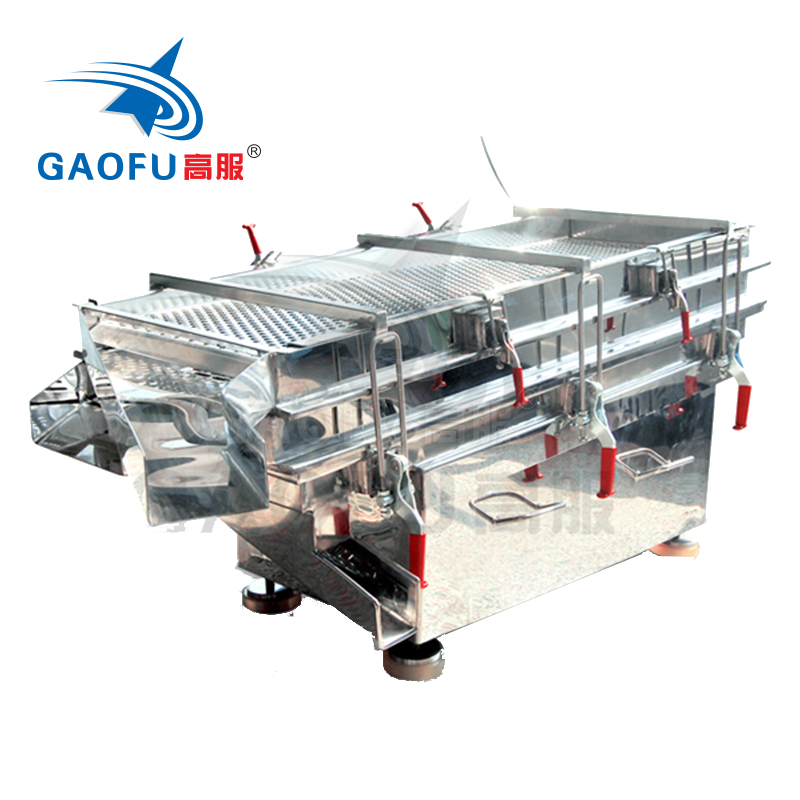
At Gaofu Machinery, our Linear Vibrating Screen is engineered with adjustable mechanical features that allow operators to fine-tune these parameters, optimizing retention time, throughput volume, and particle grading accuracy.
1. The Physics of Deck Inclination: Balancing Gravity and Vector Force
The inclination angle—the degree of downward tilt from the feed inlet to the discharge lip—directly influences how long material remains on the screening surface (residence time) and how fast it travels across the mesh.
                  [ Feed Inlet ]
                       |
                       v
         \  $\theta$ (Inclination Angle: 0° to 15°)
          \----------------------------------------- [ Deck Surface ]
           \                                       \
            \                                       \
             v [ Discharge Lip ]                     v [ Oversize/Fines ]
- Horizontal Configuration (0° Tilt): Operating the linear vibrating screen in a completely flat position relies 100% on the mechanical throwing vector of the dual motors to convey material. This maximizes retention time, making it ideal for difficult separations where fine particles require extended contact with the mesh.
- Inclined Configuration (5° to 15° Tilt): Introducing a downward slope harnesses gravitational acceleration to assist material flow. This configuration is preferred for high-throughput raw grain intake or bulky mash lines where high volumetric capacity takes precedence over deep stratification.
2. Decoding Stroke Length and Amplitude: Managing Particle Integrity
While inclination controls material travel speed, stroke length (amplitude) dictates the energy transferred to the particle bed. Stroke length is determined by the eccentric weight configuration on the synchronized vibratory motors.
- Long Stroke / High Amplitude: Generates higher G-forces, effectively breaking up stubborn agglomerates, fluidizing dense material beds, and preventing blinding. However, excessive amplitude when processing fragile finished feeds can lead to mechanical pellet degradation and unwanted fines generation.
- Short Stroke / Low Amplitude: Delivers high-frequency, gentle micro-throws. This setting is critical when processing brittle crumbles, soft extruded aquaculture feeds, or vitamin-mineral premixes, ensuring precise sizing without fracturing delicate pellet structures.
3. Optimizing Parameters for Diverse Feed Profiles
Different feed types demand a tailored balance between angle and stroke. Process engineers can adjust these settings based on material properties:
| Feed Type | Recommended Deck Tilt | Recommended Stroke Setting | Primary Objective |
| Raw Grains & Mash | 5° – 10° | Medium-High Amplitude | High volume capacity, debris removal |
| Fragile Crumbles | 0° – 5° | Short Stroke, High Frequency | Gentle grading, zero pellet breakage |
| High-Fat Aqua Pellets | 0° (Horizontal) | Moderate Amplitude | Extended retention time, maximum fines extraction |
4. Precision Control with Gaofu Engineering
The Gaofu Linear Vibrating Screen is designed to make parameter adjustments safe, intuitive, and mechanically reliable:
- Adjustable Motor Weights: Segmented eccentric weight plates allow maintenance personnel to quickly alter the centrifugal force and stroke length during scheduled commissioning.
- Flexible Support Springs: Tuned isolation assemblies maintain stable stroke performance across various tilt angles without transmitting excessive vibration back to facility structures.
Fine-Tune Your Line with Gaofu Machinery
Mastering the balance between inclination angles and stroke length unlocks the full potential of your feed classification circuit. Gaofu Machinery provides comprehensive technical support to help your plant achieve optimal sizing efficiency.
Contact our application engineering team today to discuss your facility's specific feed formulations and receive expert guidance on configuring your linear vibrating screen.