

Dual-Motor Synchronized Vibration: The Physics of High-Speed Protein Powder Classification
Post Date: 2026-10-25
In high-throughput industrial screening, achieving rapid, highly repeatable particle separation across massive bulk volumes requires more than simple vibration—it requires precise mechanical synchronization. When handling high-density bulk streams of plant proteins, whey isolates, or complex amino acid matrices, standard single-motor screening systems often struggle with material piling, uneven bed distribution, and localized mesh overload.
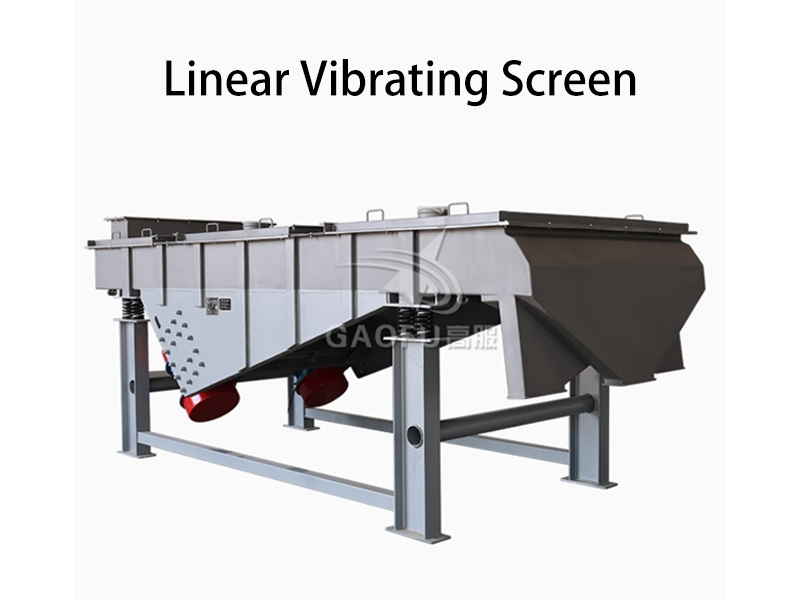
At Gaofu Machinery, we solve these operational throughput challenges by applying advanced vibration mechanics to our industrial Linear Vibrating Screen. Powered by dual-motor self-synchronization physics, this system provides balanced dynamic acceleration that drives rapid, high-precision protein powder classification.
The Mechanical Physics of Dual-Motor Self-Synchronization
The core performance of Gaofu Machinery's Linear Vibrating Screen relies on the principle of spontaneous synchronization (or self-synchronization) between two parallel, counter-rotating vibratory motors.
       [ Motor A: Counter-Clockwise ]          [ Motor B: Clockwise ]
                    ↺                                    ↻
             ( Eccentric Mass )                   ( Eccentric Mass )
                    │                                    │
                    └─────────────┬──────────────────────┘
                                  │
                                  ▼
           [ Resultant Linear Force Vector (Up-Forward Thrust) ]
                                  │
                                  ▼
           [ Rectangular Screen Box & Material Bed Trajectory ]
When two identical unbalance motors are mounted on a shared flexible mechanical frame and wired to rotate in opposite directions:
- Self-Synchronizing Phase Lock: Without requiring mechanical gears, timing belts, or electronic linkages, the mechanical coupling through the screen box frame naturally forces both motor shafts to lock into identical rotational frequencies in exact phase opposition.
- Horizontal Force Vector Cancellation: The horizontal centrifugal force components generated by the two counter-rotating eccentric masses constantly oppose and cancel each other out ($F_{\text{horizontal}} = 0$).
- Vertical & Inclined Acceleration Summation: The vertical force components reinforce each other ($F_{\text{vertical}} = F_1 + F_2$), generating a pure, directional linear force vector acting through the screen box's center of gravity (typically inclined at a $30^\circ\text{–}60^\circ$ angle relative to the screen bed).
Dynamic Impact on Powder Classification Behavior
This synchronized linear force vector creates distinct physical conditions across the material bed that maximize screening efficiency:
- Micro-Hop Parabolic Motion: Incoming bulk powder receives consistent linear impulses, propelling particles upward and forward in short, high-frequency parabolic arcs. This continuous lifting motion fluidizes the powder bed, preventing fine protein particles from clumping together under mass pressure.
- Instantaneous Bed Stratification: As the powder bed lifts and drops back onto the mesh, natural kinetic sorting occurs instantly: coarse particles rise to the top layer while smaller particles fall through the interstitial voids directly onto the screen cloth.
- Uniform Mass Velocity: Because the linear force is distributed evenly across the full width of the rectangular screen box, powder moves downstream at a constant, uniform velocity without tracking to one side or creating dead zones.
Practical Engineering Benefits for Processing Plants
1. High Energy Transfer Efficiency with Lower Power Consumption
By eliminating power-robbing mechanical drive belts, gears, and complex linkages, direct dual-motor excitation transfers over $90\%$ of generated electrical power directly into structural vibration, minimizing energy costs per ton of screened product.
2. Fine-Tuned Stroke & Amplitude Control
Plant engineers can easily adjust the relative angle between the eccentric weights on each motor shaft. This allows precise tuning of vibration amplitude (stroke length) and throw angle to match the specific moisture, bulk density, and cohesion characteristics of various protein isolates.
3. Reduced Structural Fatigue & Noise Generation
Self-synchronizing linear vibration eliminates the torsional twisting forces common in asymmetrical screening drives. When paired with heavy-duty steel isolation springs, dynamic stress on weld joints is minimized, and operational noise is held strictly below industry standards.
Partner with Gaofu Machinery for High-Speed Processing
Understanding the mechanical physics behind screening technology allows Gaofu Machinery to build equipment that excels under demanding industrial conditions. Whether you need high-speed scalping or complex multi-fraction classification, our engineering team customizes motor power, stroke amplitude, and deck geometry to optimize your processing line.
Contact Gaofu Machinery today to consult with our engineering specialists on how dual-motor synchronized linear screening can maximize your plant’s throughput and particle separation precision.