

How to Evaluate a Sieving Machine for Fine Mesh Filtration in Food Manufacturing
Post Date: 2026-08-07
Introduction
Fine mesh filtration is an important process in many food manufacturing operations. Flour, starch, sugar, milk powder, beverage ingredients, liquid seasonings, and other food materials may require screening or filtration before entering mixing, storage, filling, or packaging stages. Choosing an appropriate sieving machine therefore requires more than comparing equipment dimensions or nominal capacity.
Manufacturers should evaluate how a machine interacts with the material, how the screen is configured, how easily it can be cleaned, and how well it fits into the existing production line. These considerations become particularly important when fine mesh filtration is required, because smaller openings can place greater demands on material distribution, screen condition, and operating parameters.
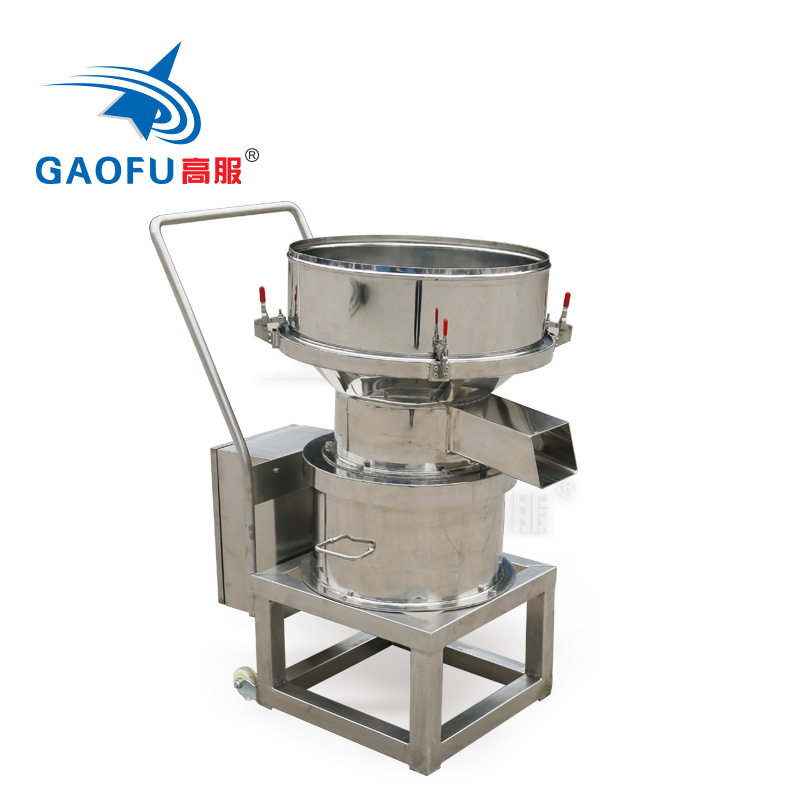
The Gaofu Filtration Sieve is designed for fine screening and filtration applications across food and other processing industries. This guide presents practical criteria that manufacturers can use when evaluating a sieving machine for fine mesh food processing applications.
1. Define the Actual Filtration Objective
The first step is to establish what the machine needs to accomplish.
Fine mesh filtration may be used for different purposes, including:
- Removing oversized particles from food powders
- Separating agglomerated ingredients
- Filtering suspended solids from liquids
- Classifying fine particles
- Preparing ingredients before blending
- Supporting product recovery
A machine intended for powder screening may require a different configuration from one processing a liquid or slurry. Defining the separation objective first helps narrow the equipment selection.
2. Examine the Material Characteristics
Material properties have a direct influence on screening and filtration behavior.
Before selecting equipment, manufacturers should evaluate:
Particle Size
Determine the approximate particle size distribution and the size range that needs to be separated.
Moisture
Moisture can influence powder cohesion and flowability.
Flowability
Free-flowing powders generally behave differently from cohesive or easily agglomerated materials.
Bulk Density
Different bulk densities can affect the quantity of material presented to the screen at a given feed rate.
Liquid Viscosity
For liquid applications, viscosity can influence how readily the product passes through fine mesh.
Material testing can help determine the appropriate equipment and screen specification.
3. Evaluate Fine Mesh Compatibility
The selected mesh should correspond to the required separation point.
When evaluating a sieving machine, manufacturers should consider:
- Available mesh specifications
- Screen material
- Screen construction
- Screen tension
- Screen replacement procedures
- Compatibility with the processed product
Using a finer mesh does not automatically produce a better result. The appropriate opening should balance the desired separation with material flow and production requirements.
4. Assess Screen Area
Available screening area is another important consideration.
A larger effective screening area can provide more space for material distribution, while equipment dimensions also need to match the available installation area.
Manufacturers should therefore evaluate:
- Screen diameter
- Effective screening area
- Number of screen decks
- Required production capacity
- Available factory space
The correct size should be determined from actual material characteristics and process requirements rather than equipment size alone.
5. Examine Material Distribution
Fine mesh applications benefit from appropriate material distribution across the screen.
During operation, controlled vibration moves incoming material across the screening surface. A suitable machine configuration can help distribute material over the available screen area rather than concentrating it in a single location.
When evaluating equipment, consider whether the design supports:
- Even material spreading
- Continuous movement
- Stable discharge
- Suitable residence time
Actual performance depends on feed conditions, material characteristics, mesh selection, and operating parameters.
6. Consider Single-Deck or Multi-Deck Screening
The number of screen decks should correspond to the desired separation process.
Single-Deck Screening
Suitable for applications such as:
- Removing oversized flour particles
- Screening food powders
- Safety screening before packaging
Multi-Deck Screening
Can be considered when manufacturers need to produce several particle size fractions.
The additional screen decks should only be selected when they provide a useful process function.
7. Evaluate Screen Replacement and Cleaning
Fine mesh screens require regular inspection and appropriate cleaning procedures.
Manufacturers should examine:
- Accessibility of the screen assembly
- Screen replacement procedures
- Cleaning requirements
- Inspection access
- Availability of replacement screens
For food manufacturing, cleaning procedures should be compatible with the facility's sanitation program and the equipment manufacturer's recommendations.
8. Check Product-Contact Materials
The construction materials of the equipment should match the intended application.
For food processing, manufacturers commonly consider stainless steel for product-contact components because of its corrosion resistance and suitability for routine cleaning.
Other factors include:
- Surface condition
- Weld quality
- Sealing components
- Material compatibility
- Applicable customer specifications
The exact material grade and finish should be selected according to the product and relevant regulatory or customer requirements.
9. Evaluate Filtration of Liquids and Slurries
Some food production facilities process both dry and liquid materials.
If liquid filtration is required, additional factors become important:
- Liquid viscosity
- Solid concentration
- Feed pressure
- Flow rate
- Particle characteristics
- Required filtration opening
A filtration sieve configured for liquid-solid separation can be integrated with pumps, tanks, and other process equipment.
10. Consider Production Line Integration
A filtration sieve should be evaluated as part of the complete process rather than as an isolated machine.
It may be connected to:
Upstream Equipment
- Feeding Systems
- Vacuum Feeders
- Big Bag Feeding Stations
- Storage Hoppers
- Mixing Tanks
- Pumps
Downstream Equipment
- Mixers
- Storage Silos
- Holding Tanks
- Filling Machines
- Packaging Systems
The inlet and outlet arrangement, machine height, discharge direction, and capacity should be coordinated with surrounding equipment.
11. Evaluate Operating and Maintenance Requirements
Fine mesh filtration equipment requires routine attention to maintain stable operation.
Manufacturers should establish procedures for:
- Screen inspection
- Fastener checks
- Seal inspection
- Motor inspection
- Equipment cleaning
- Scheduled component replacement
Operators should also monitor changes in material flow, vibration, noise, and discharge behavior.
Maintenance intervals should be based on operating conditions and the equipment manufacturer's instructions.
12. Consider Product Changeovers
Food processing facilities may handle multiple ingredients on the same production line.
If frequent product changes are expected, manufacturers should evaluate how the equipment supports:
- Screen replacement
- Internal cleaning
- Product residue removal
- Inspection
- Reassembly
A practical changeover procedure can help production teams manage different product formulations while following the facility's hygiene requirements.
13. Evaluate Capacity Against the Complete Process
The capacity of the filtration sieve should be compatible with both upstream and downstream equipment.
For example, a screening machine should not become a significant restriction between a high-capacity feeder and a downstream mixer.
Capacity evaluation should consider:
- Average production rate
- Peak production rate
- Material bulk density
- Feed characteristics
- Screen specification
- Future production requirements
Actual throughput varies with material and machine configuration, so application testing can be useful when precise performance data is required.
Features of the Gaofu Filtration Sieve
The Gaofu Filtration Sieve provides configurable screening and filtration solutions for food manufacturing and other powder or liquid processing applications.
Fine Mesh Screening Options
Different mesh specifications can be selected according to particle separation requirements.
Flexible Configurations
Machine size, screen deck arrangement, and discharge configuration can be matched to different production conditions.
Stainless Steel Product-Contact Components
Product-contact parts can be manufactured using stainless steel materials suitable for food processing applications.
Dry and Liquid Applications
Depending on configuration, the equipment can be used for:
- Fine powder screening
- Flour screening
- Starch screening
- Liquid filtration
- Slurry separation
- Oversized particle removal
Production Line Integration
The equipment can be connected with:
- Feeding Systems
- Vacuum Feeders
- Big Bag Feeding Stations
- Pumps
- Mixing Equipment
- Storage Tanks
- Packaging Equipment
Equipment specifications and optional configurations vary according to customer requirements.
Typical Food Manufacturing Applications
The Gaofu Filtration Sieve can be configured for a variety of food materials.
Fine Powders
- Wheat flour
- Rice flour
- Corn starch
- Potato starch
- Sugar powder
- Cocoa powder
- Milk powder
- Protein powder
- Baking ingredients
- Seasoning powders
Liquid and Slurry Materials
- Fruit juice
- Vegetable juice
- Syrups
- Starch slurry
- Dairy liquids
- Beverage ingredients
- Liquid seasonings
Application suitability depends on material properties, required separation, production capacity, and equipment configuration.
A Practical Evaluation Checklist
Before purchasing a sieving machine, food manufacturers can review the following questions:
| Evaluation Factor | Key Question |
|---|---|
| Material | What are the powder or liquid characteristics? |
| Separation | What particle size needs to be removed or classified? |
| Mesh | Which mesh opening is appropriate? |
| Capacity | Can the machine match the required production rate? |
| Configuration | Is single- or multi-deck screening required? |
| Cleaning | Can the screen and product-contact areas be accessed efficiently? |
| Construction | Are the contact materials suitable for the application? |
| Integration | Can the machine connect with existing equipment? |
| Maintenance | Are inspection and replacement procedures practical? |
| Future Needs | Can the configuration accommodate changing production requirements? |
This checklist can help purchasing and engineering teams compare equipment using process-specific criteria rather than relying on a single specification.
Fortune 500 Client Testimonials
CNPC、CSCEC、Sinochem Holdings、CRCC、China Minmetals Corporation、CNOOC、CR、Sinopharm、CHN Energy、COFCO Corporation、Huawei Technologies、PowerChina、CITIC Group、Wuchan Zhongda Group、NORINCO、Chalco、CNBM、 Shaanxi Coal and Chemical Industry Group、Ansteel Group、CETC、CSSC、CASC、CEC、Jinchuan Group、CASIC、Conch Cement、CNNC、SPH、Shanxi Coking Coal Group、 Zhongtai Chemical、GPHL、DEC、Sinosteel Corporation、MCC、China National Salt Industry Chemical、China Baowu Steel Group、China Animal Husbandry Industry Co., Ltd.、CECEP
About Gaofu
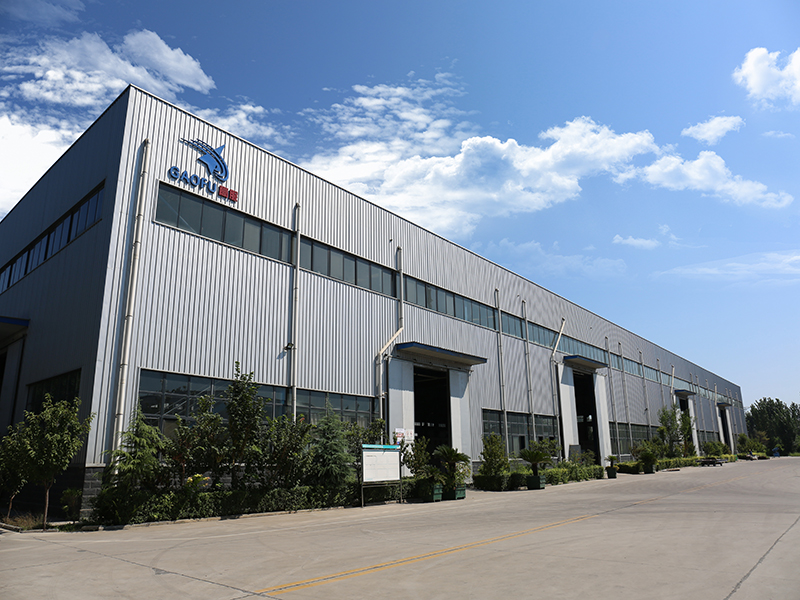
Xinxiang Gaofu Machinery Co., Ltd. was founded back in the 1980s. With over 40 years of development, it has been certified as a National-level Specialized, Refined, Unique & Innovative Little Giant Enterprise, National Green Factory, National High-tech Enterprise, and National Intellectual Property Advantage Enterprise, and serves as the President Unit of China Vibration Screening Industry Association.
The company is accredited with the Henan Provincial Industrial Design Center, Henan Provincial Engineering Technology Research Center for Intelligent On-line Screening System, and Xinxiang Municipal Engineering Technology Research Center for Fine Screening.
Gaofu has obtained more than 500 patents including invention patents, utility model patents and design patents, been awarded the Science and Technology Achievement Prize issued by the Ministry of Industry and Information Technology of China, and participated in drafting and formulating 4 national standards.
Gaofu’s product portfolio covers multiple series and hundreds of specifications, including vibrating screening equipment, conveying equipment, coal crushing equipment, filtration equipment and automatic material handling systems.
Core products include vibrating screens, screening machines, vibratory sifters, rotary vibrating screens, ultrasonic vibrating screens, linear vibrating screens, airflow screens, gyratory screens, roller screens, dewatering screens, bar screens, vacuum feeding machines, dust-free feeding stations, bulk bag feeding stations, feeding systems, automatic powder feeding systems, automatic slag-discharging filters, leaf filters, clay filters, toothed roll crushers, coal crushers and other machinery.
These products are widely applied in food, pharmaceutical, chemical, metallurgy, construction materials, mining, thermal power, environmental protection and many other industries, winning recognition and trust from over 10,000 clients worldwide.
Gaofu products enjoy strong sales across Greater China, and are exported to more than 100 countries and regions such as Russia, Canada, the United States, New Zealand, Japan, Brazil and South Africa.
Upholding the corporate mission of Improving material quality & efficiency to fully satisfy customer demands, Gaofu maintains long-term partnerships with clients to achieve win-win development.
At present, Gaofu is an official qualified supplier for numerous Fortune Global 500 enterprises, including CNPC, Sinopec, Sinochem Holdings, China Resources Group, Sinopharm Group, COFCO, China National Building Material, China Aerospace Science and Technology Corporation, Jinchuan Group and more.
Gaofu Machinery ranks No.1 in global sales volume of vibrating screens.
In May 2024, Frost & Sullivan, a world-renowned international consulting firm, issued a Market Position Verification Certificate confirming that Gaofu achieved the world’s largest shipment volume of vibrating screens in the global market in 2023.