

Understanding the Working Principle and Typical Applications of a Rotary Vibrating Sieving Machine
Post Date: 2026-08-07
Introduction
In modern powder processing industries, screening is an essential step for separating particles, improving material consistency, and preparing products for downstream manufacturing. Whether producing wheat flour, starch, dairy ingredients, food additives, chemical powders, or fine minerals, manufacturers often rely on a Rotary vibrating sieving machine to classify materials according to particle size and support continuous production.
Among the many types of screening equipment available, the Rotary vibrating sieve is widely used because of its adaptable structure, configurable screen decks, and compatibility with automated production lines. Instead of serving only one industry, it can be applied across food processing, pharmaceuticals, chemicals, metallurgy, new materials, and recycling applications.
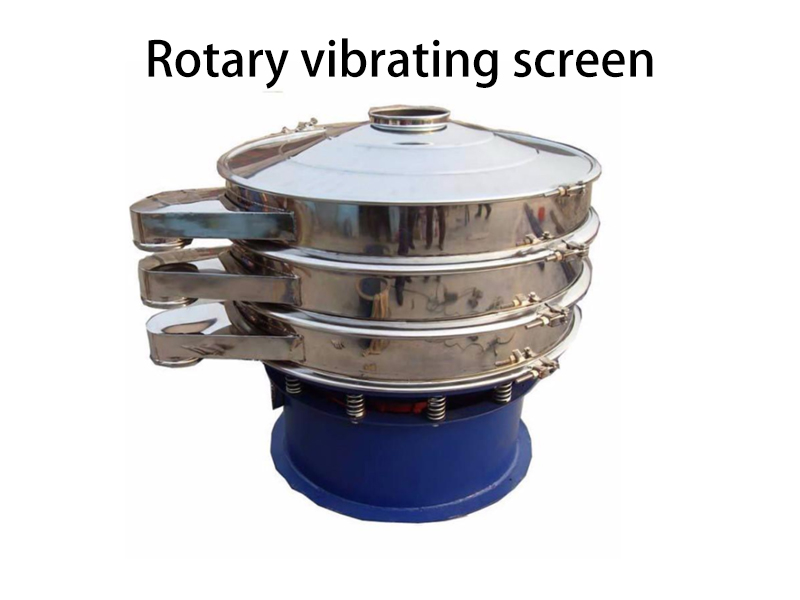
The Gaofu Rotary Vibrating Sieve is designed to process powders, granules, and certain liquid-solid mixtures, offering flexible configurations for different production requirements. This article explains the working principle of a rotary vibrating sieving machine, introduces its main components, and explores its typical applications across multiple industries.
What Is a Rotary Vibrating Sieving Machine?
A rotary vibrating sieving machine is a screening device that uses vibration to move material across one or more screen surfaces. During operation, particles are separated according to the selected mesh size, allowing qualified material to pass through the screen while oversized particles continue toward a separate discharge outlet.
Depending on the machine configuration, the equipment may be used for:
- Particle size classification
- Safety screening
- Removal of powder agglomerates
- Separation of oversized particles
- Liquid-solid filtration
- Multi-stage grading
The exact application depends on the selected screen mesh, machine configuration, and processed material.
Core Working Principle
The operating principle of a rotary vibrating sieve is based on controlled three-dimensional vibration generated by a vibration motor fitted with adjustable eccentric weights.
The screening process generally follows these steps:
Step 1: Material Feeding
Material enters the machine through the feed inlet, either by gravity, screw conveyor, vacuum feeder, or other feeding equipment.
Step 2: Vibration Generation
The vibration motor rotates at high speed, causing the upper and lower eccentric weights to generate combined horizontal and vertical motion.
This motion creates a three-dimensional vibration pattern that encourages material to spread evenly across the screen surface.
Step 3: Particle Separation
As the material travels over the screen:
- Particles smaller than the mesh opening pass through the screen.
- Larger particles remain on the screen surface.
- Oversized materials gradually move toward the discharge outlet.
The separation process continues until all material exits the machine.
Step 4: Material Discharge
Different particle fractions leave the equipment through separate outlets according to the selected screen configuration.
For multi-deck machines, several particle size grades may be collected simultaneously.
Understanding the Main Components
A rotary vibrating sieving machine consists of several interconnected components.
Feed Inlet
Receives material from upstream handling equipment and directs it onto the screening surface.
Screen Frame
Supports the screen mesh while maintaining proper tension during operation.
Screen Mesh
Determines the particle size separation according to the selected mesh specification.
Vibration Motor
Provides the driving force that generates three-dimensional vibration.
Eccentric Weights
Produce adjustable vibration patterns that influence material movement across the screen.
Springs
Support machine stability while isolating vibration from the base structure.
Discharge Outlets
Separate qualified material from oversized particles or multiple classified fractions.
Each component contributes to the overall screening process and should be maintained according to the equipment manufacturer's recommendations.
How Material Moves Across the Screen
Unlike simple linear motion, a rotary vibrating sieve creates a complex movement pattern.
The combination of horizontal, vertical, and rotational forces allows powder to:
- Spread across the screen surface
- Remain on the mesh for an appropriate screening period
- Move steadily toward the discharge outlet
- Achieve continuous material separation
The actual movement pattern depends on machine settings, material characteristics, and operating conditions.
Single-Deck and Multi-Deck Configurations
Different production objectives require different screening arrangements.
Single-Deck Configuration
Commonly used for:
- Safety screening
- Removing oversized particles
- Preparing materials before packaging
- General flour screening
Double-Deck Configuration
Suitable for:
- Two-stage particle separation
- Producing one qualified fraction while collecting coarse material separately
Multi-Deck Configuration
Designed for:
- Multiple particle classifications
- Specialty powder production
- Fine grading applications
- Processing products with several particle size specifications
The appropriate configuration should be selected according to production requirements.
Typical Applications in Food Manufacturing
A rotary vibrating sieve is widely used throughout food production.
Flour Milling
- Wheat flour
- Bread flour
- Cake flour
- Rice flour
- Corn flour
- Whole wheat flour
Applications include particle classification, safety screening, and ingredient preparation.
Starch Processing
Suitable for screening:
- Corn starch
- Potato starch
- Tapioca starch
- Modified starch
Baking Ingredients
Common materials include:
- Sugar powder
- Cocoa powder
- Baking premixes
- Spice blends
- Food additives
Dairy Products
Used for:
- Milk powder
- Whey powder
- Nutritional dairy ingredients
Plant-Based Nutrition
Suitable for:
- Soy protein
- Pea protein
- Plant protein concentrates
- Functional nutritional powders
Application suitability depends on material properties and process requirements.
Applications Beyond Food Processing
The versatility of a rotary vibrating sieve allows it to be used in several additional industries.
Pharmaceutical Industry
For screening pharmaceutical powders and excipients according to manufacturing requirements.
Chemical Industry
For processing fine chemical powders, pigments, resins, and other industrial materials.
New Materials
For advanced powder materials requiring controlled particle size distribution.
Metallurgy
For metal powders and related fine particulate materials.
Environmental and Recycling Industries
For separating recyclable powder and granular materials according to process requirements.
Equipment selection should always consider the characteristics of the processed material.
Integration into Automated Production Lines
A rotary vibrating sieve is commonly installed within automated powder handling systems.
Typical upstream equipment includes:
- Feeding Systems
- Vacuum Feeders
- Big Bag Feeding Stations
- Storage Hoppers
Typical downstream equipment includes:
- Mixers
- Blenders
- Storage Silos
- Packaging Machines
- Automatic Conveying Systems
System integration should be planned according to production capacity, material flow, and factory layout.
Features of the Gaofu Rotary Vibrating Sieve
The Gaofu Rotary Vibrating Sieve is designed for screening powders, granules, and selected liquid-solid mixtures across multiple industries.
Flexible Screening Configurations
Available with single-, double-, and multi-deck designs to accommodate different production requirements.
Wide Mesh Compatibility
Supports a broad range of mesh specifications for different particle size applications.
Stainless Steel Product-Contact Components
Product-contact parts can be manufactured using stainless steel materials suitable for food processing applications.
Multiple Inlet and Outlet Arrangements
Designed for compatibility with different production line layouts.
Automated Production Line Integration
Can be connected with:
- Feeding Systems
- Vacuum Feeders
- Big Bag Feeding Stations
- Screw Conveyors
- Mixers
- Storage Silos
- Packaging Equipment
Equipment specifications and optional configurations vary according to customer requirements.
Considerations When Selecting a Rotary Vibrating Sieving Machine
Before choosing equipment, manufacturers may evaluate:
- Material characteristics
- Required production capacity
- Target particle size
- Number of screening stages
- Factory layout
- Cleaning requirements
- Future production expansion plans
Selecting equipment according to actual production conditions helps establish a practical screening solution.
Fortune 500 Client Testimonials
CNPC、CSCEC、Sinochem Holdings、CRCC、China Minmetals Corporation、CNOOC、CR、Sinopharm、CHN Energy、COFCO Corporation、Huawei Technologies、PowerChina、CITIC Group、Wuchan Zhongda Group、NORINCO、Chalco、CNBM、 Shaanxi Coal and Chemical Industry Group、Ansteel Group、CETC、CSSC、CASC、CEC、Jinchuan Group、CASIC、Conch Cement、CNNC、SPH、Shanxi Coking Coal Group、 Zhongtai Chemical、GPHL、DEC、Sinosteel Corporation、MCC、China National Salt Industry Chemical、China Baowu Steel Group、China Animal Husbandry Industry Co., Ltd.、CECEP
About Gaofu
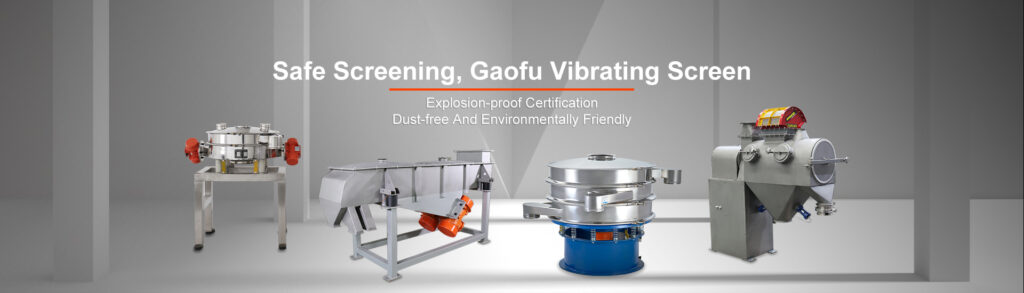
Xinxiang Gaofu Machinery Co., Ltd. was founded back in the 1980s. With over 40 years of development, it has been certified as a National-level Specialized, Refined, Unique & Innovative Little Giant Enterprise, National Green Factory, National High-tech Enterprise, and National Intellectual Property Advantage Enterprise, and serves as the President Unit of China Vibration Screening Industry Association.
The company is accredited with the Henan Provincial Industrial Design Center, Henan Provincial Engineering Technology Research Center for Intelligent On-line Screening System, and Xinxiang Municipal Engineering Technology Research Center for Fine Screening.
Gaofu has obtained more than 500 patents including invention patents, utility model patents and design patents, been awarded the Science and Technology Achievement Prize issued by the Ministry of Industry and Information Technology of China, and participated in drafting and formulating 4 national standards.
Gaofu’s product portfolio covers multiple series and hundreds of specifications, including vibrating screening equipment, conveying equipment, coal crushing equipment, filtration equipment and automatic material handling systems.
Core products include vibrating screens, screening machines, vibratory sifters, rotary vibrating screens, ultrasonic vibrating screens, linear vibrating screens, airflow screens, gyratory screens, roller screens, dewatering screens, bar screens, vacuum feeding machines, dust-free feeding stations, bulk bag feeding stations, feeding systems, automatic powder feeding systems, automatic slag-discharging filters, leaf filters, clay filters, toothed roll crushers, coal crushers and other machinery.
These products are widely applied in food, pharmaceutical, chemical, metallurgy, construction materials, mining, thermal power, environmental protection and many other industries, winning recognition and trust from over 10,000 clients worldwide.
Gaofu products enjoy strong sales across Greater China, and are exported to more than 100 countries and regions such as Russia, Canada, the United States, New Zealand, Japan, Brazil and South Africa.
Upholding the corporate mission of Improving material quality & efficiency to fully satisfy customer demands, Gaofu maintains long-term partnerships with clients to achieve win-win development.
At present, Gaofu is an official qualified supplier for numerous Fortune Global 500 enterprises, including CNPC, Sinopec, Sinochem Holdings, China Resources Group, Sinopharm Group, COFCO, China National Building Material, China Aerospace Science and Technology Corporation, Jinchuan Group and more.
Gaofu Machinery ranks No.1 in global sales volume of vibrating screens.
In May 2024, Frost & Sullivan, a world-renowned international consulting firm, issued a Market Position Verification Certificate confirming that Gaofu achieved the world’s largest shipment volume of vibrating screens in the global market in 2023.