

Choosing a Tumbler Screen for Salt: Key Factors for Different Particle Sizes and Processing Conditions
Post Date: 2026-09-18
Selecting screening equipment for salt processing requires more than identifying the material as “salt.” Different salt products can vary in particle size, moisture condition, crystal shape, bulk density, and production requirements. These differences can influence how the material moves through a screening machine and how the equipment should be configured.
A Tumbler screen can be considered for salt applications requiring particle-size separation, classification, or removal of oversized material. Its configuration should be developed around the actual processing conditions rather than based on a standard machine specification alone.
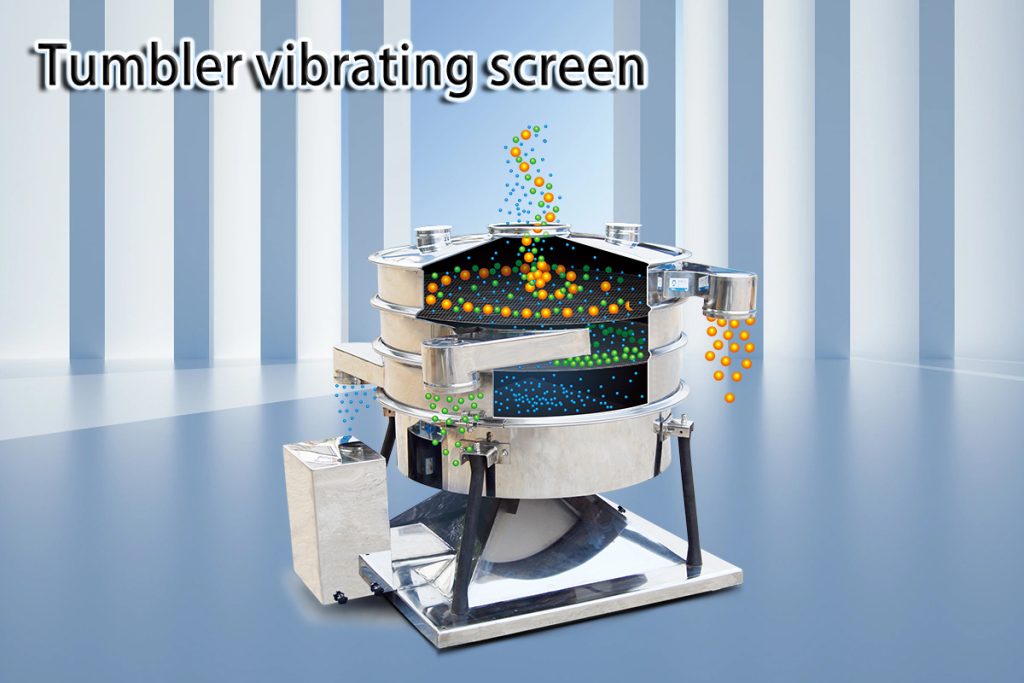
This article outlines practical factors that salt processors can evaluate when considering a Tumbler screen for different particle sizes and operating conditions.
1. Define the Salt Product Before Selecting Equipment
The first step is to identify what type of salt will be processed.
The material may include:
- Fine edible salt
- Coarse edible salt
- Refined salt
- Industrial salt
- Crystalline salt
- Salt containing larger agglomerates
- Salt blended with other granular ingredients
These materials may require different screening arrangements.
For example, a fine salt product intended for packaging may require a different process from coarse industrial salt used as a manufacturing raw material.
Therefore, equipment selection should begin with the actual material rather than the product name alone.
2. Determine the Required Particle-Size Range
Particle size is one of the basic parameters for a screening project.
Before choosing a Tumbler screen, the processor can define:
- Feed particle-size distribution
- Desired product-size range
- Minimum particle size
- Maximum acceptable particle size
- Number of required fractions
- Oversized material limit
For example, a process may simply require:
Salt → Target Fraction + Oversize
Another application may require several commercial grades.
The machine configuration should correspond to the actual separation objective.
3. Consider Fine, Medium, and Coarse Salt Separately
Different particle-size conditions can affect the screening process.
Fine Salt
Fine salt generally requires smaller screen openings and careful consideration of material distribution and screen condition.
Medium-Size Salt
Medium-sized crystalline salt may require a balance between screening area, opening size, and feed rate.
Coarse Salt
Coarse salt may involve larger crystals and oversized particles, making the mechanical condition of the material and screen strength relevant considerations.
The appropriate configuration should be established from actual samples and production parameters.
4. Look at the Complete Particle-Size Distribution
The average particle size does not tell the whole story.
Two salt samples can have a similar average size but very different distributions.
For example:
Sample A: Most particles fall within a relatively narrow size range.
Sample B: The material contains significant quantities of both fine and coarse particles.
These two materials may require different screening approaches even if their average particle size appears similar.
A particle-size distribution analysis can therefore provide useful information for equipment selection.
5. Evaluate Required Processing Capacity
Capacity is another important selection factor.
The required processing rate may be expressed as:
- kg/h
- t/h
- batches per hour
The actual capacity of a Tumbler screen depends on factors such as:
- Material characteristics
- Screen area
- Screen opening
- Number of decks
- Feed distribution
- Required separation
- Operating conditions
A machine should therefore be evaluated based on the complete screening requirement rather than a nominal capacity figure alone.
Where the application is capacity-sensitive, representative material testing can provide a more practical basis for equipment evaluation.
6. Consider Salt Moisture
Salt with different moisture levels can behave differently during screening.
Drier crystalline salt may flow more freely, while increased moisture can contribute to:
- Agglomeration
- Particle adhesion
- Material buildup
- Changes in flowability
If moisture varies significantly during production, the screening system should be evaluated under the expected operating range.
For applications involving wet or partially dried material, it is particularly important to confirm whether the proposed Tumbler screen is suitable for the material condition.
7. Check Whether the Salt Forms Agglomerates
Storage and transportation can sometimes cause salt particles to form larger clusters.
If the process objective is to separate these agglomerates from acceptable product, the Tumbler screen may be positioned as an agglomerate-removal stage.
A representative route is:
Stored Salt → Tumbler Screen → Qualified Salt + Oversized Agglomerates
The appropriate screen specification depends on the size of the agglomerates and the desired product fraction.
If the agglomerated material needs further processing, its discharge route should also be considered.
8. Consider the Desired Number of Product Grades
The number of finished product grades can influence the machine configuration.
For example:
One Separation Boundary
→ A simpler screening configuration may be sufficient.
Several Separation Boundaries
→ Multiple screening decks may be considered.
However, adding decks should correspond to actual product requirements.
The objective is to establish the necessary separation stages without introducing unnecessary complexity.
9. Evaluate the Feeding Method
The way salt enters the Tumbler screen can affect material distribution.
Possible feeding methods include:
- Hopper feeding
- Belt conveying
- Screw conveying
- Bucket elevator discharge
- Intermediate storage hopper
- Other customized feeding arrangements
The feeding system should deliver material at a rate compatible with the screening process.
A sudden material surge can create uneven loading, while an insufficient feed may not utilize the available screening area effectively.
10. Consider the Bulk Density of Salt
Bulk density can vary between salt products and can influence material handling.
The equipment evaluation should consider the relationship between:
Bulk Density + Feed Rate + Screen Area + Material Distribution
This is particularly relevant when comparing different salt grades or crystalline materials.
Providing representative bulk-density information can help suppliers better understand the expected loading conditions.
11. Examine Crystal Shape and Surface Characteristics
Salt crystals are not always uniform in shape.
They can have different geometric forms depending on the production process.
Irregular particles may interact with the screen opening differently from more uniform particles.
For this reason, particle shape can become relevant when the separation boundary is relatively narrow.
Sample testing can help verify how the actual crystals behave on the proposed screening surface.
12. Select the Screen According to the Process Requirement
Screen selection should consider more than the nominal mesh number.
Relevant parameters may include:
- Opening size
- Screen material
- Wire diameter
- Open-area ratio
- Screen construction
- Required separation
- Material compatibility
For food-grade salt, contact-material and hygiene requirements should also be considered according to the applicable standards and destination market.
For industrial salt, the operating environment and material compatibility may have different priorities.
13. Consider the Required Product Recovery Route
A screening machine can generate several material streams.
Before choosing the equipment, determine where each stream will go.
For example:
Tumbler Screen
→ Fine Salt → Fine Product Hopper
→ Medium Salt → Medium Product Hopper
→ Coarse Salt → Reprocessing
This is particularly important for multi-grade salt production.
The equipment configuration should be compatible with the available collection and conveying equipment.
14. Evaluate Cleaning and Changeover Requirements
A facility processing multiple salt grades may need regular product changeovers.
Selection considerations can include:
- Screen accessibility
- Cleaning access
- Contact-surface design
- Residual-material removal
- Screen replacement
- Inspection points
- Changeover frequency
For food-processing facilities, cleaning procedures should be consistent with the site's hygiene management system and applicable requirements.
A machine should be practical not only during normal production but also during cleaning and product changeover.
15. Consider the Operating Environment
The installation environment can affect equipment selection.
Factors may include:
- Indoor or outdoor installation
- Ambient humidity
- Temperature
- Corrosive conditions
- Available floor space
- Equipment elevation
- Cleaning method
- Operator access
Salt-processing environments can require attention to corrosion-related conditions, particularly where moisture is present.
The equipment materials and surface treatment should be discussed according to the actual operating environment.
16. Consider Food-Grade Requirements for Edible Salt
When processing edible salt, equipment contact surfaces may need to meet specific food-processing requirements.
The project team can evaluate:
- Contact materials
- Surface finish
- Cleaning procedures
- Sealing arrangements
- Residual-material control
- Product changeover procedures
The exact requirements depend on the applicable regulations and the customer's quality system.
Equipment claims should therefore be based on documented specifications rather than general statements about being “food grade.”
17. Evaluate Industrial and Chemical Salt Separately
Industrial salt may be used in different manufacturing environments.
The equipment selection may therefore need to consider:
- Chemical compatibility
- Material temperature
- Moisture
- Particle size
- Dust characteristics
- Environmental conditions
Where the material presents combustible-dust or other safety risks, the complete installation should be assessed according to applicable regulations, material properties, and site-specific safety requirements.
A screening machine should be evaluated as part of the complete system rather than as an isolated component.
18. Determine Whether Enclosed Screening Is Needed
Some salt-processing environments may benefit from an enclosed material-transfer and screening arrangement.
This can be considered when the process needs to manage:
- Fine airborne particles
- Material containment
- Product protection
- Operator exposure
- Cleaning requirements
The appropriate enclosure and dust-handling method depends on the complete process and site conditions.
For combustible materials, safety engineering should be performed according to the relevant requirements rather than relying on a general equipment description.
19. Consider Installation Space Before Finalizing the Machine
A Tumbler screen can be configured with different deck arrangements and dimensions.
Before equipment selection, measure:
- Available floor area
- Ceiling height
- Feed elevation
- Discharge elevation
- Maintenance access
- Material-transfer routes
- Nearby equipment
This is especially important for multi-deck configurations.
The equipment should fit not only into the available physical space but also into the intended material flow.
20. Test the Tumbler Screen With Representative Salt
When the application has specific separation requirements, sample testing can provide valuable information.
A practical evaluation may involve:
- Providing a representative salt sample.
- Recording particle-size distribution.
- Confirming moisture condition.
- Defining the required product fractions.
- Testing suitable screen specifications.
- Evaluating material movement.
- Checking the separated fractions.
- Reviewing the results against the customer's requirements.
Testing does not eliminate the need for production-site validation, but it can provide useful technical information during equipment selection.
21. A Practical Selection Checklist
Before requesting a Tumbler screen proposal, salt processors can prepare the following information:
| Parameter | Information to Prepare |
|---|---|
| Material | Salt type and application |
| Particle Size | Feed and target ranges |
| Moisture | Typical operating condition |
| Capacity | Required processing rate |
| Fractions | Number of desired product sizes |
| Feed | Hopper, conveyor, or other method |
| Discharge | Collection or downstream equipment |
| Material | Contact-material requirements |
| Cleaning | Cleaning and changeover procedure |
| Installation | Available space and equipment height |
| Environment | Temperature, humidity, and other conditions |
Providing this information can help make the equipment discussion more specific and reduce uncertainty during the preliminary design stage.
22. Gaofu Machinery Tumbler Screen for Salt Processing
Gaofu Machinery provides Tumbler screen equipment for powder and granular material screening and classification applications.
For salt-processing projects, the equipment configuration can be evaluated according to:
- Salt particle-size distribution
- Required screening objective
- Processing capacity
- Number of product fractions
- Screen specifications
- Material moisture
- Feeding conditions
- Discharge requirements
- Contact-material requirements
- Cleaning and changeover procedures
- Installation environment
Gaofu Machinery can also review representative material information and process parameters when determining a suitable Tumbler screen arrangement.
For food applications, hygiene and applicable food-contact requirements can be included in the technical discussion. For industrial applications, material compatibility and site-specific operating conditions can likewise be evaluated.
Conclusion
Choosing a Tumbler screen for salt processing requires consideration of the entire application rather than a single specification.
Particle size, particle-size distribution, moisture, crystal shape, bulk density, capacity, feeding conditions, product grades, cleaning requirements, and installation conditions can all influence the appropriate configuration.
For fine salt, coarse salt, industrial salt, or multi-grade crystalline products, the screening requirements may differ substantially. Representative material testing and clear process information can help establish a more suitable equipment configuration.
Gaofu Machinery can evaluate these application parameters and provide Tumbler screen solutions based on the customer's specific salt-processing conditions and production requirements.