

Salt Screening Challenges and Tumbler Screen Solutions for Handling Fine, Granular, and Coarse Salt
Post Date: 2026-09-18
Salt processing may involve fine salt, granular salt, coarse salt, or mixtures with different particle-size distributions. Although the material itself may appear relatively simple to screen, differences in crystal size, shape, moisture, flowability, and particle distribution can create different screening challenges.
A Tumbler screen can be configured to address these process conditions through controlled material movement, multiple screening decks, enclosed operation, and flexible discharge arrangements. Instead of applying the same screening approach to every salt product, processors can evaluate the actual material characteristics and production objectives before determining an appropriate configuration.
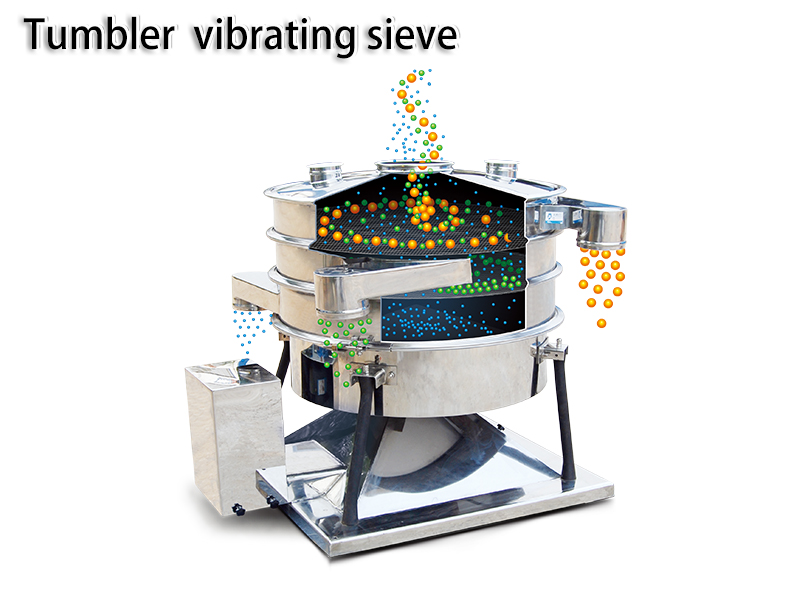
For salt processors, understanding the relationship between screening challenges and equipment configuration is an important step toward developing a stable and practical screening process.
1. Challenge: Fine Salt Can Contain Agglomerated Particles
Fine salt has relatively small particles and may be more sensitive to moisture and surface adhesion. During storage or transportation, individual particles can form small agglomerates.
If these agglomerates enter the screening process without sufficient separation, they may behave differently from individual fine particles. Some may remain on the screen surface and leave with the oversize fraction, while others may break apart during handling.
Tumbler Screen Approach
A tumbler screen uses a controlled, three-dimensional screening movement that allows material to travel across the screening surface while particles interact with the openings.
For fine salt applications, the system can be configured around:
- Appropriate screen openings for the target fraction
- Suitable screening area
- Controlled feeding distribution
- Multiple screening stages where required
- Enclosed material transfer
- Suitable collection arrangements
The final configuration should be determined according to the actual salt condition and required separation.
2. Challenge: Granular Salt May Have a Broad Particle Distribution
Granular salt can contain particles covering a relatively wide size range. A single screening stage may therefore produce only one separation point, while some production processes require several fractions.
For example, a processor may need to separate incoming granular salt into coarse, medium, and fine fractions before subsequent processing or packaging.
Tumbler Screen Approach
A multi-deck Tumbler screen can provide several screening stages within one machine.
A simplified process can be represented as:
Salt Feeding → Primary Screening → Intermediate Classification → Fine Screening → Separate Discharge Streams
Each deck can use a different screen opening so that material is progressively separated into the required fractions.
This configuration can help processors organize different salt grades through one screening unit rather than handling every size range as a separate operation.
3. Challenge: Coarse Salt Requires Suitable Material Movement
Coarse salt crystals are larger and can behave differently from fine particles. Their size, shape, and weight influence how they move across a screening surface.
If feeding is uneven, a large amount of coarse material may accumulate in one area of the screen, reducing the effective use of the screening surface.
Tumbler Screen Approach
The feeding section should distribute salt across the available screening area as evenly as practical.
Depending on the application, the system can be designed with:
- Appropriate feed inlet dimensions
- Controlled material distribution
- Suitable screen area
- Multiple screening decks
- Dedicated coarse-material discharge
- Enclosed transfer sections
The objective is to create a material path that gives the salt sufficient opportunity to pass through the intended openings while directing larger particles toward the appropriate outlet.
4. Challenge: Mixed-Size Salt Can Create Classification Difficulties
Some salt streams do not contain one clearly defined particle size. Instead, they may contain a mixture of fine, medium, and coarse crystals.
This creates a different requirement from simple oversize removal. The process must divide the incoming material into several defined fractions.
Tumbler Screen Approach
A Tumbler screen can be equipped with multiple screen decks for staged classification.
For example:
Feed Material
↓
Coarse Fraction Separation
↓
Medium Fraction Separation
↓
Fine Fraction Collection
The number of decks and screen openings should correspond to the required product fractions.
This approach can be useful when several particle-size grades need to be collected independently for downstream processing, storage, or packaging.
5. Challenge: Uneven Feeding Can Affect Screening Stability
Even when the screen itself is properly configured, unstable feeding can influence screening performance.
Sudden increases in feed rate may create excessive material loading on the screen surface. Conversely, insufficient feeding can reduce the effective use of the screening area.
For salt-processing lines, the screening machine therefore needs to work as part of the overall material-flow system.
Tumbler Screen Approach
The Tumbler screen can be connected with an appropriate feeding arrangement so that material enters the screening surface at a controlled and reasonably distributed rate.
The overall system may include:
Storage Hopper → Feeding Device → Tumbler Screen → Fraction Collection
The appropriate arrangement depends on the production capacity, material characteristics, equipment layout, and downstream process.
6. Challenge: Salt Moisture Can Change Material Behavior
Salt can encounter different moisture conditions during production, transportation, and storage. Moisture may influence particle adhesion and flow behavior.
Fine salt with increased moisture sensitivity may be more prone to agglomeration, while larger crystals can also experience changes in flow characteristics depending on processing conditions.
Tumbler Screen Approach
Instead of treating moisture as an isolated equipment issue, processors can evaluate it as part of the complete screening process.
Important considerations include:
- Moisture condition of incoming salt
- Storage environment
- Feeding stability
- Screen loading
- Agglomeration tendency
- Required particle separation
- Cleaning requirements
- Operating environment
Where moisture significantly changes the material behavior, sample testing can help determine whether the proposed Tumbler screen configuration is appropriate.
7. Challenge: Different Salt Grades May Require Different Process Routes
A salt-processing facility may handle more than one product specification. Fine salt, coarse salt, granular salt, and blended crystalline products can have different screening requirements.
Using one fixed operating approach for every material may not provide sufficient flexibility.
Tumbler Screen Approach
A configurable Tumbler screen can be designed around the material grades being processed.
Depending on the project, this may involve changes to:
- Screen specifications
- Number of screening decks
- Feed arrangements
- Discharge outlets
- Screening sequence
- Collection containers
- Cleaning and changeover procedures
The objective is to create a screening system that matches actual production requirements rather than relying on a one-size-fits-all configuration.
8. Challenge: Product Fractions Need Clear Separation After Screening
Screening does not end when particles pass through the mesh. The separated fractions must also move to the correct downstream destination.
If different salt grades are not clearly routed, material mixing can occur after classification.
Tumbler Screen Approach
Multiple discharge outlets can be arranged according to the required fractions.
A typical route may look like:
Coarse Salt → Coarse Outlet → Dedicated Collection
Medium Salt → Intermediate Outlet → Dedicated Collection
Fine Salt → Fine Outlet → Dedicated Collection
This arrangement helps connect screening with subsequent storage, weighing, blending, or packaging operations.
The discharge design should be coordinated with downstream equipment to suit the required material flow.
9. Challenge: Salt Dust Can Affect the Working Environment
Fine salt can generate airborne particles during feeding, screening, and discharge, particularly when material falls between equipment sections or when open transfer points are used.
Dust management therefore needs to be considered as part of the screening-system design.
Tumbler Screen Approach
An enclosed Tumbler screen configuration can help contain material during screening and transfer.
Depending on site requirements, the overall system may incorporate:
- Enclosed screening chambers
- Sealed connections
- Closed discharge routes
- Appropriate dust-collection interfaces
- Suitable material-transfer equipment
Dust-control requirements should be evaluated according to the actual material, process conditions, workplace requirements, and applicable regulations.
10. Challenge: Screening Requirements Can Change Between Production Batches
A facility may process different salt grades on the same production line. When the material specification changes, the screening system may also need to accommodate a different classification requirement.
The challenge is not simply changing a screen. Operators also need to consider material residue, product carryover, collection routes, and production procedures.
Tumbler Screen Approach
A practical batch-change procedure can include:
- Stop the incoming material supply.
- Allow material inside the screening system to discharge.
- Check the screening decks and material-contact areas.
- Complete the required cleaning procedure.
- Confirm the next screen configuration.
- Check discharge routing.
- Restart the feeding system under controlled conditions.
Specific procedures should be established according to the material, equipment configuration, hygiene requirements, and production management system.
11. Fine, Granular, and Coarse Salt Require Different Process Attention
The differences between salt grades can be summarized from a process perspective:
| Salt Type | Typical Screening Challenge | Process Consideration |
|---|---|---|
| Fine salt | Agglomeration, small particles, dust | Screen condition, feed distribution, moisture management |
| Granular salt | Broad particle distribution | Classification stages and fraction routing |
| Coarse salt | Larger crystals and heavier particle movement | Feed distribution, screen area, discharge arrangement |
| Mixed-size salt | Several particle fractions | Multi-stage classification |
| Moist or agglomerated salt | Reduced flowability | Material conditioning and process evaluation |
This comparison does not mean that every salt product requires a different machine. Rather, it shows why screening configuration should be connected to the actual material and process objective.
12. Connecting the Tumbler Screen with the Complete Salt-Processing Line
A screening machine generally performs one stage of the production process. Its performance also depends on the equipment connected before and after it.
A practical salt-processing arrangement may include:
Raw Salt Storage
↓
Feeding System
↓
Size Adjustment or Processing
↓
Tumbler Screen
↓
Fraction Collection
↓
Storage / Blending / Packaging
The exact process varies according to the salt product, production capacity, particle-size requirements, and downstream operations.
For example, a line producing one finished salt grade may focus primarily on removing unwanted oversize material. A line producing several grades may require multiple screening decks and independent collection routes.
13. Why Process Testing Matters Before Final Configuration
Salt screening problems are often related to the interaction between material characteristics and operating conditions. Equipment dimensions alone cannot fully describe how a specific salt product will behave.
Sample testing can therefore provide useful information about:
- Actual particle-size distribution
- Screening behavior
- Material flow
- Agglomeration tendency
- Required separation points
- Suitable screen configuration
- Fraction recovery routes
For projects involving multiple salt grades or unusual material conditions, testing the actual material can provide a more practical basis for equipment configuration.
14. Gaofu Machinery Tumbler Screen for Salt Screening Applications
Gaofu Machinery provides screening equipment and process solutions for powder and granular materials across food, chemical, mineral, and other industrial applications.
For salt screening projects, the Tumbler screen can be considered according to the customer's material characteristics and production requirements. Configuration discussions may cover screening stages, screen specifications, feeding, discharge, material-contact requirements, equipment layout, and downstream connections.
The focus is not simply on selecting a machine model. A practical screening solution should consider how salt enters the machine, how particles are classified, and how each fraction is transferred to the next process.
Gaofu Machinery can work with customers to evaluate the application requirements and develop a screening configuration suitable for the proposed process conditions.
Conclusion
Fine, granular, and coarse salt can present different screening challenges because particle size, moisture, crystal characteristics, feed conditions, and required product fractions may vary.
A Tumbler screen provides a flexible platform for screening and multi-size classification, with configuration options that can be matched to different material conditions. Multi-deck screening, controlled feeding, separate discharge routes, enclosed operation, and process testing can all be considered when developing a salt-screening system.
For salt processors, the key is to connect the screening equipment with the actual material characteristics and production workflow. By evaluating the complete process—from feeding and classification to fraction collection and downstream handling—processors can develop a screening arrangement that is practical for their specific application.
Contact Gaofu Machinery to discuss your salt screening requirements and evaluate a suitable Tumbler screen configuration based on your material and process conditions.