

Clean Considerations for the Protein Powder Feeding Station: Sanitary Design Requirements for Rapid Batch Changeover and Compliance
Post Date: 2026-11-02
In modern nutritional powder processing, maintaining absolute hygienic integrity across short production runs is essential. Facilities handling diverse protein bases—ranging from dairy whey isolates to plant-based pea, soy, and pumpkin seed proteins—face strict regulatory mandates regarding cross-contact prevention and batch validation. A major operational challenge during multi-product runs is avoiding extended downtime during sanitation.
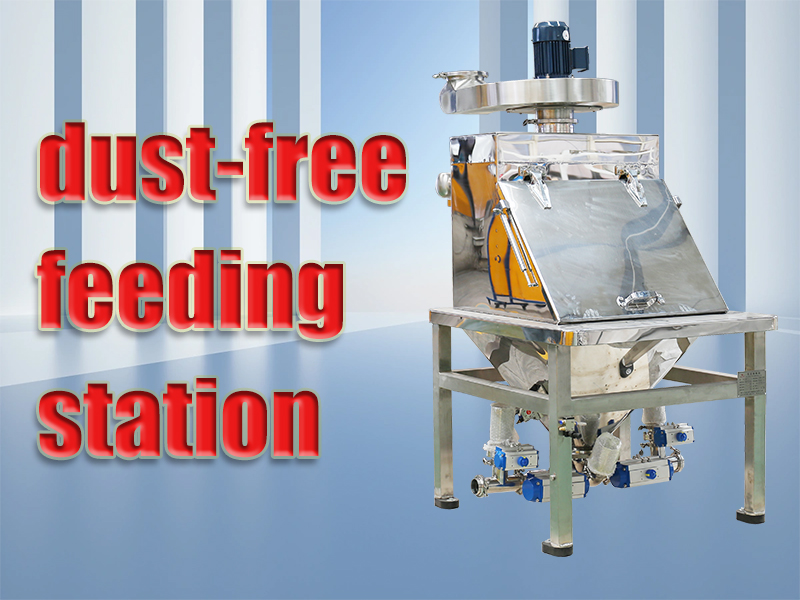
The Gaofu feeding station provides an engineered solution for raw material intake, combining sanitary construction features that streamline manual cleaning routines, shorten line clearance cycles, and uphold compliance with global food safety standards.
1. Structural Engineering for Fast and Thorough Cleaning
Traditional bulk powder receiving hoppers often contain internal hardware, sharp angles, or non-food-grade seals that trap dry organic matter, requiring tedious manual scraping and scrubbing. The sanitary design of the Gaofu feeding station eliminates these contamination traps at the structural level.
- Radius-Contoured Internal Transitions: Interior hopper walls feature smooth, continuous radii ($\ge 6.35\text{ mm}$), preventing powder build-up in $90^\circ$ corners and allowing dry wipes or washdown fluids to sweep clean effortlessly.
- Crevice-Free Polish Standards: All product-contact surfaces undergo continuous TIG welding and are ground flush to a smooth finish ($R_a \le 0.4\ \mu\text{m}$ option available). This smooth surface texture minimizes particle adhesion and allows rapid visual verification during sanitation checks.
- Tool-Free Modular Disassembly: Internal sifting screens, support grates, and deflector plates utilize quick-release v-band clamps and swing-away latches. Operators can disassemble the internal contact components in minutes without specialized hand tools, drastically reducing line clearance times.
2. Preventing Allergen Cross-Contact During Batch Shifts
Switching a processing line from an allergenic raw ingredient to a non-allergenic formulation requires verifiably clean contact surfaces.
[ Line Clearance ] ➔ [ Rapid Tool-Free Teardown ] ➔ [ Targeted Washdown & Swab Test ] ➔ [ Fast Reassembly ]
- Complete Evacuation Geometry: The steeply pitched lower discharge cone ($50^\circ\text{ to }60^\circ$ angle) ensures complete gravitational discharge of dry powders, eliminating residual heel material before washdown begins.
- Accessible Inspection & Swab Points: Strategically positioned hygienic inspection doors provide clear sightlines and easy physical access for quality assurance teams to conduct swab testing for allergen proteins or microbial indicators prior to sign-off.
- Food-Grade Seal Compounds: All gasket materials—including door seals, filter head interfaces, and discharge sleeves—are molded from non-porous, FDA-compliant elastomers (EPDM, Silicone, or PTFE) that resist degradation from sanitizing chemical agents.
3. Comparative Cleanability & Changeover Metrics
| Feature | Legacy Intake Hoppers | Sanitary Gaofu Feeding Station |
| Disassembly Method | Standard bolted flanges requiring hand tools | Quick-release v-band clamps & swing latches |
| Internal Surface Finish | Standard industrial finish ($R_a > 1.6\ \mu\text{m}$) | Sanitary ground & polished finish ($R_a \le 0.4\ \mu\text{m}$) |
| Changeover Time | High (2 to 3 hours manual scrubbing) | Low (30 to 45 minutes thorough wash/dry cycle) |
| Validation Risk | High (crevices retain trace allergens) | Low (crevice-free, fully accessible surfaces) |
Conclusion
Streamlining raw ingredient intake while meeting strict food safety regulations requires equipment built specifically for rapid sanitation and allergen control. Incorporating a sanitary Gaofu feeding station at your primary dumping node minimizes changeover friction, protects brand integrity, and keeps high-value protein production lines running efficiently.