

Improving Throughput and Ergonomics in Protein Powder Production: High-Capacity Feeding Station Solutions for Food and Dairy-Grade Operations
Post Date: 2026-11-02
In high-volume nutritional powder manufacturing, balancing rapid raw material intake with operator ergonomics is critical for maintaining plant productivity. As demand grows for dairy-based whey proteins, specialized caseinates, and plant-derived isolates, processing facilities must handle larger quantities of bulk bagged ingredients without creating bottlenecks at the primary feeding node.
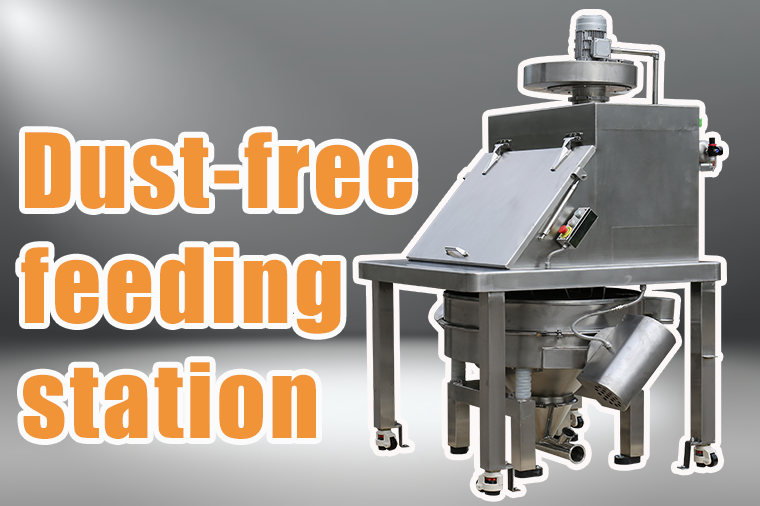
The Gaofu feeding station is engineered to optimize material throughput and physical workflow, offering high-capacity bag unloading solutions that protect worker health while maintaining continuous supply to downstream processing lines.
1. Ergonomic Engineering for High-Volume Unloading
Repetitive manual lifting, bag slitting, and sustained bending during high-capacity dumping shifts can lead to operator fatigue and lower line efficiency. Gaofu feeding stations integrate structural design features to streamline manual handling:
- Optimized Workstation Elevation: The loading shelf height is ergonomically positioned to allow operators to slide, support, and tilt 25 kg sacks using natural body leverage, reducing lumbar stress during extended shifts.
- Pneumatic Hood Assistance: The dual-shock, gas-spring access door lifts smoothly with minimal force, staying securely in place during bag unloading cycles to ensure unobstructed access.
- Integrated Bag Slitting Knife Options: High-throughput units feature internal serrated stainless steel bag-cutting blades. Operators simply slide the sack across the blade, allowing instant, clean discharge without requiring handheld utility knives.
2. High-Capacity Material Discharging Mechanics
High-volume production lines require continuous powder movement without line backing up or bridging inside the intake hopper.
- Expanded Hopper Volumetrics: Gaofu high-capacity feeding stations feature expanded internal surge volumes (up to 300L+ capacity), allowing operators to stage multiple bag discharges sequentially without waiting for complete hopper evacuation.
- Fluidized Cone Transition: To prevent cohesive protein powders from compacting during rapid dumping, aeration pads and targeted vibration mounts apply localized excitation to the hopper walls, maintaining continuous material movement into lower rotary valves or screw feeders.
- High-Flow Dust Extraction Fans: Increased hopper volume is supported by higher CFM exhaust blowers, maintaining negative pressure and face velocity even during aggressive, continuous bag unloading.
3. Workflow Comparison: Standard Intake vs. High-Capacity Gaofu Station
Standard Intake Chute:
[ Manual Lift ] ➔ [ Slow Hopper Discharge ] ➔ [ Line Stoppage / Bridging ] ➔ [ High Fatigue ]

High-Capacity Gaofu Feeding Station:
[ Slide & Cut Shelf ] ➔ [ Fluidized Surge Volume ] ➔ [ Continuous Downstream Feed ] ➔ [ Ergonomic Efficiency ]
4. Key Performance Specifications for High-Throughput Lines
| Parameter | Standard Industrial Model | High-Capacity Dairy-Grade Model |
|---|---|---|
| Discharge Throughput | Up to $3.0\text{ tons/hr}$ (powder dependent) | Up to $8.0\text{ tons/hr}$ with active fluidization |
| Surge Hopper Capacity | 100 L – 150 L | 250 L – 400 L custom volume configurations |
| Blower Airflow Velocity | $500 - 800\text{ m}^3/\text{h}$ | $1200 - 1800\text{ m}^3/\text{h}$ continuous extraction |
| Construction Material | SUS304 Stainless Steel | AISI 316L Stainless Steel with mirror polish |
Conclusion
Maximizing output in modern protein powder plants requires equipment that optimizes operator motion while accelerating material intake. By implementing high-capacity Gaofu feeding stations at raw material intake points, food and dairy processors can reduce line bottlenecks, protect workforce safety, and support high-volume manufacturing requirements.