

Designing a Flexible Feeding System for Sieving Machine Applications Across Food, Chemical, and Powder Industries
Post Date: 2026-08-18
Introduction
Different industries place different demands on powder handling and screening. A food manufacturer may prioritize cleanable equipment and product changeover, while a chemical plant may focus more heavily on material compatibility, abrasion, or specialized safety requirements. Mineral and industrial powder processors may have their own requirements related to bulk density, particle size, and material flow.
Because of these differences, a Feeding system for a sieving machine should not necessarily follow one fixed configuration. Flexible system design allows the feeding arrangement to be evaluated according to material characteristics, production requirements, equipment connections, and the surrounding process.
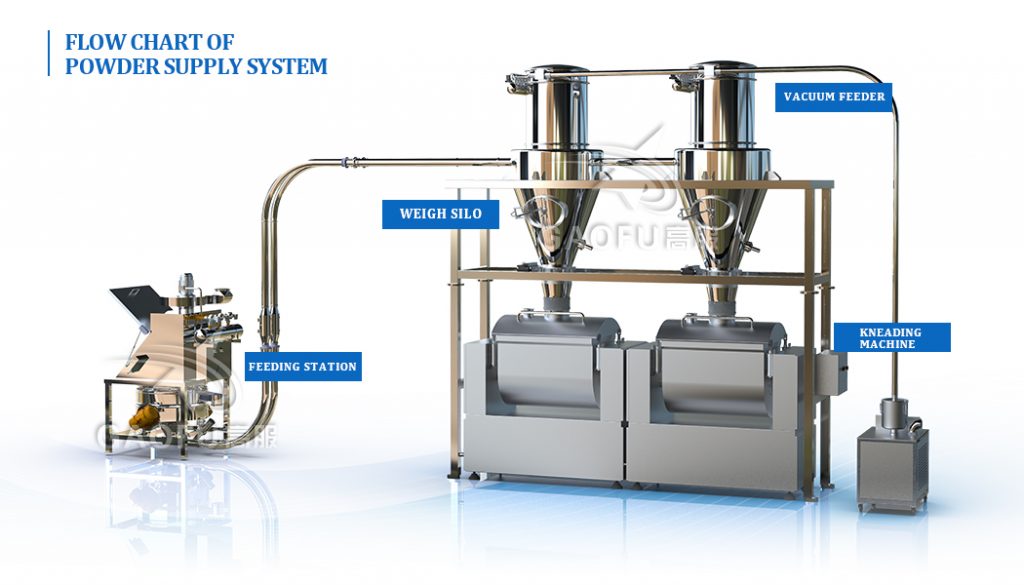
This article explores practical considerations for designing adaptable Feeding systems for food, chemical, and other powder-processing applications.
1. Why Flexible Feeding System Design Matters
A powder-processing line can generally be represented as:
Material Receiving → Storage → Feeding System → Sieving Machine → Collection → Further Processing
The Feeding system connects the material source with the screening stage.
Its configuration can influence:
- Material transfer route
- Feeding method
- Equipment connection
- Production-line layout
- Automation options
- Cleaning and maintenance access
A flexible design approach allows these factors to be considered together rather than selecting feeding equipment independently from the rest of the production line.
2. Start with Material Characteristics
The material is one of the most important variables when designing a Feeding system.
Before selecting equipment, evaluate:
- Particle size
- Bulk density
- Flowability
- Moisture content
- Cohesion
- Abrasiveness
- Temperature
- Chemical compatibility
For example, free-flowing granules may move differently from fine cohesive powders. Abrasive mineral powders may also require different material-contact considerations from food ingredients.
Therefore, the same Feeding system configuration may not be suitable for every application.
3. Designing for Food Powder Applications
Food-processing lines may handle:
- Flour
- Starch
- Powdered sugar
- Cocoa powder
- Milk powder
- Protein powder
- Food ingredients
A representative workflow is:
Ingredient Storage → Feeding System → Sieving Machine → Collection → Packaging
The Feeding system can be designed around practical requirements such as:
Cleanability
Material-contact areas should allow appropriate cleaning and inspection procedures.
Product Changeover
Facilities handling several products may need convenient procedures for removing residual material.
Enclosed Transfer
An enclosed configuration may be considered when the process requires more controlled powder transfer.
Material Compatibility
Contact components should be selected according to the application and applicable requirements.
4. Flexible Feeding for Flour and Starch
Flour and starch are common examples of fine food powders.
Their handling characteristics can be influenced by:
- Particle size
- Moisture
- Bulk density
- Storage conditions
- Flowability
A possible configuration is:
Hopper → Feeding System → Rotary Vibrating Sieve → Collection
The feeding arrangement should provide material to the screening stage according to the actual process requirements.
For fine powders, operators should also consider powder accumulation, cleaning access, and the connection between the feeder and screen inlet.
5. Designing for Chemical Powder Applications
Chemical-processing facilities may handle materials with different physical and chemical characteristics.
Potential materials include:
- Chemical additives
- Mineral powders
- Ceramic powders
- Industrial fillers
- Other process powders
Important considerations may include:
- Material compatibility
- Corrosion resistance
- Abrasion
- Moisture
- Temperature
- Special safety requirements
The Feeding system should be configured according to the material and the applicable operating standards.
For materials with specific hazards, the complete production line should be assessed according to relevant regulations rather than relying on a single equipment feature.
6. Designing for Mineral and Industrial Powders
Industrial powder applications may involve materials with relatively high density or abrasive characteristics.
Examples include:
- Quartz-related materials
- Ceramic powders
- Mineral fillers
- Industrial powders
Potential Feeding system considerations include:
- Wear-resistant component selection
- Appropriate outlet design
- Material transfer distance
- Maintenance access
- Structural requirements
Regular inspection of material-contact areas may also be appropriate depending on operating conditions.
7. Match the Feeding System with the Sieving Machine
Flexibility also means adapting the Feeding system to different screening technologies.
Rotary Vibrating Sieve
Possible arrangement:
Feeding System → Rotary Vibrating Sieve → Collection
Consider:
- Feed inlet dimensions
- Material supply
- Screening layers
- Powder characteristics
Centrifugal Sifter
Possible arrangement:
Feeding System → Centrifugal Sifter → Collection
Consider:
- Continuous feeding
- Transfer conditions
- Powder flowability
Ultrasonic Vibrating Screen
Possible arrangement:
Feeding System → Ultrasonic Vibrating Screen → Collection
Consider:
- Fine powder characteristics
- Screen mesh requirements
- Feeding consistency
Linear Vibrating Screen
Possible arrangement:
Feeding System → Linear Vibrating Screen → Discharge
Consider:
- Material distribution
- Feeding direction
- Screen configuration
The appropriate combination depends on the actual screening objective.
8. Flexible Feeding from Different Material Sources
A versatile production line may receive material from different sources.
Storage Hopper
Storage Hopper → Feeding System → Sieving Machine
Big Bag Feeding Station
Big Bag Feeding Station → Feeding System → Sieving Machine
Vacuum Feeder
Vacuum Feeder → Sieving Machine
Upstream Processing Equipment
Mixer / Grinder → Feeding System → Sieving Machine
The Feeding system should be designed around the characteristics of the incoming material and the connection requirements of the upstream equipment.
9. Consider Batch and Continuous Production
Different production modes may require different feeding arrangements.
Batch Processing
Material Loading → Feeding → Screening → Collection
The Feeding system supplies material according to a production cycle.
Continuous Processing
Continuous Supply → Feeding → Screening → Collection
The Feeding system is integrated into an ongoing material-flow process.
When selecting equipment, manufacturers should determine whether the process is batch-based, continuous, or a combination of both.
10. Flexible Capacity Planning
Capacity matching is another important part of Feeding system design.
Consider the complete chain:
Material Supply Capacity
↓
Feeding Capacity
↓
Sieving Capacity
↓
Collection Capacity
The Feeding system should be selected according to the actual production target and the capacity of connected equipment.
Factors such as bulk density and particle characteristics can also affect material volume and transfer requirements.
Capacity should therefore be confirmed through application-specific engineering rather than relying only on a nominal equipment value.
11. Designing for Different Plant Layouts
A flexible Feeding system should accommodate the physical conditions of the production facility.
Consider:
- Floor space
- Equipment height
- Transfer distance
- Horizontal and vertical connections
- Operator access
- Maintenance clearance
Compact Layout
The Feeding system may connect directly to the sieving machine.
Multi-Level Layout
The material transfer path may require vertical integration.
Distributed Layout
Additional conveying equipment may be required between material storage and screening.
The final arrangement should be developed according to the actual plant layout.
12. Enclosed Feeding System Design
Some applications may benefit from an enclosed transfer route.
A representative process is:
Material Source → Enclosed Feeding System → Sieving Machine → Enclosed Collection
Potential considerations include:
- Connection sealing
- Transfer path
- Cleaning access
- Dust-collection interface
- Material properties
For food, chemical, or special powder applications, enclosure requirements should be determined according to the production environment and applicable regulations.
13. Automation for Flexible Production Lines
A Feeding system can also be integrated with automated production controls.
Potential functions include:
- Material-level monitoring
- Automatic feeding
- Feeding sequence control
- Equipment status feedback
- Alarm functions
- Start/stop coordination
A representative sequence:
Sieving Machine Ready
↓
Feeding System Activated
↓
Material Transfer
↓
Screening
↓
Collection
The automation level can be selected according to production requirements.
14. Designing for Multiple Products
Some factories process several powders on the same production line.
In this case, consider:
- Cleaning procedures
- Material residue
- Screen changeover
- Feeding-system cleaning
- Production scheduling
For food applications, these factors can be especially important when different ingredients are processed using shared equipment.
The design should support the facility's actual cleaning and changeover procedures.
15. Flexible Feeding for Different Powder Flow Behaviors
Powders can behave very differently during transfer.
Free-Flowing Powder
May require a relatively straightforward hopper and outlet configuration.
Fine Cohesive Powder
May require additional attention to hopper geometry and material buildup.
Moist Powder
May require consideration of storage and transfer conditions.
Abrasive Powder
May require additional attention to component wear.
The Feeding system should therefore be matched to the actual material rather than classified only by industry.
16. Maintenance and Accessibility
Flexibility should also be considered from a maintenance perspective.
Important areas include:
Hopper
Should allow inspection and cleaning.
Feeding Components
Should be accessible for routine inspection.
Connections
Should allow operators to check seals and interfaces.
Sieving Machine Inlet
Should provide access for cleaning and inspection where required.
A well-planned layout can make routine service more manageable.
17. Example: Food Powder Screening Line
Consider a flour-processing application:
Flour Storage → Feeding System → Rotary Vibrating Sieve → Collection → Packaging
The Feeding system may be evaluated according to:
- Flour flowability
- Required production capacity
- Inlet configuration
- Cleaning requirements
- Packaging schedule
If the material source changes, the feeding arrangement can be reviewed without necessarily redesigning the entire screening process.
18. Example: Chemical Powder Screening Line
A chemical powder line could be arranged as:
Material Storage → Feeding System → Centrifugal Sifter → Collection
The design may focus on:
- Material compatibility
- Continuous feeding
- Transfer conditions
- Equipment sealing
- Maintenance requirements
Special material-handling requirements should be assessed during system engineering.
19. Example: Industrial Mineral Powder Line
A mineral powder process may use:
Bulk Material Storage → Feeding System → Linear / Rotary Sieving Machine → Collection
Key considerations may include:
- Bulk density
- Abrasion
- Feeding capacity
- Screen selection
- Wear inspection
The system configuration should be determined according to the actual material and operating conditions.
20. A Practical Framework for Flexible Feeding System Design
A useful design sequence is:
Step 1: Analyze the Material
Identify particle size, density, flowability, moisture, and other relevant characteristics.
Step 2: Define the Screening Objective
Determine whether the sieving machine will remove oversize particles, classify materials, or perform another screening task.
Step 3: Select the Sieving Machine
Choose the appropriate screening technology based on the material and process.
Step 4: Design the Feeding System
Match the inlet, outlet, capacity, transfer route, and control method to the selected screening machine.
Step 5: Integrate Upstream and Downstream Equipment
Check all equipment interfaces and material-flow paths.
Step 6: Review Cleaning and Maintenance
Ensure the system allows practical inspection and servicing.
21. Gaofu Feeding System for Multi-Industry Sieving Applications
Gaofu Machinery provides Feeding system solutions that can be evaluated for different powder-processing applications.
The Feeding system can be integrated with equipment such as:
- Rotary Vibrating Sieves
- Centrifugal Sifters
- Ultrasonic Vibrating Screens
- Linear Vibrating Screens
- Vacuum Feeders
- Big Bag Feeding Stations
Configurations can be considered according to:
- Material properties
- Feeding method
- Production capacity
- Screening requirements
- Plant layout
- Automation requirements
- Cleaning and maintenance needs
This approach allows the feeding stage to be planned together with the complete screening process.
Why Choose Gaofu Machinery?
Gaofu Machinery provides equipment and system solutions for:
- Powder screening
- Material feeding
- Powder conveying
- Filtration
- Integrated processing lines
Its product range includes:
- Feeding Systems
- Rotary Vibrating Sieves
- Centrifugal Sifters
- Filtration Sieves
- Ultrasonic Vibrating Screens
- Linear Vibrating Screens
- Vacuum Feeders
- Big Bag Feeding Stations
Equipment selection should be based on actual material properties, process conditions, production requirements, and applicable industry standards.
Conclusion
Designing a flexible Feeding system for sieving machine applications requires an understanding of both the material and the complete production process. Food, chemical, mineral, and other powder industries may have different requirements, but the same basic engineering principle applies: the feeding stage should be matched with the material source, screening equipment, capacity, plant layout, and downstream process.
A practical design path is:
Material Analysis → Screening Objective → Sieving Machine Selection → Feeding System Configuration → Line Integration → Maintenance Planning
With this approach, manufacturers can develop a Feeding system that is better aligned with their specific powder-processing conditions and production workflow, while allowing different feeding and screening configurations to be considered for changing application requirements.