

From Salt Feed Material to Finished Product: Understanding Salt Crushing Machine Selection and Process Flow
Post Date: 2026-10-08
Producing a consistent salt product involves more than reducing the size of incoming material. The processing route must connect the condition of the feed material with the required finished-product specification. Between these two points, operators may need to consider feeding, size reduction, classification, inspection, storage, and packaging.
A Double Roller Crusher can serve as an important size-reduction stage when salt contains particles that need to be reduced before classification or further processing. Gaofu's published salt-crusher information describes its salt crusher as using cutting as the main crushing action, supplemented by extrusion and pressing, with adjustable crushing clearance for particle-size control.
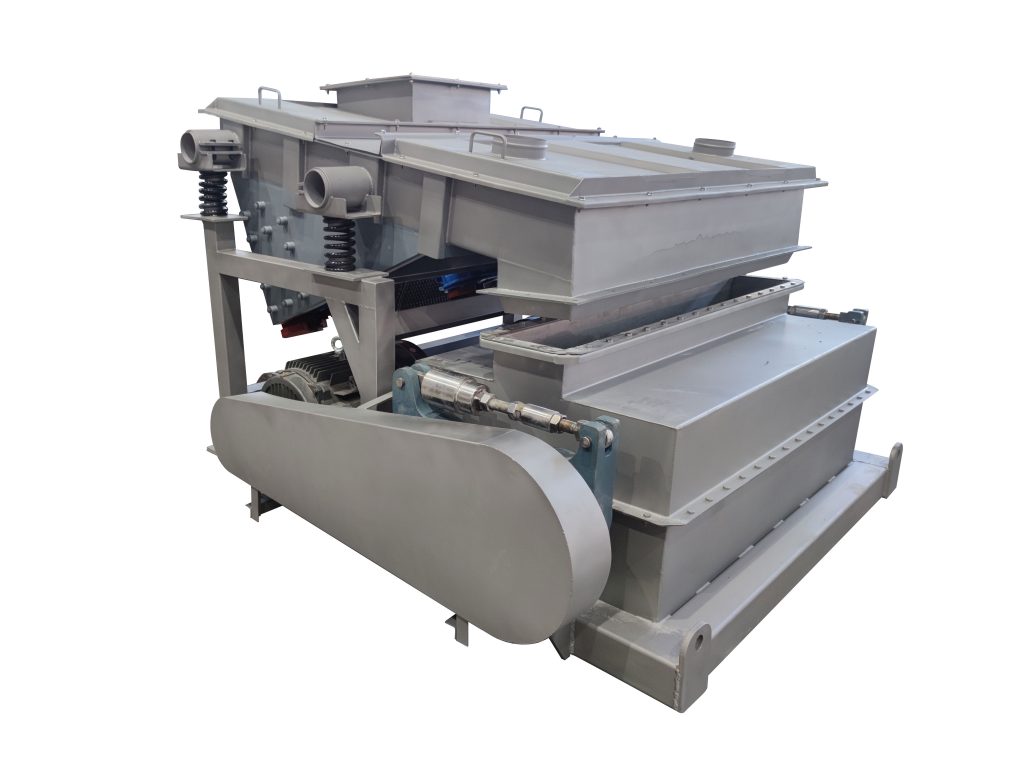
The most practical way to evaluate a salt crushing machine is therefore to start with the finished product requirement and work backward toward the incoming feed.
This article follows that approach, examining the key checkpoints from salt feed material to finished product and explaining where a Double Roller Crusher can fit within the process.
1. Start with the Finished Product, Not the Crusher
A common mistake in equipment planning is to begin by asking:
“Which crusher should we buy?”
A better starting point is:
“What must the finished salt product look like and how must it perform?”
The answer may include:
- Required particle-size range
- Maximum allowable oversize
- Fine-particle requirements
- Product grade
- Required production capacity
- Packaging format
- Downstream application
- Food or industrial requirements
For example, a salt producer may need a relatively narrow particle-size range for a particular customer specification, while another product may accept a wider distribution.
These requirements determine what the crushing and classification stages need to accomplish.
The Double Roller Crusher should therefore be selected as part of a defined processing duty rather than as an isolated machine.
2. Step One: Define the Incoming Salt Feed
Once the finished-product target has been established, the next question is what material will enter the process.
The feed may consist of relatively uniform salt particles, larger crystals, mixed-size material, or material containing oversized pieces.
Important information includes:
- Typical feed size
- Maximum feed size
- Feed-size distribution
- Feed rate
- Moisture condition
- Bulk density
- Presence of agglomerates
- Foreign-material risk
- Storage condition
The purpose of this information is not simply to describe the salt.
It establishes the starting point from which the processing system must reach the finished-product specification.
3. Step Two: Determine the Required Size Reduction
Not all incoming salt needs the same degree of crushing.
For example:
Feed A: Most particles are already close to the finished specification.
Feed B: A significant proportion is oversized.
Feed C: The material contains large pieces or agglomerates that need to be reduced before screening.
These three situations can require different process arrangements.
A Double Roller Crusher is most useful when there is a defined size-reduction duty. The objective is generally not to crush every particle as small as possible, but to reduce the material sufficiently for the next processing stage.
This distinction helps prevent unnecessary crushing and supports a more application-specific process design.
4. Step Three: Decide Where the Double Roller Crusher Belongs
The position of the crusher within the process can influence the overall workflow.
Several arrangements are possible.
Crusher Before Classification
Salt Feed → Double Roller Crusher → Screening → Finished Product
This arrangement may be considered when the incoming material contains significant oversized particles and the screening stage is intended to produce defined product fractions.
Pre-Screening Before Crushing
Salt Feed → Screening → Oversize → Double Roller Crusher → Re-Screening
This approach can be considered when only a particular fraction requires size reduction.
Crushing for Downstream Processing
Salt Feed → Double Roller Crusher → Process Equipment
Here, the crusher prepares the salt for another production stage rather than directly producing the final commercial grade.
The appropriate arrangement depends on the percentage of material requiring reduction and the finished-product specification.
5. Step Four: Match the Feed System to the Crusher
The crushing process begins before material reaches the rollers.
A stable feed can make it easier to maintain consistent operating conditions. An inconsistent feed may cause the material entering the crushing zone to vary significantly over time.
The feeding arrangement should therefore be evaluated together with the crusher.
Relevant considerations include:
- Hopper volume
- Feeder type
- Feed rate
- Material flow
- Transfer chute
- Crusher inlet
- Upstream storage
- Available installation space
The objective is to deliver material to the Double Roller Crusher at a rate and condition compatible with the intended processing duty.
This is especially important when the finished product has a specific particle-size requirement.
6. Step Five: Confirm the Crusher's Feed and Discharge Requirements
Equipment selection should then be compared against the actual process data.
Gaofu's current published salt-crusher specifications list several models. The listed models have 3–10 mm feed-size ranges and 0–5 mm discharge-size ranges, while manufacturer-published capacities vary from approximately 3–5 t/h to 20–40 t/h depending on the model.
These figures are manufacturer-published reference specifications for the listed models, not universal performance guarantees for every salt-processing condition.
For an actual project, the following should be checked together:
| Process Requirement | Equipment Question |
|---|---|
| Feed size | Is the material within the specified feed range? |
| Required discharge | Can the proposed configuration meet the target? |
| Capacity | Is the model suitable for the required operating rate? |
| Material condition | Has representative material been evaluated? |
| Downstream process | What particle distribution does the next stage require? |
| Installation | Can the equipment fit the planned layout? |
This approach connects equipment specifications with the actual production requirement.
7. Step Six: Establish the Crushing Objective
The next stage is to define what the Double Roller Crusher is expected to accomplish.
There are several possible objectives.
Objective A: Reduce Oversized Particles
The crusher handles particles above the desired range.
Objective B: Prepare Material for Screening
The crusher reduces larger particles so that the screening stage can classify the material more effectively.
Objective C: Prepare Salt for a Downstream Process
The crusher creates a suitable feed for dissolving, mixing, blending, conveying, or another process.
Objective D: Reprocess an Off-Size Fraction
The crusher handles material that does not meet the finished-product specification and may be suitable for further processing.
Clearly defining the objective helps determine whether the crusher should process the entire feed or only a particular fraction.
8. Step Seven: Establish the Crushing Clearance
The crushing clearance is one of the important operating variables of a Double Roller Crusher.
Gaofu states that the crushing clearance of its salt crusher can be adjusted to control particle size.
However, the appropriate setting should be established from the actual material and desired output.
A practical relationship can be considered as:
Feed Condition → Crushing Clearance → Discharge Distribution
The objective is not simply to select a narrow clearance. Instead, the setting should be evaluated against:
- Required product size
- Feed size
- Feed consistency
- Fine fraction
- Oversize fraction
- Downstream screening requirements
Actual production testing should be used to establish suitable operating parameters.
9. Step Eight: Evaluate the First Crushing Result
After the first crushing stage, the material should be evaluated.
Looking only at the average particle size may not provide enough information.
A more useful evaluation can include:
- Target-size fraction
- Oversized fraction
- Fine fraction
- Particle-size distribution
- Material flow
- Visible agglomerates
- Unusual material buildup
For example, if the average particle size appears acceptable but the oversize fraction remains high, the process may still require adjustment.
Likewise, if the target fraction is acceptable but unnecessary fines increase, the crushing conditions may need to be reviewed.
The goal is to evaluate the distribution of particles, not simply one average value.
10. Step Nine: Add Screening When Classification Is Required
A Double Roller Crusher reduces particle size; it does not replace every classification operation.
When the finished product has a defined particle-size range, screening may be used after crushing.
A typical process can be:
Salt Feed → Double Roller Crusher → Screening → Finished Product
The screen can separate the crushed material into different fractions.
For example:
- Product fraction
- Oversize fraction
- Fine fraction
Gaofu's screening portfolio includes equipment listed for raw and edible salt classification. Its probability-screen product information, for example, lists raw salt and edible salt among applicable materials.
This creates a practical division of responsibility:
Crusher = Size Reduction
Screen = Size Classification
The actual equipment combination should be determined according to the required product specifications and process capacity.
11. Step Ten: Decide What Happens to Oversized Material
Oversized material after screening should have a defined process route.
It may be:
- Returned for additional crushing
- Sent to another product grade
- Collected separately
- Used in another process
- Removed as off-spec material
If reprocessing is appropriate, a loop may be established:
Crushing → Screening → Oversize → Crushing → Screening
The purpose of this loop is not to repeatedly crush material without limits. Instead, it provides a controlled route for material that has not yet reached the required specification.
The acceptable reprocessing strategy should be determined by product quality requirements and actual production data.
12. Step Eleven: Evaluate the Finished Product
Once the material reaches the final classification stage, the finished product should be checked against the original specification.
A finished-product evaluation may include:
Particle Size
Does the product fall within the specified range?
Distribution
Is the proportion of different fractions appropriate?
Oversize
Is the amount of material above the specified maximum acceptable?
Fines
Is the fine fraction within the process requirement?
Flowability
Can the finished material move effectively through storage and packaging equipment?
Appearance
Does the final material meet the customer's product requirements?
These checks close the loop between the original customer specification and the crushing process.
13. Step Twelve: Connect the Finished Product to Storage
Once the salt has reached the required specification, it normally needs to be transferred to storage or the next production stage.
The transfer route should be designed to avoid unnecessarily changing the condition of the finished material.
Potential equipment may include:
- Conveyors
- Elevators
- Hoppers
- Storage bins
- Feeding equipment
- Packaging systems
The important point is that the process does not end when the salt exits the screen.
The finished product must remain within the required specification as it moves toward storage or packaging.
14. Step Thirteen: Prepare for Packaging
When the final salt product is intended for packaging, the crushing and classification stages should be matched to the packaging system.
A possible process is:
Raw Salt → Feeding → Double Roller Crusher → Screening → Finished Product Bin → Packaging
The final product bin can provide a buffer between continuous processing and packaging operations where appropriate.
The actual arrangement depends on:
- Packaging rate
- Product grade
- Storage volume
- Batch requirements
- Changeover frequency
- Packaging equipment
The objective is to prevent the crushing stage from becoming disconnected from the final production rate.
15. Step Fourteen: Consider Multiple Finished Products
Some salt-processing plants may produce several grades.
In this situation, one processing route may supply several finished-product specifications.
For example:
Raw Salt
↓
Double Roller Crusher
↓
Classification
↓
Grade A / Grade B / Other Fraction
The important consideration is that each finished product should have its own defined specification.
The crusher does not necessarily need to create every final grade directly. It may instead prepare the material for classification into several grades.
This can provide greater flexibility when customer requirements vary.
16. Step Fifteen: Use Process Data to Verify the Flow
A good process flow should be measurable.
Operators can establish records for:
- Feed quantity
- Feed particle size
- Crushing clearance
- Crusher operating time
- Discharge quantity
- Screening results
- Target fraction
- Oversize fraction
- Fine fraction
- Finished-product quantity
These records can help identify changes between the incoming feed and the final product.
For example, if the finished product suddenly contains more oversize material, the investigation can move backward through the process:
Finished Product → Screening → Crusher Discharge → Crusher Operation → Feed Material
This creates a structured troubleshooting path without assuming that the crusher is always the source of the problem.
17. A Practical Feed-to-Product Process Example
Consider a hypothetical salt-processing project in which the customer needs a defined granular product from an incoming salt feed containing a proportion of larger particles.
A possible process could be:
Stage 1 — Feed Receiving
Salt enters the plant from bulk storage.
Stage 2 — Material Feeding
A feeding device provides a controlled material flow.
Stage 3 — Size Reduction
The Double Roller Crusher reduces the oversized material.
Stage 4 — Classification
A screening machine separates the crushed salt into specified fractions.
Stage 5 — Oversize Handling
Material above the target range is directed to an appropriate reprocessing or collection route.
Stage 6 — Finished-Product Storage
The accepted fraction enters a product bin or storage system.
Stage 7 — Packaging
The finished salt is transferred to the packaging stage.
Stage 8 — Product Verification
Samples are checked against the defined product-size specification.
This example is intentionally generic. Actual process flow should be developed from the material, capacity, product specification, plant layout, and downstream requirements.
18. How to Select the Double Roller Crusher Within This Flow
Instead of selecting a crusher first and designing the process around it, the selection can follow a sequence.
Step 1: Define the Finished Product
Determine the required particle-size range and product grade.
Step 2: Characterize the Feed
Measure feed size, maximum particle size, moisture condition, bulk density, and other relevant properties.
Step 3: Calculate the Size-Reduction Duty
Determine how much of the incoming material actually needs crushing.
Step 4: Determine Required Capacity
Establish the required mass flow and operating schedule.
Step 5: Evaluate Crushing and Screening Together
Determine whether classification is required after crushing.
Step 6: Confirm Equipment Dimensions
Check the inlet, outlet, installation space, maintenance access, and material-transfer routes.
Step 7: Conduct Material Testing Where Appropriate
Use representative salt samples to verify the proposed configuration.
Step 8: Establish Operating Parameters
Determine appropriate crushing clearance and feeding conditions from test or production data.
This sequence places the Double Roller Crusher in the context of the complete product route without repeating a general equipment-buying checklist.
19. When Material Testing Can Add Value
Salt can behave differently depending on its source and physical condition.
For projects with specific particle-size requirements, material testing can provide useful information before final equipment configuration.
Testing may evaluate:
- Feed-size distribution
- Crushing response
- Discharge-size distribution
- Fine generation
- Oversize generation
- Capacity under test conditions
- Screening result
The objective is to replace assumptions with data from representative material.
For a commercial project, test results should still be interpreted within the actual operating environment and process conditions.
20. Food and Industrial Salt Require Different Process Checks
The same feed-to-product framework can be used for both food and industrial salt, but the final evaluation criteria may differ.
Food Salt
Additional attention may be given to:
- Product-contact materials
- Cleaning procedures
- Cross-contamination control
- Applicable food-contact requirements
- Finished-product specifications
Industrial Salt
The process may place greater emphasis on:
- Throughput
- Product-size requirements
- Downstream chemical or industrial processes
- Bulk handling
- Storage
- Customer specifications
Applicable regulations and product requirements should be confirmed for the intended market and application.
21. What Makes the Process Flow Practical?
A practical salt-crushing process should answer five questions clearly:
1. What enters the process?
The feed material and its measured characteristics.
2. What must change?
The required size-reduction duty.
3. What does the Double Roller Crusher do?
It reduces the size of suitable feed material according to the defined crushing requirement.
4. What happens after crushing?
Screening, classification, reprocessing, storage, or another downstream operation.
5. How is the finished product verified?
Through defined product-size and quality checks.
If these five questions have clear answers, the equipment selection becomes easier to connect with the actual production objective.
22. Gaofu Double Roller Crusher for Salt Size Reduction
Gaofu Machinery's salt crusher is specifically presented for salt crushing applications. The company's current published information lists adjustable crushing clearance and multiple model configurations, with manufacturer-published feed, discharge, capacity, motor-power, and dimensional data for each model.
For example, Gaofu currently lists six salt-crusher configurations with published capacities ranging from 3–5 t/h to 20–40 t/h. These values are model-specific reference data and should be verified against the customer's actual material and process conditions before equipment selection.
Gaofu also provides screening and other material-processing equipment, allowing a salt project to be evaluated from the perspective of the complete material route rather than the crusher alone.
For a specific project, the recommended configuration should be based on:
- Actual salt feed
- Required feed rate
- Target discharge size
- Finished-product specification
- Screening requirements
- Installation conditions
- Applicable safety and hygiene requirements
Conclusion
A salt crushing machine should be selected according to the journey from incoming feed material to finished product.
The process begins by defining the finished salt specification, then works backward through feed characteristics, size-reduction requirements, crusher configuration, screening, oversize handling, storage, packaging, and final product verification.
Within this route, a Double Roller Crusher can serve as the controlled size-reduction stage. Its role is to reduce suitable salt feed material so that the following process can achieve the required product specification.
The most useful equipment decision is therefore not simply a question of crusher capacity. It is a question of whether the selected machine, operating conditions, and downstream equipment form a logical process from:
Salt Feed → Controlled Size Reduction → Classification → Finished Product
For Gaofu Machinery projects, the final Double Roller Crusher configuration should be established from the actual salt material, production requirements, target particle size, downstream process, and site conditions. Where appropriate, representative material testing can provide additional information for equipment and process evaluation.
This feed-to-finished-product approach can help salt processors develop a clearer technical specification and communicate their requirements more effectively when evaluating a Double Roller Crusher for a new or existing production line.