

Salt Crushing Machine Applications: Using Double Roller Crushers for Controlled Salt Size Reduction
Post Date: 2026-10-07
Salt is used across food manufacturing, chemical processing, water treatment, industrial production, and other applications. Although the raw material is chemically similar, the required particle size can vary considerably according to the final product and processing method.
For this reason, salt crushing is not simply a matter of making large particles smaller. In many applications, the objective is to prepare salt within a defined size range while limiting unnecessary fines and creating a suitable feed for subsequent screening, mixing, dissolving, conveying, or packaging operations.
A Double Roller Crusher can be used as a controlled size-reduction stage for suitable salt materials. Gaofu's salt crusher information describes its crushing action as primarily cutting, supplemented by extrusion and pressing, with adjustable crushing clearance for controlling particle size.
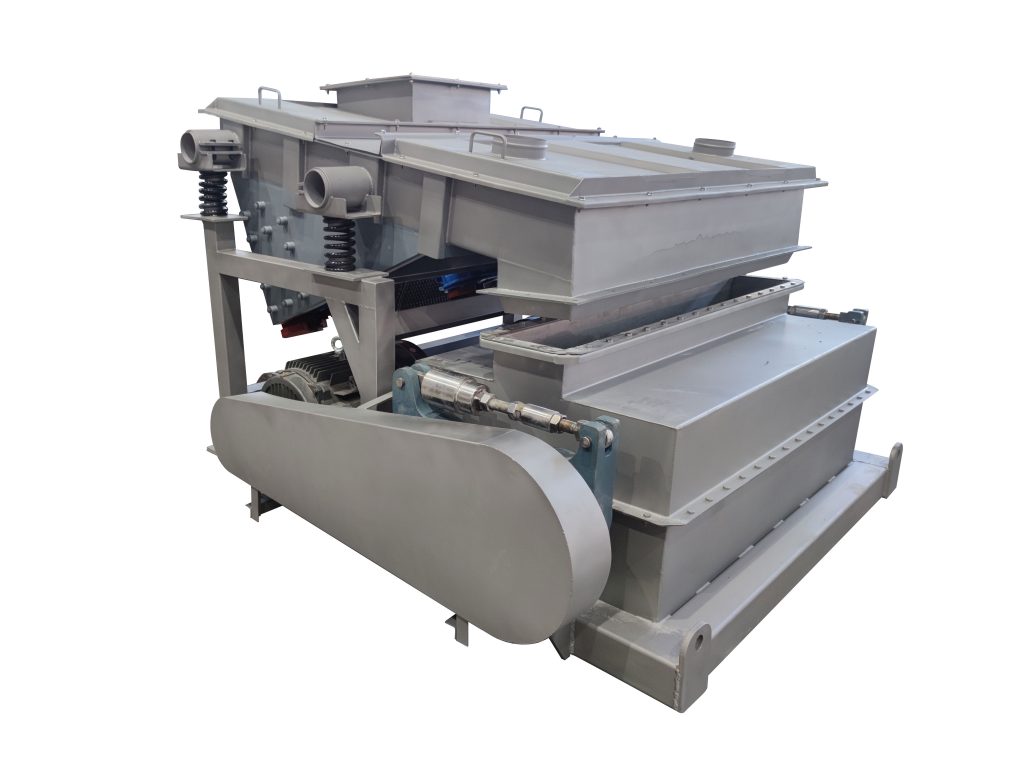
This article examines practical application scenarios in which a Double Roller Crusher may be considered for salt size reduction, focusing on the relationship between the intended application and the required crushing result.
1. Why Salt Size Reduction Depends on the End Application
Different salt products can require different particle-size characteristics.
For example, a food manufacturer may need salt suitable for seasoning or blending, while an industrial user may require a particular granular range for downstream processing. A water-treatment application can have different handling requirements again.
Particle size can influence characteristics such as:
- Flow behavior
- Mixing uniformity
- Dissolution behavior
- Product appearance
- Conveying performance
- Screening requirements
- Packaging behavior
Published food-science references also show that different salt particle sizes are associated with different food applications, including bakery toppings, snack foods, seasoning, and blending.
Therefore, the appropriate crushing objective should be defined by the final application rather than by the crusher alone.
2. Application 1: Preparing Salt for Food Seasoning
One common application for controlled salt size reduction is food seasoning.
Salt used in seasoning products may need a particle size that supports consistent distribution over or within another food material. The desired size can vary according to the product, application method, and formulation.
A Double Roller Crusher can be considered when the incoming salt contains particles larger than the required range and controlled reduction is needed before subsequent classification.
A typical processing concept may be:
Salt Feed → Double Roller Crusher → Screening → Seasoning or Packaging
The crusher performs the size-reduction stage, while the screening equipment can separate the resulting fractions.
This division of functions is useful because crushing and classification have different purposes. The crusher changes particle size; the screen separates particles according to size.
The exact target size should be established from the customer's product specification rather than assumed to be the same for every seasoning application.
3. Application 2: Salt for Food Blending
Salt is also used as an ingredient in seasoning blends and other food formulations.
In a blended product, particle-size compatibility can influence how different ingredients distribute throughout the mixture. Salt that is substantially different in size from other ingredients may behave differently during feeding and mixing.
A controlled crushing stage can therefore be used to prepare oversized salt before blending.
For example:
Raw Salt → Size Reduction → Classification → Ingredient Blending
The purpose of the Double Roller Crusher in this case is not necessarily to produce the finest possible salt. Instead, the objective may be to bring oversized material into a more suitable range for subsequent classification or blending.
The appropriate particle-size specification should be determined from the actual recipe and mixing process.
4. Application 3: Preparing Salt for Screening and Grading
Another important application is the preparation of salt for classification.
Salt may arrive with a wider particle-size distribution than the final product requires. A Double Roller Crusher can be positioned before screening to reduce selected oversized particles, after which a screening machine can separate the material into defined fractions.
A possible process is:
Incoming Salt → Double Roller Crusher → Screening → Multiple Product Fractions
This configuration can be useful when the crushing stage and classification stage have clearly defined responsibilities.
Gaofu also supplies screening equipment for salt applications. Its published probability-screen information, for example, lists raw salt and edible salt among applicable materials.
The actual crusher-screen combination should be established according to feed size, target fractions, capacity, and the characteristics of the finished product.
5. Application 4: Producing Granular Salt for Industrial Processing
Industrial salt can be used as a raw material in a variety of manufacturing processes.
In such applications, particle size may be specified according to the downstream process rather than consumer appearance.
A Double Roller Crusher can be used to reduce larger particles or selected oversized material before the salt enters another production stage.
Potential objectives include:
- Preparing a consistent feed
- Reducing oversized particles
- Supporting downstream screening
- Improving material handling
- Preparing material for a subsequent process
The required crushing result should be defined by the downstream equipment or process specification.
This application-oriented approach helps avoid treating crushing capacity as the only evaluation criterion.
6. Application 5: Salt for Water-Treatment Processes
Certain salt products are used in water-treatment and water-softening applications.
The final salt form and particle-size requirements depend on the specific treatment system. Where oversized or irregular feed material needs to be reduced before further processing, a Double Roller Crusher may be considered as a size-reduction stage.
The important question is not simply whether the crusher can reduce the salt. It is whether the resulting material is appropriate for the next stage.
A project evaluation can therefore consider:
Feed Size → Required Reduction → Product Classification → Storage or Treatment Use
If the final application requires a particular particle-size distribution, screening may be used after crushing to separate the required fraction.
7. Application 6: Salt Used in Chemical Processing
Salt is an important raw material in various chemical processes.
In chemical applications, particle size may affect how the material is fed, dissolved, reacted, mixed, or transferred. The exact influence depends on the specific process.
When oversized salt must be reduced before entering a chemical production stage, a Double Roller Crusher can serve as a preparation unit.
For example, the process may require:
- Controlled feed particle size
- Reduction of large particles
- Limited generation of unnecessary fines
- Consistent downstream feeding
- Separation of off-size material
The crushing requirement should be established from the chemical process rather than applying a generic particle-size target.
Where combustible dust or other process hazards may exist, the complete installation should also be evaluated according to applicable local regulations, site-specific risk assessments, and relevant safety requirements.
8. Application 7: Preparing Salt for Dissolution
Particle size can also matter when salt is prepared for a dissolution process.
Reducing oversized particles can create a different surface-area-to-volume relationship and may influence the subsequent dissolution behavior. However, the actual effect depends on the salt characteristics, liquid conditions, process temperature, agitation, and other factors.
Therefore, a Double Roller Crusher should be viewed as a size-preparation unit, rather than as a guarantee of a particular dissolution rate.
A conceptual process could be:
Bulk Salt → Double Roller Crusher → Size Classification → Dissolution Process
The crusher's target output should be established through process testing.
9. Application 8: Salt Used in Blended Industrial Materials
Some industrial processes combine salt with other solid ingredients.
In these applications, particle-size compatibility can become important because very different particle sizes may affect feeding, segregation, and mixing behavior.
A Double Roller Crusher can be used upstream to prepare oversized salt before the blending stage.
The process designer may evaluate:
- Salt particle-size range
- Other ingredient particle sizes
- Required blend ratio
- Mixing equipment
- Feed-system characteristics
- Acceptable oversize and fines
- Final product specification
The crusher therefore becomes part of a broader material-preparation strategy.
10. Application 9: Preparing Salt for Packaging
Packaging lines generally require a predictable material flow.
If incoming salt contains oversized particles or a broad size distribution, a crushing and classification stage may be used before the material reaches the packaging system.
One possible arrangement is:
Salt Storage → Double Roller Crusher → Screening → Finished-Product Bin → Packaging
The Double Roller Crusher handles size reduction, while the screen can help separate material according to the finished-product specification.
Gaofu's salt-processing information also describes screening applications around product preparation and classification, illustrating how crushing and screening can serve complementary functions in a salt-processing line.
The final arrangement depends on the required product grade and existing packaging equipment.
11. Application 10: Recovering Oversized Salt
Not every production stream consists entirely of material requiring crushing.
After screening or another classification operation, an oversized fraction may be generated. Depending on the process specification, some of this material may be suitable for controlled reprocessing.
A Double Roller Crusher can be considered as a reprocessing stage:
Screening → Oversize Collection → Double Roller Crusher → Reclassification
This arrangement allows the crusher to work specifically on the fraction that requires further size reduction.
It can be useful when the process objective is to recover suitable material rather than repeatedly crush the entire feed stream.
The feasibility of such a route depends on the material, product specification, capacity, and quality requirements.
12. Application 11: Preparing Different Salt Product Grades
Some salt-processing operations produce more than one commercial grade.
In this situation, the crushing stage may be adjusted or configured according to the required product range, with screening used to separate the resulting fractions.
A simplified concept is:
Raw Salt → Controlled Crushing → Multi-Fraction Screening → Grade A / Grade B / Other Fractions
The advantage of this approach is that the crushing stage and classification stage can be evaluated separately.
The Double Roller Crusher does not need to create every final grade directly. Instead, it can prepare the material for the subsequent classification process.
This distinction is particularly important when several finished products have different particle-size specifications.
13. Application 12: Salt for Seasoning and Snack Manufacturing
Food applications can have particularly diverse particle-size requirements.
Published references associate different salt particle sizes with applications such as pretzels, crackers, snack foods, nuts, popcorn, bread products, and other foods.
This means that a "food salt crusher" should not be associated with one universal output size.
For a seasoning or snack application, the process may need to establish:
- Desired salt size
- Application method
- Required distribution
- Mixing or coating conditions
- Packaging requirements
- Acceptable fines
- Product-contact requirements
A Double Roller Crusher can then be evaluated according to that defined duty.
For food-contact applications, applicable hygiene, material, cleaning, and regulatory requirements should be verified for the target market and product.
14. Application 13: Preparing Coarse Salt for Further Classification
Coarse salt can contain particles outside the desired commercial range.
Rather than attempting to classify the entire material without preparation, some processes may use a crusher to reduce selected large particles first.
The resulting material can then enter a classification stage.
This approach can help create a clearer relationship between:
Oversized Feed → Controlled Reduction → Classification → Finished Product
The exact configuration depends on the percentage of oversized material and the desired final product.
If only a small fraction requires crushing, it may be more appropriate to process that fraction separately rather than send the entire material stream through the crusher.
15. Application 14: Salt Processing for Different Customer Specifications
B2B salt suppliers may manufacture products according to different customer specifications.
One customer may require relatively coarse salt, while another may specify a smaller particle-size range. In such situations, controlled size reduction can provide an additional processing step between raw material preparation and final classification.
A practical production strategy may include:
- Define the customer's particle-size specification.
- Determine the incoming salt condition.
- Establish the required size-reduction duty.
- Select an appropriate crushing configuration.
- Test the crushed material.
- Screen or classify the material if necessary.
- Record the final particle-size distribution.
- Confirm the product against the customer's specification.
This approach places the Double Roller Crusher within a customer-specific production workflow rather than treating it as a standalone machine.
16. Why Controlled Size Reduction Matters
The purpose of controlled crushing is to achieve the required reduction without creating an unnecessarily large quantity of material outside the target range.
For salt processing, this can mean balancing three fractions:
Target Fraction + Oversize Fraction + Fine Fraction
The target fraction is the material that meets the product specification.
The oversize fraction may require additional processing or another use.
The fine fraction may have a different value or application depending on the process.
Therefore, evaluating only the crusher's nominal capacity does not provide a complete picture of application suitability.
Particle-size testing can provide more useful information about the actual crushing result.
17. Double Roller Crusher as a Controlled Reduction Stage
Gaofu's published salt crusher uses a roller-based crushing structure and provides adjustable crushing clearance. Its listed salt-crusher models include different roller lengths and manufacturer-published capacity ranges, allowing configurations to be considered for different processing requirements.
For example, Gaofu lists models with manufacturer-published capacities from approximately 3–5 t/h through 20–40 t/h, with the listed models showing a 3–10 mm feed-size range and 0–5 mm discharge-size range. These figures are reference specifications for the corresponding models, not universal guarantees for every salt or operating condition.
For a specific project, the actual salt sample, feed conditions, target product size, required capacity, and downstream process should be evaluated before final equipment configuration.
18. Combining Crushing and Screening for Application-Specific Results
In many salt applications, crushing and screening perform complementary functions.
The Double Roller Crusher reduces oversized material, while the screening machine separates the resulting particles.
For example:
Food seasoning
Salt → Crushing → Screening → Seasoning
Industrial salt
Salt → Crushing → Classification → Industrial Process
Packaging preparation
Salt → Crushing → Screening → Finished Product Bin → Packaging
Oversize recovery
Screen Oversize → Crushing → Re-Screening → Product
This modular approach allows the process to be configured around the actual application rather than forcing one machine to perform every processing task.
19. Application Testing Before Equipment Configuration
Because salt products can differ considerably, representative testing is useful when the required crushing result is specific.
A test program may examine:
- Feed particle-size distribution
- Maximum particle size
- Moisture condition
- Bulk density
- Required product size
- Crushing response
- Fine generation
- Oversize generation
- Screening result
- Material flow
- Required capacity
The objective is to establish whether the proposed Double Roller Crusher configuration can meet the intended processing duty under representative conditions.
This is especially useful when the final product has a narrow particle-size specification or when the material contains significant variation.
20. Gaofu Double Roller Crusher for Salt Applications
Gaofu Machinery offers a salt crusher designed specifically for salt size-reduction applications. According to Gaofu's published product information, the machine uses cutting as the primary crushing action, with extrusion and pressing also contributing to size reduction, and the crushing clearance can be adjusted for particle-size control.
The company's salt-crusher application information lists food, chemical, system, and other industry cases.
Gaofu's broader product portfolio also includes screening, conveying, feeding, and crushing equipment, which can be combined according to the requirements of a particular material-processing project.
For a salt-processing project, the appropriate configuration should be determined from the actual material, target particle size, capacity, downstream requirements, installation conditions, and applicable industry standards.
Conclusion
A Salt Crushing Machine can serve many different purposes depending on where it is used in the production process. For food seasoning, blending, industrial processing, dissolution preparation, packaging, product grading, or oversized-material recovery, the crushing objective can be different even when the raw material is simply described as salt.
A Double Roller Crusher can provide a controlled size-reduction stage for suitable salt materials. Its role is generally to reduce particle size, while downstream screening or classification can separate the resulting fractions according to the final product specification.
The key to selecting and operating the equipment is therefore to begin with the application requirement:
What is the salt used for? What particle size is required? Which fraction needs to be reduced? What happens after crushing?
By answering these questions first, processors can establish a more appropriate crushing duty and determine whether a Double Roller Crusher fits the production process.
For Gaofu Machinery salt-crusher projects, material testing and application-specific evaluation can be used to connect the customer's salt characteristics with the desired crushing result, equipment configuration, and downstream processing requirements.