

How a Tumbler Screen Supports Multi-Size Salt Classification in Food and Industrial Processing
Post Date: 2026-09-17
Salt products can be processed into different particle-size ranges for food manufacturing, industrial applications, and packaging. When one production process needs to divide bulk salt into several size fractions, the screening system needs to provide a controlled separation route for each fraction.
A Tumbler screen can be considered for multi-size salt classification applications where gentle, three-dimensional screening movement is suitable for the material and process requirements. Compared with a simple two-way screening operation, a multi-deck tumbler screen can be arranged to separate several particle-size fractions in one screening process.
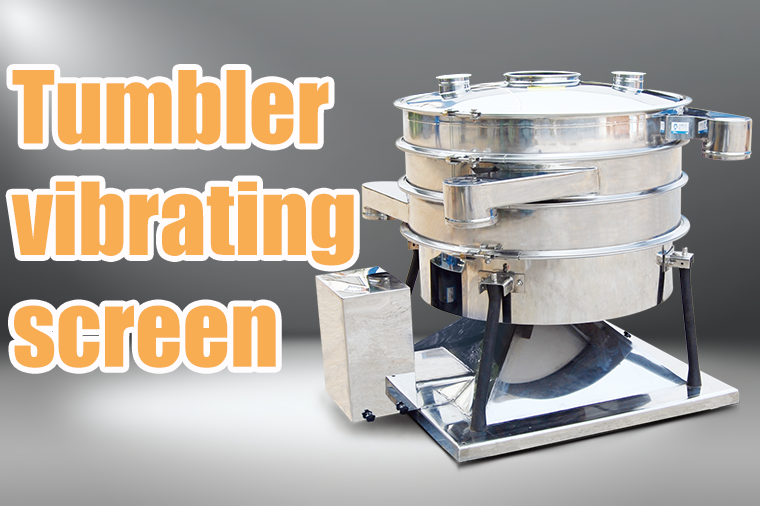
This makes the tumbler screen relevant to salt processors handling different grades of crystalline materials.
1. What Is Multi-Size Salt Classification?
Multi-size classification means separating salt into several particle-size ranges rather than simply dividing it into oversized and undersized material.
For example, a production process may require:
Bulk Salt → Coarse Fraction → Medium Fraction → Fine Fraction
Each fraction can then be directed to a separate storage, blending, or packaging process.
The actual number of grades depends on the customer's product specifications.
A Tumbler screen can be configured with multiple screening decks so that different particle-size boundaries can be established within the same machine.
2. Why a Tumbler Screen Can Be Considered for Salt
A tumbler screen uses a reciprocating or elliptical screening motion rather than the high-frequency vibration commonly associated with some conventional vibrating screens.
Its movement is designed to provide repeated contact between the material and screen surface.
For certain crystalline materials, this screening approach can be considered when the process requires:
- Multi-size classification
- Controlled material movement
- Multiple screening stages
- Separation of different crystal fractions
- Continuous processing
The suitability depends on the salt characteristics, required capacity, particle-size distribution, and target separation.
3. From Bulk Salt to Multiple Fractions
A typical multi-size classification process can be represented as:
Bulk Salt
↓
Tumbler Screen – Upper Deck
→ Coarse Salt
↓
Tumbler Screen – Middle Deck
→ Medium Salt
↓
Tumbler Screen – Lower Deck
→ Fine Salt
This arrangement allows several fractions to be collected separately.
The exact screen openings and deck configuration should be determined according to the required product specifications.
4. One Screening Process, Several Product Streams
One of the practical considerations in multi-size classification is how to manage the resulting product streams.
For example:
Feed Material
→ Fraction A → Product Hopper A
→ Fraction B → Product Hopper B
→ Fraction C → Product Hopper C
→ Fraction D → Product Hopper D
Each discharge can be connected to downstream equipment according to the production process.
This can simplify the material route when several grades need to be produced from the same feed material.
5. Classifying Fine Salt
Fine salt may require a relatively small screen opening to establish the desired separation range.
In a tumbler-screen application, the fine fraction can be collected after passing through the relevant screening deck.
The screening process should consider:
- Fine particle characteristics
- Moisture
- Feed distribution
- Screen opening
- Material loading
- Cleaning requirements
Fine salt may behave differently from coarse crystals, so actual material testing can be useful when the required separation is specific.
6. Classifying Coarse Salt
Coarse salt can contain a broad distribution of crystal sizes.
A tumbler screen can separate larger crystals from smaller fractions through appropriately arranged screening decks.
A simplified process could be:
Coarse Salt Feed → Large Opening → Medium Opening → Fine Opening
The resulting streams may then be routed separately.
If unusually large particles are present, the first deck can serve as an initial separation point for the coarse fraction.
7. Three-Size and Four-Size Classification
The number of required product grades influences the number of screening decks.
Three Product Sizes
A possible configuration is:
Feed → Deck 1 → Coarse
↓ Deck 2 → Medium
↓ → Fine
Four Product Sizes
A more complex configuration may be:
Feed → Deck 1 → Largest Fraction
↓ Deck 2 → Coarse Fraction
↓ Deck 3 → Medium Fraction
↓ → Fine Fraction
The machine configuration should be determined according to the actual particle-size boundaries rather than simply increasing the number of decks.
8. Salt Classification for Food Processing
Food manufacturers may process salt for different formulations, ingredient systems, or packaging specifications.
A Tumbler screen can be used as part of a food-processing line when the equipment configuration meets the applicable production requirements.
Important considerations may include:
- Contact-material selection
- Surface finish
- Cleaning access
- Residual-material removal
- Product changeover
- Screen replacement
- Hygienic production procedures
The applicable food-contact standards should be confirmed according to the destination market and specific application.
9. Salt Classification for Industrial Processing
Industrial salt can be used in different manufacturing processes, and its required particle-size distribution may vary.
A Tumbler screen can be positioned to classify salt before:
- Storage
- Further processing
- Chemical production
- Material blending
- Industrial packaging
The machine configuration should reflect the physical properties of the industrial salt and the requirements of the downstream process.
For chemical or potentially hazardous materials, the complete installation should be evaluated according to material properties, site conditions, and applicable safety requirements.
10. Handling Different Salt Crystal Sizes
Salt crystals can differ in:
- Size
- Shape
- Surface characteristics
- Moisture
- Bulk density
These properties influence how particles interact with a screening surface.
A classification system should therefore be developed around the actual salt rather than relying solely on a generic salt category.
Sample testing can help determine whether the selected screen arrangement can achieve the intended separation under representative conditions.
11. Controlling the Feed to the Tumbler Screen
Multi-deck classification requires the material to enter the screening surface in a suitable manner.
An excessively concentrated feed can reduce the effective screening area available to individual particles.
A controlled feeding arrangement can help distribute material across the screening surface.
The complete feeding system may include:
Storage Hopper → Feeder → Tumbler Screen
The feeding method should be matched to the machine capacity and material characteristics.
12. Managing Product Discharge
Every separated fraction needs a defined discharge route.
For example:
Coarse Salt → Outlet 1 → Storage Bin
Medium Salt → Outlet 2 → Storage Bin
Fine Salt → Outlet 3 → Packaging
Discharge design becomes particularly important when several grades are produced simultaneously.
The outlet arrangement should provide sufficient space for downstream connections and allow operators to access relevant areas for inspection and cleaning.
13. When Salt Agglomerates Are Present
Salt may form larger agglomerates during storage or transportation.
In some applications, screening can be used to separate these larger pieces from the main product stream.
For example:
Salt Feed → Tumbler Screen → Target Fraction + Oversized Agglomerates
The oversized fraction can then be handled according to the customer's production procedure.
Whether the material should be returned for further processing depends on the complete production process.
14. Multi-Size Classification Before Packaging
A tumbler screen can be placed upstream of packaging when different salt grades need to be separated before filling.
A representative route is:
Bulk Salt → Tumbler Screen → Multi-Size Classification → Product Hoppers → Packaging
Each product hopper can supply a designated packaging line or packaging specification.
This arrangement can be useful when a facility handles several salt grades within the same general production process.
15. Using a Tumbler Screen for Product Separation Rather Than Final Inspection
It is useful to distinguish classification from inspection screening.
Classification aims to divide material into defined particle-size ranges.
Inspection screening generally focuses on identifying or removing unwanted oversized particles.
A Tumbler screen can potentially be used for either purpose, but the configuration may differ.
For multi-size salt classification, the machine needs to be designed around several separation boundaries.
For simple oversize removal, a more straightforward configuration may be sufficient.
16. Product Changeover Between Salt Grades
Food and industrial facilities may process more than one salt specification.
When switching between products, the production team may need procedures for:
- Removing residual salt
- Cleaning contact surfaces
- Inspecting screens
- Confirming screen configuration
- Checking discharge routes
- Verifying the next product specification
These procedures can help reduce the risk of mixing different product grades.
The exact changeover procedure should follow the facility's quality and hygiene requirements.
17. Tumbler Screen Applications Beyond Salt
The same type of multi-size classification concept can apply to other crystalline or granular materials.
Potential applications may include:
- Sugar crystals
- Fertilizer granules
- Mineral particles
- Certain chemical crystals
- Granular food ingredients
However, equipment suitability depends on the individual material.
Different materials can have different density, shape, moisture, flowability, and screen-interaction characteristics. Testing and process evaluation are therefore useful when selecting equipment for a new application.
18. Evaluating a Tumbler Screen for a Salt Project
Before finalizing a tumbler-screen configuration, processors can prepare several key parameters:
Material Information
- Salt type
- Particle-size distribution
- Moisture condition
- Bulk density
- Crystal characteristics
Screening Requirements
- Desired particle-size fractions
- Number of grades
- Required capacity
- Feed condition
- Product discharge requirements
Production Requirements
- Food or industrial application
- Cleaning procedure
- Product changeover frequency
- Available installation space
- Downstream equipment
This information gives the equipment supplier a clearer basis for evaluating the appropriate machine arrangement.
19. Gaofu Machinery Tumbler Screen for Salt Classification
Gaofu Machinery provides screening equipment for powder and granular material processing applications.
For salt classification projects, a Tumbler screen can be configured around requirements such as:
- Number of particle-size fractions
- Screening deck arrangement
- Screen specifications
- Material characteristics
- Feed rate
- Discharge configuration
- Contact-material requirements
- Cleaning and changeover needs
- Production-line connections
For food applications, hygiene-related requirements can be considered during equipment configuration.
For industrial materials, the equipment can be evaluated according to material properties and site-specific operating conditions.
Gaofu Machinery can review customer samples and process parameters to help develop a Tumbler screen configuration for the intended application.
Conclusion
Multi-size salt classification requires a screening system that can separate material into clearly defined particle-size ranges while providing practical routes for each resulting fraction.
A Tumbler screen can be considered for applications involving fine, medium, coarse, or multiple salt grades. With multiple screening decks, the machine can create several product streams within one screening process, depending on the material and required separation.
For both food and industrial salt processing, the appropriate configuration should be based on actual material characteristics, product specifications, production capacity, and downstream requirements.
Gaofu Machinery can evaluate these factors and develop Tumbler screen configurations for salt and other crystalline or granular material classification applications.