

How a Vacuum Feeder Supports Automated Material Loading for Sieving Machine Production Lines
Post Date: 2026-08-15
Introduction
Material loading is an important connection point between raw material storage and screening equipment. In powder-processing plants, transferring material manually between process stages can make production workflows more complicated, particularly when several machines need to operate as part of one continuous line.
A Vacuum Feeder provides a pneumatic conveying method for moving powders through an enclosed pipeline. When integrated with a sieving machine, it can serve as an automated material loading component, connecting an upstream material source with downstream screening equipment.
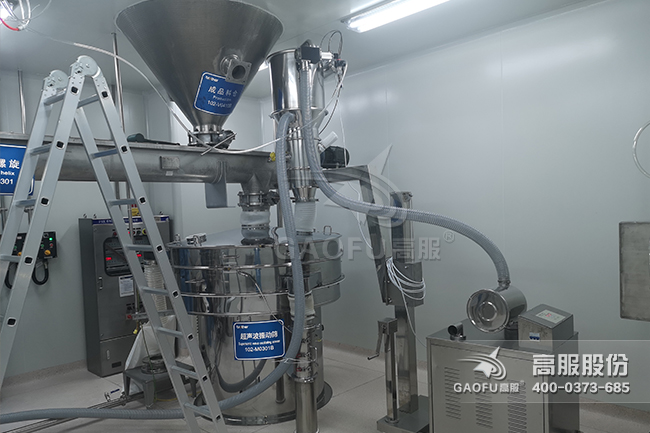
The Gaofu Vacuum Feeder can be configured according to material characteristics, conveying conditions, and production-line requirements. This article examines how a Vacuum Feeder can support automated material loading and what should be considered when designing a complete sieving system.
1. What Is Automated Material Loading?
Automated material loading refers to using mechanical or pneumatic equipment to transfer raw materials into processing equipment with reduced reliance on manual handling.
In a powder screening line, the process may be organized as:
Raw Material Storage → Vacuum Feeder → Sieving Machine → Material Collection
The Vacuum Feeder performs the material transfer function, while the sieving machine carries out screening.
This division allows the material loading stage to be considered as part of the overall production-line design rather than as an isolated operation.
2. The Role of a Vacuum Feeder in a Sieving Line
A Vacuum Feeder can connect different stages of a powder-processing system.
Depending on the application, it may receive material from:
- Storage hoppers
- Feeding stations
- Big bag unloading systems
- Mixing equipment
- Upstream production machinery
The material is then conveyed toward the sieving machine through the configured pipeline.
This creates a defined material route:
Material Source → Vacuum Transfer → Screening → Collection
The actual operating mode depends on the equipment configuration and production requirements.
3. How Automated Material Loading Works
Step 1: Material Preparation
Raw material is stored in an upstream container or processing unit.
Before selecting the feeder, manufacturers should establish:
- Material type
- Bulk density
- Flowability
- Particle size
- Required feeding rate
Step 2: Vacuum Conveying
The Vacuum Feeder creates the conveying conditions needed to transfer the material through the pipeline.
The material moves from the source toward the receiving section.
The conveying route may include horizontal or vertical sections depending on the factory layout.
Step 3: Material Discharge
After reaching the receiving section, the material is discharged toward the downstream sieving machine.
The discharge arrangement should correspond with:
- Sieving machine inlet dimensions
- Installation height
- Required feeding conditions
- Material flow direction
Step 4: Screening
The sieving machine receives the conveyed material and performs the specified screening process.
Depending on the application, screening may involve:
- Particle classification
- Oversized particle removal
- Powder separation
- Material preparation
Step 5: Collection and Further Processing
After screening, accepted material can move to:
- Storage
- Packaging
- Mixing
- Filling
- Further processing
The oversized fraction can be collected separately where the selected screening equipment provides that function.
4. How a Vacuum Feeder Supports Automated Loading
Reduced Dependence on Manual Transfer
A Vacuum Feeder can automate the movement of material between designated process stages.
Instead of repeatedly carrying or manually loading powder into the screening machine, the transfer can be incorporated into the production line.
This may help reduce routine material-handling tasks, although the degree of automation depends on the complete system configuration.
More Structured Material Supply
A dedicated conveying system provides a defined route from the material source to the sieving machine.
This helps manufacturers organize:
- Material loading
- Conveying
- Screening
- Collection
A structured process can make production-line management easier.
Enclosed Conveying Route
Vacuum conveying uses pipelines to transfer material.
When appropriately designed and sealed, an enclosed route can reduce unnecessary open powder-transfer points.
However, actual dust-control performance depends on:
- Equipment sealing
- Pipeline connections
- Filter condition
- Material characteristics
- Operating environment
5. Connecting the Vacuum Feeder with Different Material Sources
Storage Hopper
A hopper can provide a continuous or controlled material source for the Vacuum Feeder.
A possible arrangement is:
Storage Hopper → Vacuum Feeder → Sieving Machine
This can be used when raw material is already stored in a process vessel.
Big Bag Feeding Station
A Big Bag Feeding Station can be used to unload bulk material before it enters the vacuum conveying system.
The process may be:
Big Bag → Feeding Station → Vacuum Feeder → Sieving Machine
This combination can be considered for plants handling large quantities of powdered raw materials.
Upstream Processing Equipment
A Vacuum Feeder can also connect screening equipment with upstream machines such as:
- Mixers
- Crushers
- Grinding equipment
- Drying equipment
The final arrangement should be determined according to material characteristics and process sequence.
6. Automated Loading for Different Powder Applications
Flour Processing
In flour processing, the Vacuum Feeder can transfer flour from an upstream storage point toward a flour sieving machine.
A possible process is:
Flour Storage → Vacuum Feeder → Rotary Vibrating Sieve → Flour Collection
The screening requirements and conveying conditions should be evaluated according to the flour characteristics.
Starch and Sugar Powder
Starch and sugar powder may be transferred through an enclosed pipeline before screening.
The system should consider:
- Powder flowability
- Moisture
- Required feeding rate
- Screening specifications
Food Ingredient Powders
For protein powder, cocoa powder, powdered ingredients, and similar materials, manufacturers may consider:
- Material-contact requirements
- Cleaning procedures
- Conveying conditions
- Screening objectives
Equipment selection should comply with applicable food-processing requirements.
Chemical and Industrial Powders
Chemical powders, mineral powders, and industrial additives can have different bulk densities and flow behaviors.
Before selecting a Vacuum Feeder, manufacturers should evaluate:
- Material properties
- Abrasiveness
- Conveying distance
- Environmental conditions
- Safety requirements
For combustible or hazardous powders, the complete system should be designed according to applicable regulations and safety standards.
7. Choosing the Right Sieving Machine
The downstream screening machine should match the material and production objective.
Rotary Vibrating Sieve
Suitable configurations can be considered for:
- Fine powder screening
- Particle classification
- Oversized particle separation
The Vacuum Feeder can provide upstream material loading.
Centrifugal Sifter
A centrifugal sifter can be considered for continuous powder screening applications where its operating principle matches the material.
Linear Vibrating Screen
A linear vibrating screen can be considered for different bulk-material screening requirements.
The Vacuum Feeder should be matched to the screen inlet and material consumption rate.
8. Coordinating Feeding Capacity with Screening Capacity
Automated loading works best when upstream and downstream equipment are considered together.
A production line should evaluate:
Material Supply → Vacuum Feeding → Screening → Collection
Key parameters include:
- Required material throughput
- Vacuum Feeder conveying capacity
- Sieving machine processing capacity
- Operating schedule
If feeding and screening capacities are significantly mismatched, additional control or buffer arrangements may be needed.
Actual capacity should be determined according to material properties and application conditions.
9. Designing the Control Process
A more automated production line may include coordinated control between feeding and screening equipment.
Depending on the system, manufacturers may consider:
- Start/stop control
- Material-level monitoring
- Feeding-cycle control
- Equipment interlocking
- Alarm functions
For example, a downstream material-level signal can potentially be used as part of the feeding-control strategy.
The specific automation level depends on the selected equipment and control system.
10. Factory Layout Considerations
Automated material loading also depends on physical equipment arrangement.
When planning the installation, consider:
Equipment Position
Determine the relative positions of:
- Material source
- Vacuum Feeder
- Sieving machine
- Collection equipment
Pipeline Routing
Plan the shortest practical route while accounting for:
- Bends
- Elevation changes
- Maintenance access
Operator Access
Ensure that inspection and maintenance points remain accessible.
Cleaning Access
For powder applications, equipment and pipeline areas requiring routine cleaning should be considered during layout design.
11. Maintenance of an Automated Loading System
Automation does not eliminate routine equipment inspection.
Vacuum Feeder
Regularly inspect:
- Filters
- Seals
- Valves
- Inlet and discharge sections
Conveying Pipeline
Check:
- Connection points
- Sealing condition
- Pipeline condition
- Material accumulation
Sieving Machine
Inspect:
- Screen mesh
- Screen frame
- Inlet
- Discharge outlets
- Operating components
Maintenance procedures should follow the manufacturer's instructions and actual operating conditions.
12. Practical Application Checklist
Before integrating a Vacuum Feeder into a sieving machine production line, manufacturers can evaluate:
Material
- What material is being conveyed?
- What are its flow and density characteristics?
- Is the powder abrasive or moisture-sensitive?
Loading
- Where does the material originate?
- What feeding rate is required?
- How much manual intervention should the process involve?
Conveying
- What is the conveying distance?
- Are vertical sections required?
- What pipeline arrangement is practical?
Screening
- What screening objective needs to be achieved?
- Which type of sieving machine is appropriate?
- What feeding conditions does the screen require?
Automation
- Is material-level monitoring needed?
- Should feeding and screening be interlocked?
- What level of operator involvement is appropriate?
Safety
- Does the powder have special handling requirements?
- Are combustible-dust risks present?
- What local standards and regulations apply?
13. Gaofu Vacuum Feeder for Automated Powder Loading
The Gaofu Vacuum Feeder can be integrated into powder-processing lines as a material transfer component before screening.
It can be considered for connection with:
- Rotary vibrating sieves
- Centrifugal sifters
- Linear vibrating screens
- Other customized screening equipment
Depending on the application, system configuration can be evaluated according to:
- Material characteristics
- Feeding rate
- Conveying distance
- Screening requirements
- Production-line layout
- Automation objectives
This application-oriented approach allows the conveying and screening stages to be designed as part of a complete process.
Why Choose Gaofu Machinery?
Gaofu Machinery provides equipment for screening, conveying, filtration, and powder handling applications.
Its product range includes:
- Vacuum Feeders
- Big Bag Feeding Stations
- Feeding Stations
- Rotary Vibrating Sieves
- Centrifugal Sifters
- Filtration Sieves
- Linear Vibrating Screens
- Ultrasonic Vibrating Screens
By combining conveying and screening equipment according to actual process conditions, manufacturers can develop a material-loading system suited to their production requirements.
Conclusion
A Vacuum Feeder can support automated material loading by connecting an upstream powder source with a downstream sieving machine through a planned conveying route. This approach can reduce routine manual transfer operations, organize material movement, and provide an enclosed connection between different processing stages.
However, effective automation depends on more than the feeder itself. Material characteristics, conveying distance, feeding capacity, screening requirements, equipment layout, control strategy, maintenance, and safety conditions should all be evaluated before implementation.
The Gaofu Vacuum Feeder can be configured for different powder conveying applications and integrated with various screening machines, providing a practical option for manufacturers developing automated powder-handling and sieving production lines.