

How Automated Feeding Systems Help Coordinate Flour Sieve Processes for Different Powder Materials
Post Date: 2026-09-15
Modern food and powder-processing facilities often handle more than one type of powdered material. Flour, starch, sugar, protein powder, cocoa powder, milk powder, and other ingredients can have different flow characteristics and processing requirements. When these materials pass through a flour sieve, the feeding stage needs to work in coordination with the screening process.
An automated Feeding system can provide control functions between material storage, transfer, and screening equipment. Rather than relying entirely on manual intervention, automation can help coordinate equipment operation according to defined process conditions.
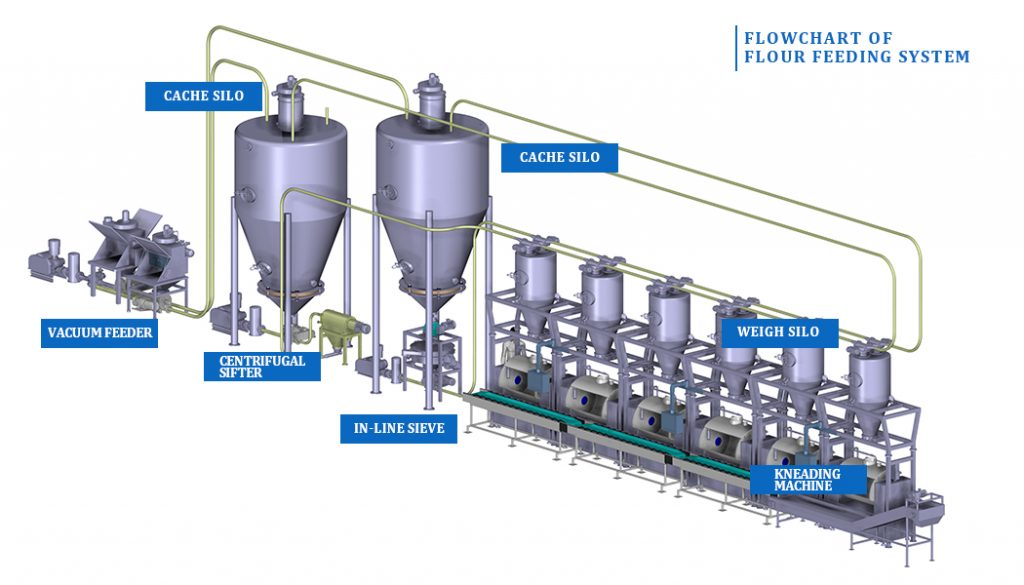
The appropriate automation level depends on the material, production process, equipment configuration, and plant requirements.
1. What Is an Automated Feeding System?
An automated Feeding system combines material-handling equipment with control components that help manage the feeding process.
A simplified process can be represented as:
Material Storage → Automated Feeding System → Flour Sieve → Material Collection
Depending on the application, the Feeding system may include hoppers, feeders, conveying equipment, sensors, valves, control panels, and other components.
The purpose is not simply to move powder from one location to another. The system can coordinate material supply with the operating status of the screening equipment.
For different powder materials, the control strategy may need to be adjusted according to their physical properties and production requirements.
2. Why Different Powders Require Different Feeding Coordination
Powder materials can behave differently during storage and transfer.
For example, flour and starch may have different flow characteristics, while sugar and protein powder may require different handling considerations. Fine powders may also respond differently to changes in humidity, bulk density, or storage conditions.
These differences can influence:
- Hopper discharge
- Feeding speed
- Material residence time
- Conveying requirements
- Cleaning intervals
- Screening conditions
- Changeover procedures
An automated Feeding system can be configured with operating parameters appropriate to the particular material and process.
The final settings should be established through actual production testing and equipment specifications rather than assuming that one control program is suitable for every powder.
3. Coordinating Feeding with Flour Sieve Operation
One important function of automation is coordinating the Feeding system with the operating condition of the flour sieve.
For example, the control sequence may be designed so that:
Sieve Ready → Feeding Starts → Material Enters Screening Stage → Feeding Adjusts or Stops When Required
Sensors or control signals can be used where appropriate to monitor equipment status or material conditions.
This can reduce the need for operators to manually coordinate every stage of the process.
The exact control logic depends on the machine configuration and the customer's production requirements.
4. Using Sensors to Monitor Material Conditions
Sensors can provide information to the control system.
Depending on the application, an automated Feeding system may monitor parameters such as:
- Hopper level
- Material presence
- Equipment status
- Motor operation
- Feeding conditions
- High- or low-level signals
For example, a level sensor can provide an indication when material in a receiving hopper reaches a predefined level.
The control system can then respond according to the programmed operating logic.
Sensors should be selected according to the material and operating environment. Fine powders can create specific challenges for detection equipment, so sensor selection and installation should be evaluated as part of the system design.
5. Adjusting Feeding Parameters for Different Powders
Different materials may require different operating parameters.
For instance, a powder with good flowability may require a different feeding arrangement from a cohesive powder that tends to accumulate in a hopper.
An automated Feeding system can allow defined parameters to be associated with different production conditions, such as:
- Feeding speed
- Operating sequence
- Start/stop timing
- Hopper level limits
- Conveying intervals
- Alarm conditions
These parameters should be established according to actual material behavior and equipment capabilities.
Automation provides the control framework, but correct parameter selection still requires process knowledge.
6. Coordinating Batch Processing
Automated Feeding systems can also be used in batch production.
A simplified batch sequence could be:
Batch Preparation → Material Loading → Feeding → Flour Sieve Screening → Collection → Batch Completion
The control system can coordinate defined steps within the batch.
For facilities processing multiple powder ingredients, batch-related control can help operators follow a repeatable process sequence.
However, automation does not replace the need for appropriate production procedures, verification, cleaning, and quality-control practices.
7. Supporting Multi-Material Production
Many food-processing facilities use the same production area for different powdered ingredients.
An automated Feeding system may support this type of operation by using different predefined operating settings for different products.
For example:
Product A → Feeding Parameters A → Flour Sieve Process A
Product B → Feeding Parameters B → Flour Sieve Process B
Product C → Feeding Parameters C → Flour Sieve Process C
The actual settings should be validated for each material.
This approach can be useful when production schedules involve frequent product changes, although shared equipment still needs appropriate cleaning and changeover procedures.
8. Managing Start-Up and Shutdown Sequences
The operating sequence at startup and shutdown can influence how material moves through a powder-processing line.
A coordinated sequence may involve:
- Checking equipment status
- Starting the flour sieve
- Confirming the screening system is ready
- Starting the Feeding system
- Introducing material
- Monitoring operation
- Stopping material feeding
- Allowing the material path to clear where appropriate
- Stopping associated equipment
The precise sequence depends on the process and machine configuration.
Automating defined startup and shutdown steps can help establish a consistent operating procedure and reduce unnecessary manual coordination.
9. Alarm and Interlock Functions
Automation can also provide alarm and interlock functions.
For example, the control system may be configured to respond to selected conditions such as:
- Hopper high level
- Hopper low level
- Motor fault
- Sieve operating fault
- Conveying fault
- Abnormal equipment status
An interlock may prevent the Feeding system from operating when a required downstream condition has not been met.
These functions should be designed according to the actual process risk and equipment architecture.
They should complement, rather than replace, operator procedures and safety systems.
10. Automated Feeding for Flour
Flour is a fine powder widely used in food processing. Its feeding behavior can be affected by moisture, particle characteristics, storage conditions, and equipment geometry.
An automated Feeding system can coordinate flour supply with the screening process by using predefined operating conditions.
A possible process is:
Flour Storage → Automated Feeding System → Flour Sieve → Screened Flour Collection
The system can incorporate suitable monitoring and control functions according to the production requirements.
The actual feeding parameters should be established based on the flour being processed and the specific flour sieve configuration.
11. Automated Feeding for Starch and Fine Powders
Starch and other fine powders may have different flow behavior from conventional flour.
Potential considerations include:
- Fine particle size
- Powder cohesiveness
- Hopper discharge
- Dust generation
- Cleaning requirements
- Material changeover
The Feeding system can be configured with suitable control functions for the specific material.
Where the powder has difficult flow behavior, mechanical or other flow-assistance measures may be considered as part of the overall equipment design.
12. Automated Feeding for Sugar and Granulated Ingredients
Sugar and other relatively free-flowing granular ingredients can have different feeding characteristics from fine flour.
The Feeding system may therefore use different operating parameters depending on:
- Particle size
- Bulk density
- Required throughput
- Hopper dimensions
- Feeding mechanism
- Screening specification
The same automation platform can potentially be configured for different production recipes or operating conditions, provided that the equipment is technically suitable for the materials involved.
13. Automated Feeding for Protein, Cocoa, and Other Food Powders
Protein powders, cocoa powder, milk powder, and similar food ingredients may require careful consideration of material handling, cleaning, and product changeover.
For these applications, an automated Feeding system can coordinate the material supply stage with the flour sieve while incorporating appropriate operating sequences.
For example:
Powder Storage → Feeding System → Flour Sieve → Collection → Downstream Processing
The control configuration can be adapted according to the material and production process.
Where several products are processed on shared equipment, sanitation and changeover procedures remain important parts of the production system.
14. Automation and Dust Management
Fine food powders can generate airborne particles during loading and transfer. Automation can help coordinate equipment operation, but it should not be considered a standalone dust-control solution.
A complete dust-management strategy may involve:
- Enclosed transfer
- Suitable sealing
- Ventilation
- Dust collection
- Grounding
- Appropriate electrical equipment
- Cleaning procedures
- Operating controls
Where combustible powder dust may present a hazard, the complete installation should be assessed according to applicable regulations, site risk assessments, and relevant safety requirements.
The appropriate automation and electrical configuration should be determined as part of the overall safety engineering process.
15. Data and Operator Monitoring
Depending on the control architecture, an automated Feeding system may provide operators with information about equipment status and process conditions.
A control interface may display items such as:
- Equipment running status
- Hopper level
- Feeding status
- Alarm information
- Operating sequence
- Selected product or recipe
Such information can help operators understand the current condition of the Feeding system and respond according to established procedures.
The level of monitoring should be matched to the complexity of the production process.
16. How Gaofu Machinery Approaches Automated Feeding
Gaofu Machinery provides Feeding system solutions for powder-processing applications and can consider automation requirements when developing equipment configurations for flour sieve processes.
Depending on the project, the system may incorporate feeding equipment, conveying components, sensors, control functions, and screening equipment.
Technical planning can consider:
- Powder characteristics
- Production capacity
- Operating mode
- Required automation level
- Flour sieve configuration
- Material changeover
- Hopper requirements
- Dust-management conditions
- Installation environment
The automation strategy can then be developed around the actual production process.
Final control parameters and equipment configurations should be confirmed through technical evaluation, commissioning, and process requirements.
Conclusion
Different powder materials can behave differently before and during flour sieve processing. An automated Feeding system can provide a control framework for coordinating material supply, equipment operation, monitoring, alarms, and defined production sequences.
For flour, starch, sugar, protein powder, cocoa powder, milk powder, and other food ingredients, the appropriate automation strategy should be based on the material's characteristics and the requirements of the production process.
The key is not simply to automate every operation, but to apply automation where it can provide practical control and coordination.
Gaofu Machinery can develop customized Feeding system solutions for powder-processing applications, with the equipment and control configuration determined according to specific materials, screening requirements, production conditions, and site requirements.