

How to Match Screen Mesh and Sieve Configuration with Different Salt Processing Requirements
Post Date: 2026-09-17
In salt processing, screen mesh selection is closely related to the particle-size range, screening objective, material condition, and required product fractions. A Rotary vibrating sieve can be configured with different screen specifications and deck arrangements to accommodate these variations.
However, there is no single screen mesh specification that fits every salt application. Coarse crystalline salt, fine salt, refined salt, and blended salt products can have different screening requirements. The sieve configuration should therefore be developed according to the actual material and process conditions.
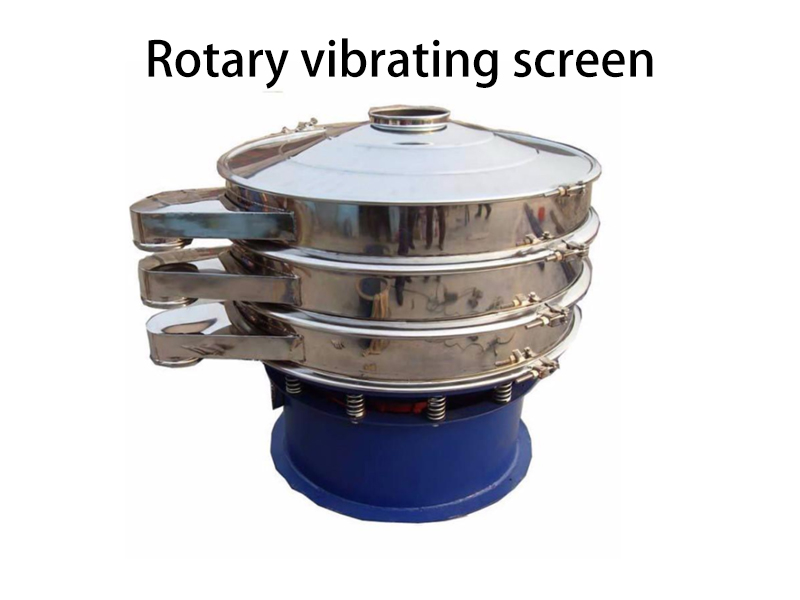
This article explains how salt processors can approach the matching of screen mesh and Rotary vibrating sieve configuration for different applications.
1. Start With the Actual Screening Objective
Before selecting a screen mesh, it is useful to identify what the sieve needs to accomplish.
Common objectives in salt processing include:
- Removing oversized particles
- Separating coarse and fine fractions
- Producing several particle-size grades
- Removing agglomerated material
- Controlling the size range before packaging
- Screening blended salt products
The same salt material may require different screen configurations depending on its position in the production process.
For example, a machine used to remove oversized particles may require a different arrangement from one designed to produce three or four commercial size fractions.
Therefore, the first question should be “What separation is required?”, rather than simply “Which mesh should be used?”
2. Understand What Screen Mesh Represents
Screen mesh is commonly used to describe the number of openings within a defined screen length. However, mesh number alone does not fully describe the actual screening performance.
Important factors can include:
- Opening size
- Wire diameter
- Opening shape
- Screen material
- Screen construction
- Effective screening area
- Particle characteristics
Two screens with the same nominal mesh number may not have identical open areas or physical characteristics if their construction differs.
For salt processing, engineers should therefore evaluate the actual opening specification and screen design together with the material.
3. Coarse Salt Screening
Coarse salt generally contains larger particles and may require relatively larger screen openings.
A typical arrangement could be:
Coarse Salt Feed → Large-Opening Screen → Qualified Coarse Salt + Oversized Material
The screen opening should be related to the target particle-size boundary rather than selected only according to the material name.
If the purpose is simply to remove unusually large particles, a single screening deck may be sufficient.
If several coarse grades are required, multiple decks can be considered.
4. Fine Salt Screening
Fine salt requires a different approach because the screen opening becomes smaller and the interaction between particles and the screen surface becomes more important.
A fine-screening configuration may involve:
- Appropriate fine screen opening
- Suitable screen tension
- Controlled feeding
- Adequate effective screening area
- Proper discharge arrangement
Very fine particles can also increase the possibility of screen loading or material accumulation under certain operating conditions.
Consequently, the screen specification should be evaluated together with material moisture, particle shape, feed rate, and the required separation.
5. Multi-Deck Configuration for Several Salt Grades
When one production line needs several particle-size fractions, a multi-deck Rotary vibrating sieve can be considered.
A simplified arrangement is:
Feed
↓
Deck 1 → Coarse Fraction
↓
Deck 2 → Medium Fraction
↓
Deck 3 → Fine Fraction
Each deck uses a different screen opening so that the material is separated progressively.
The number of decks should correspond to the number of required fractions and the available installation conditions.
Adding more decks is not automatically beneficial. The configuration should be based on the actual separation requirements.
6. Matching Screen Opening to the Target Cut Size
The target cut size is one of the most important factors when selecting a screen.
For example, if a salt processor wants to separate particles around a particular size boundary, the screen opening needs to be selected around that separation requirement.
The relationship can be considered as:
Material Size Distribution → Target Cut Size → Screen Opening → Deck Configuration
The final selection should also account for particle shape and the possibility that some particles may pass through the opening in different orientations.
For this reason, laboratory screening tests or sample evaluation can be useful for applications where the separation boundary is critical.
7. Screen Material and Salt Processing Conditions
Screen material should also be considered.
Depending on the application, factors may include:
- Corrosion resistance
- Food-contact requirements
- Mechanical strength
- Cleaning procedures
- Operating environment
- Expected service conditions
Salt can create a demanding environment for metallic components, particularly when moisture is present.
For food-processing applications, the contact material and surface requirements should be evaluated according to the applicable regulations and the customer's production standards.
8. Consider the Open Area of the Screen
Screen opening size is only one part of screen selection. The open area can also influence how much material can interact with the screening surface.
A screen with a suitable opening but an inappropriate open-area ratio may not provide the desired material distribution.
Engineers can therefore consider:
Opening Size + Wire Diameter + Open Area + Screen Area
rather than relying on mesh number alone.
The appropriate balance depends on salt particle size, feed rate, separation requirements, and the mechanical characteristics of the screen.
9. Screen Tension and Surface Condition
The screen must remain properly installed and tensioned during operation.
An improperly tensioned screen may change the effective screening conditions and can contribute to:
- Uneven material movement
- Localized loading
- Screen vibration
- Premature screen wear
- Reduced screening stability
Screen tension should therefore be treated as part of the overall sieve configuration rather than as an isolated maintenance issue.
For applications requiring frequent product changes, the screen installation method should also be considered from the beginning of equipment design.
10. Matching the Number of Decks With the Product Specification
The number of decks should reflect the required number of particle-size categories.
For example:
Two Fractions
Feed → Screen → Fine Salt + Coarse Salt
A single screening deck may be sufficient.
Three Fractions
Feed → Deck 1 → Coarse Fraction
↓ Deck 2 → Medium Fraction
↓ → Fine Fraction
Two screening decks can produce three primary fractions.
Multiple Grades
For more complex product specifications, additional decks may be considered, subject to equipment dimensions, material characteristics, capacity, and installation conditions.
This prevents the configuration from becoming unnecessarily complicated.
11. Matching Screen Configuration With Salt Moisture
Moisture is another factor that can influence screen selection.
Dry crystalline salt may move differently from salt containing higher moisture levels. Moisture can contribute to particle adhesion or agglomeration, which may change the way material interacts with the screen.
When moisture varies during production, engineers should evaluate:
- Screen opening
- Feed rate
- Material loading
- Cleaning requirements
- Screening surface condition
- Possible agglomeration
If the material condition changes significantly between production batches, a screen configuration developed for completely dry material may require adjustment.
12. Screening Agglomerated Salt
Salt can form agglomerates during storage or transportation.
In this situation, the screening objective may not simply be particle-size classification. The process may instead need to separate acceptable particles from larger agglomerated material.
A possible process is:
Salt Feed → Rotary Vibrating Sieve → Qualified Material + Oversized Agglomerates
The oversized fraction can then be handled according to the customer's process, such as separate collection or further processing.
Screen selection should consider both the normal particle size and the size of the agglomerates that need to be separated.
13. Matching Screen Configuration With Cleaning Requirements
For food-related salt processing, cleaning and product changeover can be important parts of equipment planning.
When different salt grades are processed on the same machine, the configuration can be evaluated for:
- Screen accessibility
- Contact-surface cleaning
- Residual material removal
- Screen replacement
- Inspection access
- Product changeover procedures
A configuration that meets the particle-size requirement but is difficult to clean may create operational challenges.
Therefore, screening performance and practical operation should be considered together.
14. When a Single Screen Is More Appropriate
Not every salt application requires multiple decks.
A single-deck Rotary vibrating sieve may be appropriate when the process requires:
- Oversized particle removal
- Simple two-way separation
- Basic product screening
- One defined screening boundary
A simpler configuration can make material routing easier and may reduce unnecessary equipment complexity.
The final choice should depend on the process specification rather than the number of available machine configurations.
15. When Multi-Layer Screening Can Be Considered
A multi-layer design can be considered when several particle-size fractions need to be produced simultaneously.
For example:
Raw Salt
→ Large particles
→ Medium particles
→ Fine particles
This can reduce the need for multiple separate screening machines in some production layouts.
However, multi-layer systems also require appropriate consideration of machine height, screen area, material distribution, discharge routes, and maintenance access.
16. Screen Mesh Selection Should Be Tested Against Real Material
Material names alone are not enough to determine the final screen specification.
A practical evaluation can include:
- Obtain a representative salt sample.
- Measure or estimate the particle-size distribution.
- Define the desired separation boundaries.
- Identify the required number of fractions.
- Test suitable screen openings.
- Observe material movement and separation.
- Check the screened fractions.
- Adjust the configuration if necessary.
Sample testing can be particularly useful when salt characteristics vary between suppliers, production processes, or batches.
17. Gaofu Machinery Rotary Vibrating Sieve Configuration
Gaofu Machinery provides Rotary vibrating sieve equipment for powder and granular material screening applications.
For salt-processing projects, the configuration can be considered according to:
- Required screening objective
- Salt particle-size distribution
- Target cut sizes
- Number of product fractions
- Screen opening specifications
- Number of screening decks
- Screen material requirements
- Feed conditions
- Discharge arrangements
- Cleaning and changeover requirements
The equipment can be developed around the customer's actual production process rather than relying on a single standard configuration.
For projects with specific particle-size requirements, customers can provide material information and process parameters so that the screening configuration can be evaluated accordingly.
Conclusion
Matching screen mesh with a Rotary vibrating sieve for salt processing requires more than selecting a mesh number from a standard chart. The screen opening, screen construction, effective area, deck arrangement, material condition, and required separation should be considered as a connected system.
For coarse salt, fine salt, agglomerated salt, or multi-grade products, the appropriate configuration may be different. Single-deck and multi-layer arrangements each have their own application scenarios.
By defining the target separation first and then evaluating screen specifications against actual salt characteristics, processors can develop a more suitable screening configuration for their production requirements.
Gaofu Machinery can work with customers to evaluate salt screening conditions and develop a Rotary vibrating sieve configuration based on material characteristics, product specifications, and process requirements.