

Vacuum Feeder and Sieving Machine Applications: Managing Powder Transfer Before Fine Particle Screening
Post Date: 2026-08-15
Introduction
Fine-powder screening is often only one stage within a larger material-processing workflow. Before powder reaches a sieving machine, it may need to be transferred from a hopper, storage vessel, feeding station, or upstream processing unit.
A Vacuum Feeder can provide a pneumatic conveying method for this upstream transfer stage. By connecting the material source with the screening equipment through a planned pipeline, it can help organize powder movement before fine-particle screening.
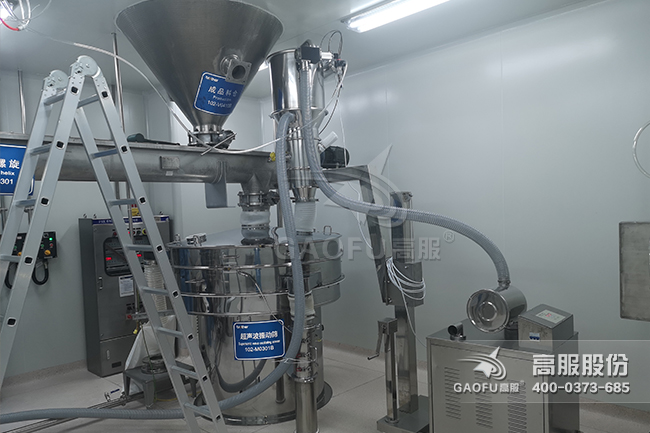
The suitability of a Vacuum Feeder depends on the material, conveying distance, required throughput, screening equipment, plant layout, and applicable operating requirements. This article explores practical application scenarios and design considerations without making universal performance claims.
1. Why Powder Transfer Matters Before Fine Screening
The condition in which powder enters a sieving machine can influence how the screening stage is arranged.
A typical process may follow:
Powder Storage → Vacuum Feeder → Conveying Line → Sieving Machine → Material Collection
The Vacuum Feeder does not perform the screening itself. Instead, it handles the transfer stage before the powder reaches the screen.
This distinction is important when designing a complete production line:
- Vacuum Feeder: material conveying
- Sieving Machine: particle separation
- Collection Equipment: receiving screened material
- Control System: coordinating the process where required
2. Applications in Flour Processing
Flour is commonly transferred between storage and screening stages during food processing.
A representative arrangement is:
Flour Hopper → Vacuum Feeder → Fine Sieving Machine → Flour Collection
Depending on the process, screening may be used to:
- Separate oversized particles
- Remove agglomerated material
- Prepare flour for subsequent processing
- Screen material before packaging
The appropriate mesh specification, feeding conditions, and conveying arrangement should be determined according to the actual flour characteristics and production requirements.
3. Starch and Powdered Ingredients
Starch, powdered sugar, protein powder, cocoa powder, and other powdered ingredients may also require conveying before screening.
A potential workflow is:
Ingredient Storage → Vacuum Feeder → Sieving Machine → Collection
For these applications, manufacturers should evaluate:
- Bulk density
- Flowability
- Moisture
- Particle size
- Required screening specification
- Cleaning requirements
Different ingredients can behave differently even when they appear similar visually, so equipment selection should be based on actual material characteristics.
4. Applications in Chemical Powder Processing
Chemical powders can require screening after storage, mixing, grinding, or another upstream process.
A typical route might be:
Chemical Material → Vacuum Feeder → Sieving Machine → Product Collection
Potential considerations include:
- Chemical compatibility
- Particle size
- Bulk density
- Abrasiveness
- Flowability
- Material temperature
- Required screening result
For combustible or hazardous powders, the complete conveying and screening installation should be evaluated according to applicable safety standards and local regulations.
5. Mineral and Industrial Powder Applications
Industrial powders may include mineral materials, ceramic powders, additives, fillers, and other dry materials.
A Vacuum Feeder can be considered when the production line requires pipeline-based transfer before screening.
For example:
Storage Vessel → Vacuum Feeder → Screening Equipment → Collection Hopper
The configuration should take into account material properties and the distance between process stages.
For abrasive powders, component selection and maintenance requirements should receive particular attention.
6. Managing Fine Powders Before Screening
Fine powders can present different conveying challenges from larger particles.
When evaluating a Vacuum Feeder for fine-powder applications, consider:
Particle Size
Very fine materials can behave differently from coarse powders during conveying.
Flowability
Cohesive powders may require a suitable material-discharge arrangement at the source.
Moisture
Moisture can affect powder flow and may contribute to agglomeration.
Bulk Density
Density influences how much material is transported during each conveying cycle.
Filter Requirements
The conveying system's filtration arrangement should correspond with the powder characteristics and operating conditions.
These factors should be evaluated before finalizing the equipment configuration.
7. Matching Powder Transfer with Fine Screening
The material-transfer stage and fine-screening stage should be designed as a connected process.
A representative workflow is:
Material Source
↓
Vacuum Feeder
↓
Conveying Pipeline
↓
Sieving Machine
↓
Fine Material Collection
The feeder should provide a suitable connection to the screening machine's inlet.
Important interface factors include:
- Inlet dimensions
- Equipment height
- Connection direction
- Feeding rate
- Material-flow path
This helps avoid treating conveying and screening as unrelated operations.
8. Choosing the Sieving Machine for Fine Screening
Different screening technologies may be appropriate for different applications.
Rotary Vibrating Sieve
A rotary vibrating sieve can be considered for fine powder screening and particle classification.
It may be integrated downstream of a Vacuum Feeder:
Vacuum Feeder → Rotary Vibrating Sieve
The final screen configuration should be determined according to the material and required separation.
Centrifugal Sifter
A centrifugal sifter can be considered for continuous powder screening applications.
Its operating principle may suit certain fine-powder processing conditions.
Ultrasonic Vibrating Screen
For selected fine-powder applications, an ultrasonic-assisted screening configuration can be considered where material and mesh requirements make it appropriate.
The complete system should be evaluated according to the specific powder and screening objective.
9. Consider Where the Powder Comes From
The source of the powder can determine how the Vacuum Feeder is incorporated into the line.
From a Storage Hopper
Hopper → Vacuum Feeder → Sieving Machine
From a Big Bag Feeding Station
Big Bag Feeding Station → Vacuum Feeder → Sieving Machine
From a Mixer
Mixer → Vacuum Feeder → Sieving Machine
From an Upstream Production Machine
Upstream Equipment → Vacuum Feeder → Sieving Machine
Each arrangement may require different connection dimensions, elevations, and material-flow conditions.
10. Plan the Transfer Route
A well-defined transfer route can make system installation and maintenance easier to evaluate.
Consider:
- Horizontal conveying distance
- Vertical conveying distance
- Pipeline bends
- Pipeline connections
- Equipment elevation
- Maintenance clearance
For example, if the sieving machine is located on an upper platform, the pipeline may need to accommodate vertical conveying.
The final route should balance process requirements with practical installation and maintenance considerations.
11. Consider the Required Production Rate
Fine screening capacity should be coordinated with upstream material supply.
A useful planning relationship is:
Material Availability → Vacuum Conveying → Screening Capacity → Collection Capacity
Evaluate:
- Required throughput
- Vacuum conveying cycle
- Screening machine capacity
- Material storage capacity
- Collection capacity
Actual throughput depends on material properties and system configuration. Therefore, nominal equipment ratings should not be treated as guaranteed production results.
12. Batch and Continuous Powder Processing
Different production modes can influence how the Vacuum Feeder and sieving machine are coordinated.
Batch Processing
The feeder may transfer a defined quantity of powder before the screening stage processes the batch.
Batch Material → Vacuum Transfer → Screening → Collection
Continuous Processing
The conveying and screening stages can be designed around an ongoing material supply.
Continuous Material Supply → Vacuum Transfer → Continuous Screening
Additional controls or buffer arrangements may be appropriate depending on the production line.
13. Managing Powder Transfer in Food Applications
For food-processing applications, powder transfer should be considered together with hygiene and cleaning requirements.
The system may need to address:
- Material-contact surfaces
- Cleaning accessibility
- Powder residue
- Product changeovers
- Filter inspection
- Screen cleaning
The appropriate hygienic design depends on the material, facility, process, and applicable regulations.
A Vacuum Feeder can be incorporated into the process, but the complete system should be evaluated rather than relying on a single equipment component to provide overall hygiene performance.
14. Powder Transfer in Chemical Applications
Chemical processing may introduce additional considerations.
Before selecting the conveying arrangement, evaluate:
- Chemical properties
- Material compatibility
- Dust characteristics
- Abrasiveness
- Temperature
- Static electricity
- Applicable safety requirements
For hazardous or combustible powders, appropriate engineering controls and compliant equipment selection are essential.
The Vacuum Feeder and sieving machine should form part of the overall safety assessment.
15. Consider Enclosed Material Transfer
A Vacuum Feeder uses a pipeline-based transfer route, which can provide a defined path between process stages.
A representative arrangement is:
Storage → Vacuum Feeder → Pipeline → Sieving Machine
This can reduce the number of open transfer operations compared with repeated manual loading.
However, actual dust containment depends on the complete installation, including seals, filters, connections, operating conditions, and powder characteristics.
16. Integrate Collection After Fine Screening
Material management should continue after the powder passes through the screen.
A complete workflow may be:
Vacuum Feeder → Fine Screening → Accepted Material → Storage or Further Processing
If oversized particles are separated:
Screening → Oversized Material → Separate Collection
Collection equipment should be considered during the original system layout to avoid creating unnecessary transfer steps after screening.
17. Plan for Product Changeovers
A facility processing multiple powders should consider how the system will be cleaned and prepared between materials.
Potential considerations include:
- Vacuum Feeder cleaning
- Pipeline inspection
- Filter cleaning or replacement
- Screen replacement
- Collection-container cleaning
- Residual material management
The specific changeover procedure depends on the materials and applicable production requirements.
18. Evaluate Automation Requirements
A Vacuum Feeder can be incorporated into a broader automated material-handling system.
Depending on the process, the control system may include:
- Automatic conveying cycles
- Material-level detection
- Start/stop sequencing
- Equipment interlocking
- Operating-status monitoring
- Alarm functions
For example, the conveying operation may be coordinated with the operating condition of the sieving machine.
The actual automation configuration should be developed according to the production process and control architecture.
19. Maintenance Considerations
Routine maintenance remains important even when material transfer is automated.
Vacuum Feeder
Inspect:
- Filters
- Seals
- Valves
- Inlet and discharge components
Conveying Pipeline
Check:
- Connections
- Sealing points
- Material accumulation
- Pipeline condition
Sieving Machine
Inspect:
- Screen mesh
- Screen frame
- Inlet
- Discharge
- Operating components
Maintenance schedules should follow the equipment manufacturer's recommendations and actual operating conditions.
20. Application-Based Selection Checklist
Before installing a Vacuum Feeder upstream of a fine-screening system, manufacturers can review:
Material
- What powder will be conveyed?
- What is its bulk density?
- How does it flow?
- Is moisture present?
- Is the material abrasive or temperature-sensitive?
Conveying
- How far must the powder travel?
- Is vertical conveying required?
- What pipeline arrangement is practical?
Screening
- What particle-size separation is required?
- Which sieving machine is appropriate?
- What feeding conditions does it require?
Production
- What throughput is required?
- Is the process batch or continuous?
- What collection capacity is needed?
Facility
- Where will the material source be located?
- Where will the sieving machine be installed?
- Is sufficient maintenance space available?
Safety and Hygiene
- What cleaning requirements apply?
- Does the material require special handling?
- Are combustible-dust considerations relevant?
- What local regulations apply?
21. Gaofu Vacuum Feeder for Powder Transfer Before Screening
The Gaofu Vacuum Feeder can be considered for powder conveying applications where pneumatic transfer is appropriate.
It can be integrated with:
- Rotary Vibrating Sieves
- Centrifugal Sifters
- Ultrasonic Vibrating Screens
- Linear Vibrating Screens
- Other customized screening equipment
Configuration can be evaluated according to:
- Powder characteristics
- Material source
- Conveying distance
- Required feeding conditions
- Fine-screening requirements
- Plant layout
- Automation objectives
This allows the material-transfer stage to be planned together with the downstream screening process.
Why Choose Gaofu Machinery?
Gaofu Machinery provides equipment for screening, conveying, filtration, and powder-processing applications.
Its product range includes:
- Vacuum Feeders
- Big Bag Feeding Stations
- Feeding Stations
- Rotary Vibrating Sieves
- Centrifugal Sifters
- Filtration Sieves
- Linear Vibrating Screens
- Ultrasonic Vibrating Screens
For powder-processing projects, equipment selection should be based on actual material characteristics, process conditions, production requirements, and applicable industry standards.
Conclusion
Managing powder transfer before fine-particle screening requires a coordinated approach to conveying, screening, collection, and process control. A Vacuum Feeder can serve as the transfer link between an upstream powder source and a downstream sieving machine, providing a pipeline-based route that can be incorporated into different production layouts.
For flour, food ingredients, chemical powders, minerals, and other dry materials, the appropriate configuration depends on particle characteristics, flowability, bulk density, conveying distance, required throughput, screening objectives, cleaning requirements, and safety conditions.
The Gaofu Vacuum Feeder can be integrated with various screening solutions according to application-specific requirements, helping manufacturers develop a structured material-transfer and fine-screening workflow without relying on one universal equipment configuration.