

Integrating Vacuum Conveying with a Sieving Machine: Practical Considerations for Powder Processing Lines
Post Date: 2026-08-15
Introduction
In powder-processing plants, conveying and screening are often positioned at different points within the production workflow. Connecting these stages effectively requires more than installing a transfer device between two machines. Material properties, conveying conditions, equipment interfaces, production capacity, cleaning requirements, and plant layout all influence the final system design.
A Vacuum Feeder can provide a pipeline-based conveying method for transferring suitable powders toward a downstream sieving machine. When these two functions are planned as a coordinated process, manufacturers can establish a clearer material route from storage or upstream processing to screening and collection.
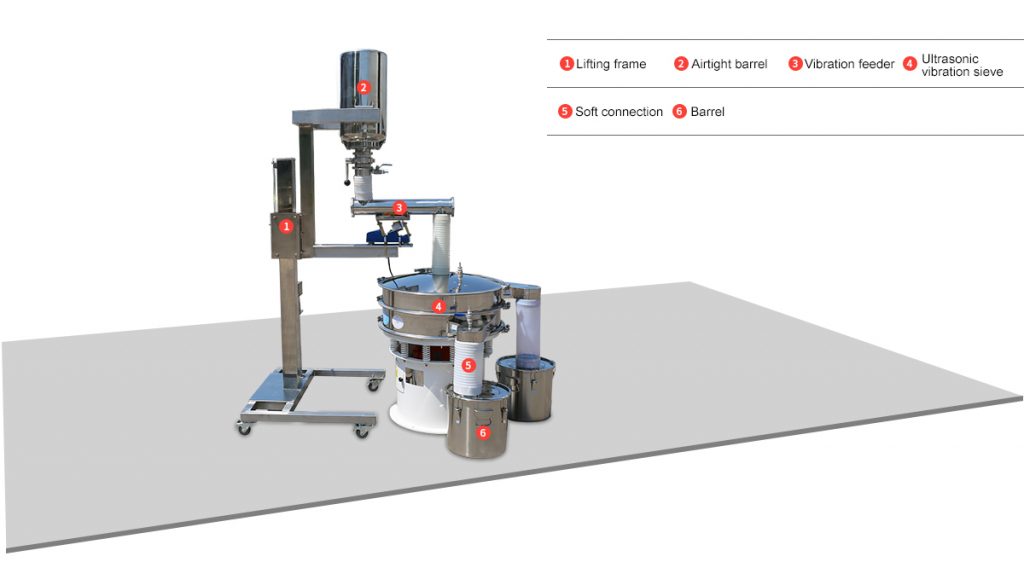
This article examines practical considerations when integrating vacuum conveying with screening equipment, with an emphasis on application-specific system planning rather than universal performance claims.
1. Start with the Complete Powder-Processing Route
The first step is to map the entire production sequence.
A typical arrangement may be:
Raw Material → Storage → Vacuum Conveying → Sieving → Collection → Further Processing
In this structure:
- The storage equipment holds the raw material.
- The Vacuum Feeder transfers the powder.
- The conveying pipeline connects different process points.
- The sieving machine performs particle separation.
- Collection equipment receives the screened material.
This approach helps define the role of every component before equipment specifications are finalized.
2. Define What the Sieving Stage Needs
The conveying system should be designed around the requirements of the downstream screening operation.
First establish the purpose of screening:
- Removing oversized particles
- Separating particle-size fractions
- Preparing powder for another process
- Screening before packaging
- Removing unwanted agglomerates where applicable
The screening objective influences the choice of machine, screen configuration, feeding arrangement, and material-flow conditions.
A Vacuum Feeder should therefore be evaluated together with the selected sieving machine.
3. Understand the Difference Between Conveying and Screening
Although these processes are connected, they perform different functions.
Vacuum Feeder
The Vacuum Feeder is primarily responsible for material transfer.
It can move suitable powders from one location to another through a conveying pipeline.
Sieving Machine
The sieving machine is responsible for particle separation according to the selected screen and process configuration.
Keeping these functions clearly defined helps prevent incorrect expectations about what either machine is designed to accomplish.
4. Evaluate the Powder Before Designing the System
Powder characteristics can significantly influence vacuum conveying.
Important parameters include:
Bulk Density
The density of the material can affect conveying conditions and material throughput.
Particle Size
Fine powders, coarse particles, and mixed-size materials may behave differently during transfer.
Flowability
Powders with different flow characteristics may require different arrangements at the material source.
Moisture
Moisture can affect flowability and may contribute to agglomeration in some materials.
Abrasiveness
Abrasive materials may require attention to wear and material-contact components.
Temperature
The material's operating temperature should be considered when selecting equipment and associated components.
5. Select the Appropriate Material Source
Vacuum conveying can be integrated with different upstream loading arrangements.
Hopper
A hopper-to-screening workflow may be:
Hopper → Vacuum Feeder → Sieving Machine
This arrangement can be considered when the powder is already stored in a process hopper.
Big Bag Feeding Station
For bulk powder handling:
Big Bag → Big Bag Feeding Station → Vacuum Feeder → Sieving Machine
This arrangement connects bulk-bag unloading with downstream screening.
Upstream Processing Equipment
A mixer, grinder, or other processing machine can also potentially feed the Vacuum Feeder:
Upstream Equipment → Vacuum Feeder → Sieving Machine
The actual connection should be designed according to the material and equipment interfaces.
6. Plan the Conveying Pipeline
Pipeline design is one of the practical aspects of integrating vacuum conveying with screening.
Consider:
- Pipeline length
- Pipeline diameter
- Number of bends
- Horizontal sections
- Vertical sections
- Connection points
- Installation height
The objective is to establish a practical route between the material source and the sieving machine.
The pipeline should also remain accessible for inspection and maintenance.
7. Match Feeding Conditions to the Sieving Machine
The connection between the Vacuum Feeder and sieving machine deserves particular attention.
Evaluate:
- Screen inlet dimensions
- Feeding height
- Material entry direction
- Required material supply rate
- Equipment connection structure
The feeding arrangement should correspond with the screening equipment's design.
A representative process is:
Vacuum Feeder → Conveying Pipeline → Sieving Machine Inlet
This creates a defined transition between conveying and screening.
8. Consider Different Screening Equipment
Vacuum conveying can potentially be integrated with several types of screening equipment.
Rotary Vibrating Sieve
A rotary vibrating sieve can be considered for powder screening and particle classification.
A typical arrangement is:
Powder Source → Vacuum Feeder → Rotary Vibrating Sieve → Collection
Centrifugal Sifter
A centrifugal sifter can be considered for continuous powder screening applications where its operating principle matches the material.
Linear Vibrating Screen
A linear vibrating screen can be considered for different bulk-material screening applications.
The selected Vacuum Feeder configuration should correspond with the inlet and material supply requirements of the chosen screen.
9. Coordinate Conveying and Screening Capacity
The conveying and screening stages should be evaluated as one production system.
Consider:
Material Availability → Conveying Rate → Screening Capacity → Collection Capacity
Important information may include:
- Required production throughput
- Vacuum conveying cycle
- Screening machine processing capacity
- Storage or buffer capacity
- Operating schedule
A higher nominal capacity at one stage does not automatically mean the complete line will achieve the same throughput.
Actual results depend on material and operating conditions.
10. Think About Intermittent and Continuous Processing
Not every production line operates in the same way.
Intermittent Processing
For batch production, the Vacuum Feeder may transfer material in defined cycles.
The workflow may be:
Batch Preparation → Vacuum Transfer → Screening → Collection
Continuous Processing
For continuous production, the conveying and screening stages need to be coordinated around ongoing material supply.
The system may include additional control or buffer arrangements depending on the process.
Understanding the production mode is therefore important when selecting the conveying configuration.
11. Consider Powder Transfer Between Different Elevations
Some factories require material to move vertically between floors.
For example:
Ground-Level Storage → Vacuum Feeder → Upper-Level Sieving Machine
In this case, evaluate:
- Vertical conveying distance
- Pipeline routing
- Equipment installation height
- Maintenance access
- Structural considerations
The complete conveying route should be planned before final equipment placement.
12. Consider Enclosed Powder Handling
A pipeline-based vacuum conveying system can provide an enclosed route between equipment.
This may be considered where manufacturers want to reduce open material-transfer points.
A representative arrangement is:
Storage → Vacuum Feeder → Enclosed Pipeline → Sieving Machine
However, the actual environmental and dust-control performance depends on the complete system, including:
- Sealing
- Pipeline connections
- Filters
- Material properties
- Operating conditions
Therefore, the Vacuum Feeder should be viewed as one component of the overall powder-handling strategy.
13. Food Processing: Hygiene and Cleaning
When integrating vacuum conveying into food powder processing, cleaning and material-contact considerations should be included in the design.
Potential applications include:
- Flour
- Starch
- Sugar powder
- Protein powder
- Cocoa powder
- Other dry food ingredients
The system should consider:
Cleaning Accessibility
Components requiring inspection or cleaning should be accessible.
Material-Contact Surfaces
Product-contact materials should be selected according to the intended application and applicable requirements.
Powder Residue
The layout should consider areas where residual powder could accumulate.
Product Changeovers
Facilities processing multiple ingredients should establish suitable cleaning and changeover procedures.
14. Chemical and Industrial Powder Applications
Chemical and industrial powders can have significantly different characteristics.
The system evaluation may need to include:
- Chemical compatibility
- Bulk density
- Particle size
- Abrasiveness
- Moisture
- Temperature
- Flowability
For combustible or hazardous powders, additional safety considerations may apply.
The Vacuum Feeder, sieving machine, electrical components, grounding, and related equipment should be evaluated as a complete installation in accordance with applicable regulations and safety standards.
15. Design the Collection Stage
The screening process does not end at the screen outlet.
The downstream collection arrangement should also be considered.
A complete workflow may be:
Vacuum Feeder → Sieving Machine → Fine Material Collection → Further Processing
Where oversized material is separated:
Sieving Machine → Oversized Material Collection
The collection containers, hoppers, or downstream conveying equipment should be compatible with the screening configuration.
16. Plan for Material Changeovers
For facilities processing different powders, changing from one material to another can affect the system design.
Consider:
- Cleaning of the Vacuum Feeder
- Pipeline cleaning
- Filter inspection
- Screen replacement
- Residual material
- Collection equipment
- Changeover procedures
The appropriate procedure depends on the materials and production requirements.
For food applications, cleaning and sanitation procedures should follow the facility's applicable requirements.
17. Integrate the Control System
The Vacuum Feeder and sieving machine can be included in a broader production-control strategy.
Depending on the application, manufacturers may consider:
- Start/stop sequencing
- Material-level monitoring
- Feeding-cycle control
- Equipment interlocking
- Alarm functions
For example, feeding operation can be coordinated with the operating state of the downstream screening equipment.
The appropriate automation level depends on the process and selected control architecture.
18. Plan Maintenance Around the Complete System
Integrated equipment requires a coordinated maintenance approach.
Vacuum Feeder
Inspect:
- Filters
- Seals
- Valves
- Inlet and discharge areas
Pipeline
Inspect:
- Connections
- Sealing points
- Material accumulation
- Physical condition
Sieving Machine
Inspect:
- Screen mesh
- Screen frame
- Inlet
- Discharge outlets
- Operating components
Maintenance schedules should follow manufacturer recommendations and be adapted to actual material and operating conditions.
19. A Practical Integration Checklist
Before integrating vacuum conveying with a sieving machine, evaluate:
Material
- What powder is being transferred?
- What is its bulk density?
- How does it flow?
- Does it contain moisture?
- Is it abrasive or temperature-sensitive?
Conveying
- What distance must the material travel?
- Are vertical sections required?
- How many bends are necessary?
- What conveying rate is needed?
Screening
- What particle separation is required?
- Which sieving machine is appropriate?
- What inlet arrangement does it require?
Layout
- Where will the material source be located?
- Where will the screen be installed?
- Is sufficient maintenance space available?
Hygiene and Safety
- What cleaning requirements apply?
- Does the powder require special handling?
- Are combustible-dust considerations relevant?
- Which local regulations apply?
Automation
- Is automatic feeding required?
- Should conveying and screening be interlocked?
- Is material-level monitoring necessary?
20. Gaofu Vacuum Feeder for Integrated Powder Processing
The Gaofu Vacuum Feeder can be considered as part of integrated powder conveying and screening systems where pneumatic transfer is suitable.
It can be connected with:
- Rotary Vibrating Sieves
- Centrifugal Sifters
- Linear Vibrating Screens
- Customized screening equipment
System planning can take into account:
- Material characteristics
- Conveying distance
- Feeding requirements
- Screening objectives
- Pipeline layout
- Production mode
- Automation requirements
This application-oriented approach allows the conveying stage to be evaluated together with the downstream screening process.
Why Choose Gaofu Machinery?
Gaofu Machinery provides equipment for screening, conveying, filtration, and powder processing applications.
Its product range includes:
- Vacuum Feeders
- Big Bag Feeding Stations
- Feeding Stations
- Rotary Vibrating Sieves
- Centrifugal Sifters
- Filtration Sieves
- Linear Vibrating Screens
- Ultrasonic Vibrating Screens
For each project, equipment selection should be based on the material, process conditions, production requirements, and applicable industry standards.
Conclusion
Integrating vacuum conveying with a sieving machine requires coordinated planning of the entire powder-processing route. The Vacuum Feeder provides the transfer function, while the sieving machine performs particle separation. Between these stages, pipeline routing, inlet configuration, feeding conditions, and capacity matching all influence the system design.
For food, chemical, and industrial powder applications, manufacturers should also consider material properties, hygiene, cleaning, safety, maintenance, automation, and product changeovers.
The Gaofu Vacuum Feeder can be integrated with different screening machines according to application requirements, offering a configurable approach to connecting powder transfer with screening operations in modern processing lines.