

Customizing a Vibrating Screen Flour Sifter for Specialized and Gluten-Free Flour Production
Post Date: 2026-06-10
The global food manufacturing industry is experiencing a significant shift in consumer demand. The market for specialized and gluten-free flours—such as almond, coconut, rice, chickpea, potato, and oat flours—continues to expand rapidly. For food processors, this diversification introduces highly profitable product lines, but it also presents unique material handling challenges.
Standard wheat flour has highly predictable physical behavior during processing. In contrast, alternative and specialized flours feature wildly divergent bulk densities, varying oil and fat contents, and a high susceptibility to static electricity.
Processing these unique materials requires moving away from standard, off-the-shelf machinery configurations. To maintain yield consistency and meet safety requirements, facilities must utilize an engineered vibrating screen tailored specifically to these non-traditional powders—a requirement achieved by customizing the industrial Rotary Vibrating Sieve.
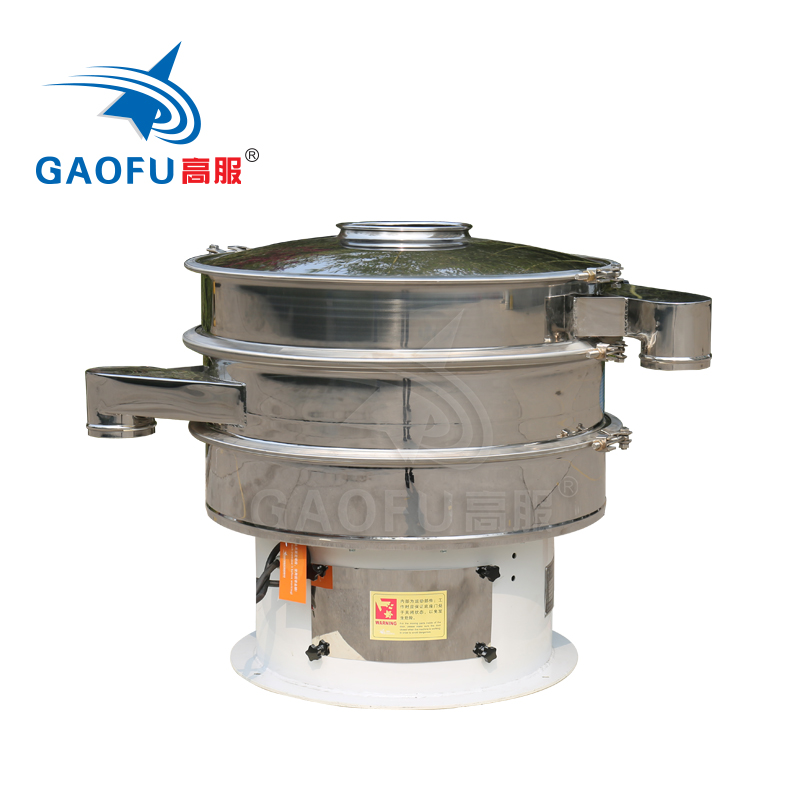
As shown in the equipment engineering assembly above, specialized fine-powder processing often requires an integrated external control system. This auxiliary control unit drives specialized anti-blinding components within the sieve decks, managing cohesive or statically charged flours that would otherwise clog standard screening surfaces.
Technical Challenges of Alternative Flour Sifting
When a factory attempts to use a conventional flour sifter configuration for alternative flours, three primary operational bottlenecks typically occur:
- Screen Blinding due to High Oil/Fat Content: Flours derived from nuts (like almond) or seeds possess a high percentage of natural lipids. Under continuous high-frequency vibration, these oils can exude slightly, causing the fine powder to agglomerate and form a paste that skins over the mesh apertures, chokes off the flow, and stops production.
- Static Electrostatic Attraction: Lighter grain and root flours, such as starch-heavy potato or rice flour, generate high static charges during pneumatic conveying. This causes particles to repel each other but adhere tenaciously to the stainless steel screen frames, reducing the effective open area of the sieve.
- Low Bulk Density Floatation: Extremely light powders tend to float or hover above the screen deck rather than passing through, requiring highly specific motor phase angles to force the material into continuous contact with the mesh cloth.
Customization Strategies for the Rotary Vibrating Sieve
To adapt a Rotary Vibrating Sieve for specialized and gluten-free applications, mechanical engineers focus on three primary customization vectors:
1. Ultrasonic Mesh De-Blinding Integration
Traditional rubber or silicone bouncing balls work well for clearing dry wheat flour by physically striking the underside of the screen. However, for high-fat almond flour or ultra-fine rice flour, bouncing balls can compact the sticky powder further into the mesh openings.
Engineering Upgrade: Replacing or supplementing mechanical bouncing balls with an Ultrasonic De-Blinding System is highly effective for specialized flours.
An integrated generator transmits a continuous, low-amplitude high-frequency ultrasonic wave (typically around 36 kHz) directly across the wire mesh cloth. This micro-vibration breaks the surface tension and static bonds between cohesive particles, allowing alternative flours to flow through fine apertures cleanly without clogging the system.
2. Specialized Surface Coatings and Material Selection
To minimize material adhesion when processing cohesive non-wheat flours, the internal product-contact zones require precise surface engineering:
- Teflon (PTFE) Mirror Coating: For exceptionally sticky or high-moisture ingredient lines, internal stainless steel walls and discharge chutes can be coated with food-grade PTFE to prevent product caking.
- Polishing Standards: All contact surfaces must be polished to a minimum of Ra < 0.4 µm. This smooth finish eliminates microscopic surface friction, enabling efficient material transit.
3. Precision Allergen Isolation Engineering
For facilities producing certified gluten-free products on lines that also handle wheat, preventing cross-contact is a critical food safety priority. If cross-contamination occurs, entire production batches must be scrapped.
| Equipment Component | Standard Wheat Configuration | Customized Allergen/Gluten-Free Configuration |
| Sealing Gaskets | Standard industrial silicone strips. | Co-molded, metal-detectable food-grade silicone or Viton seals. |
| Frame Disassembly | Bolted flanges or standard locknuts. | Tool-free, quick-release V-band toggle clamps for rapid, complete sanitation. |
| Screen Fabrication | Standard epoxy-bonded mesh edges. | Continuously welded or mechanically tensioned, glue-free sanitary screen rings to eliminate chemical cross-contamination risk. |
Conclusion
Successfully scaling up specialized and gluten-free flour production requires a thorough analysis of how alternative powders behave under mechanical forces. By modifying the Rotary Vibrating Sieve with ultrasonic clearing systems, specialized non-stick surface finishes, and high-sanitation sealing systems, processing facilities can ensure consistent throughput, protect product purity, and reliably meet rigorous food safety standards.
About Gaofu
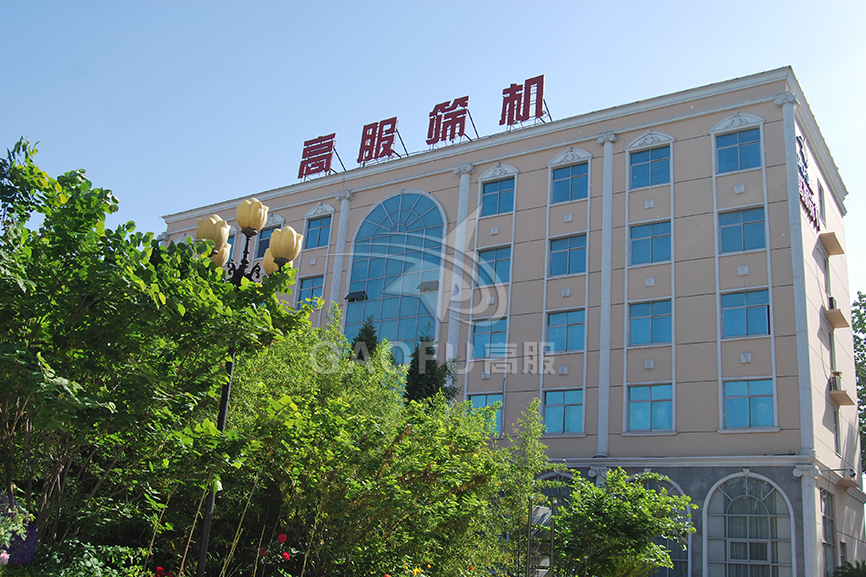
Xinxiang Gaofu Machinery Co., Ltd. was founded in the 1980s. After more than 40 years of development, it has become a "National Specialized and Innovative Small Giant Enterprise", a "National Green Factory", a "National High-tech Enterprise", a "National Intellectual Property Advantage Enterprise", and the "President Unit of the Vibration Association". Meanwhile, it has been designated as the "Henan Provincial Industrial Design Center", the "Henan Provincial Engineering Technology Research Center for Intelligent Online Screening System", and the "Xinxiang City Engineering Technology Research Center for Fine Screening". It has successfully applied for more than 500 patents, including invention, utility model and design patents, and has won the "Science and Technology Achievement Award issued by the Ministry of Industry and Information Technology". It has also participated in the drafting and formulation of 4 "National Standards".
Gaofu's product line covers multiple series and hundreds of varieties of equipment, including vibrating screening equipment, conveying equipment, coal crushing equipment, filtration equipment, and material handling automation systems. Main products include vibrating screens, screening machines, vibrating separators, rotary vibrating screens, ultrasonic vibrating screens, linear screens, air classifiers, gyratory screens, roller screens, dewatering screens, bar screens, vacuum feeders, dust-free feeding stations, ton bag feeding stations, feeding systems, automatic powder feeding systems, automatic slag discharge filters, blade filters, clay filters, toothed roller crushers, coal crushers, and other equipment. These products are widely used in food, pharmaceutical, chemical, metallurgical, building materials, mining, thermal power, environmental protection, and many other industries, earning the trust and praise of over 10,000 customers worldwide.
Gaofu's products not only sell well in Greater China, but are also exported to more than 100 countries and regions, including Russia, Canada, the United States, New Zealand, Japan, Brazil, and South Africa. The company is committed to the mission of "improving material quality and efficiency to meet customer needs" and will accompany its customers all the way to achieve harmonious win-win results. Currently, it has become a cooperative supplier for many Fortune Global 500 companies, including CNPC, Sinopec, Sinochem Group, China Resources Group, Sinopharm Group, COFCO Group, China National Building Materials Group, China Aerospace Science and Technology Corporation, and Jinchuan Group. Gaofu Machinery – the world's number one seller of vibrating screens. In May 2024, Frost & Sullivan, an internationally authoritative consulting firm, awarded it a market position confirmation certificate based on its research on the global vibrating screen market and calculated according to global vibrating screen sales in 2023.