

Enhancing Hygiene Standards in Bulk Protein Powder Handling: Design Features and Operational Benefits of Modern Bag Dumping Feeding Stations
Post Date: 2026-10-29
Maintaining uncompromising hygiene standards during raw material intake is a core priority for manufacturers of dairy-derived and plant-based protein powders. Raw ingredient intake points—where bulk bags are opened and emptied—represent one of the most vulnerable locations for environmental exposure, microbial contamination, and cross-contact.
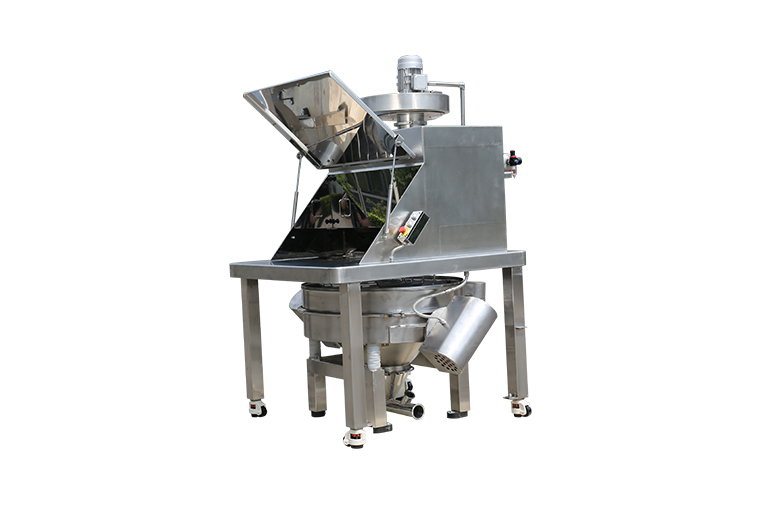
The Gaofu feeding station is engineered specifically as a primary sanitary barrier, providing structural features that streamline cleaning, prevent foreign matter ingress, and uphold stringent quality assurance protocols across hygienic food processing facilities.
Key Sanitary Design Principles
Conventional intake hoppers often harbor structural crevices, flat ledges, or non-food-grade gaskets that trap organic residues, making effective sanitation difficult. The Gaofu feeding station addresses these vulnerabilities through specialized hygienic engineering:
- Hygienic Corner Radii and Smooth Polishing: All internal hopper transitions feature generous continuous radii ($\ge 6.35\text{ mm}$), eliminating $90^\circ$ sharp corners where moisture or protein deposits can collect. Product-contact surfaces are precision-polished to $R_a \le 0.4\ \mu\text{m}$, creating a smooth finish that minimizes powder adhesion.
- Crevice-Free, Fully Welded Joints: Internal seams undergo continuous TIG welding, grinding, and flush polishing matching the base metal. Stitch welds, lap joints, and exposed internal threads are excluded from the design to remove potential harborages for bacteria such as Listeria or Salmonella.
- FDA-Compliant Hygienic Seals: All door seals, filter head gaskets, and discharge sleeve interfaces utilize food-grade, non-porous elastomers (such as FDA 21 CFR 177.2600 compliant silicone or EPDM). Quick-release tri-clamp couplings replace threaded hardware on inspection ports for rapid disassembly.
Operational Hygiene Benefits Across Processing Cycles
Integrating a sanitary feeding station into a bulk powder intake line improves operational hygiene across three distinct phases of operation:
[Raw Bag Intake] ➔ [Containment & Sifting] ➔ [CIP / Washdown Sanitation]
  • Sealed door hatch     • Negative-pressure fan   • Fully sloped internal surfaces
  • Ergonomic tray        • Integrated sieve        • Quick-release filter removal
- Inbound Contamination Prevention: Before raw powder drops into downstream blenders or pneumatic lines, an integrated mesh screen catches oversized agglomerates, packaging strings, or accidental paper fibers from outer bag layers.
- Controlled Cleaning and Washdown: Built with self-draining sloped exterior and interior surfaces ($3^\circ$ to $5^\circ$ slope), liquid washdown fluids drain completely without pooling during wet sanitation routines.
- Rapid Tool-Free Maintenance: Cartridge filters and internal sifting screens can be accessed and removed without hand tools, drastically reducing line changeover downtime and ensuring thorough verification during swab testing.
Summary of Technical Specifications for Food-Grade Applications
| Engineering Parameter | Hygienic Standard Specification |
| Primary Material | AISI 304 or AISI 316L Stainless Steel |
| Internal Surface Finish | $R_a \le 0.4\ \mu\text{m}$ ($16\ \mu\text{in}$) mirror polish / electropolished options |
| Sanitary Compliance | Designed in accordance with 3-A Sanitary Standards & EHEDG guidelines |
| Filter Sanitation | Quick-change food-grade PTFE membrane cartridges with stainless cores |
| Fastener Style | External hygienic dome nuts; no exposed internal threads |
Elevating Quality Assurance in Powder Production
By upgrading from open hoppers to an integrated, sanitary Gaofu feeding station, food processors strengthen their Hazard Analysis Critical Control Point (HACCP) programs. The equipment seals the material entry point, protects product integrity, and facilitates reliable sanitation procedures—helping processing facilities meet modern food safety expectations.