

Grading Mash and Crumble Feeds: Multi-Deck Separation with a Rotary Vibro Separator
Post Date: 2026-10-16
Animal-feed production often involves materials with different particle-size distributions. Mash feeds may contain a mixture of fine and coarse ingredients, while crumble feeds consist of broken or processed pellets with a range of particle sizes. When a production line requires these materials to be divided into defined fractions, a Rotary Vibro Separator, also known as a Rotary Vibrating Sieve, can provide a mechanical screening stage for particle-size classification.
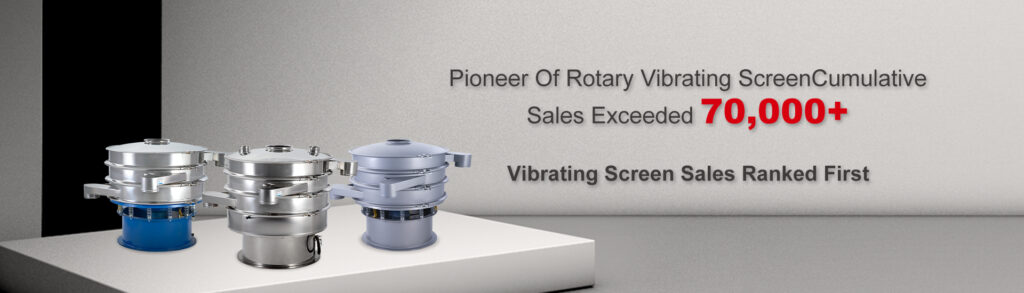
Multi-deck screening allows several size fractions to be separated within one screening unit. Instead of treating the entire material stream as a single product, the machine can direct different particle ranges toward separate discharge outlets according to the selected screen openings.
For feed manufacturers, the value of this approach lies in establishing a controlled classification step that can be adapted to the product specification. The exact screen arrangement, aperture, and operating conditions should be determined according to the material being processed and verified through representative testing where necessary.
1. Mash and Crumble Have Different Screening Requirements
Mash feed is generally a mixture of particles rather than a uniform granular product. Depending on its formulation, it may contain ground grains, protein sources, mineral components, additives, and other ingredients.
Crumble feed, meanwhile, is produced by processing pellets into smaller pieces. The resulting stream may contain:
- Desired crumble particles
- Smaller crumble particles
- Fine particles
- Oversized pieces
- Irregular fragments
Because these materials have different physical characteristics, the same screening configuration should not automatically be applied to both.
The screening objective should first be defined.
For mash feed, the objective may involve separating coarse and fine fractions. For crumble feed, the focus may instead be on classifying particles into specified size ranges or removing material outside the intended product specification.
2. What Multi-Deck Screening Means
A multi-deck Rotary Vibro Separator contains more than one screening surface, with each deck using a selected screen opening.
Material passes through the screening decks in sequence.
A simplified arrangement can be represented as:
Feed Material
↓
Upper Screen
→ Oversize Fraction A
↓
Middle Screen
→ Oversize Fraction B
↓
Lower Screen
→ Fine Fraction
This arrangement can produce multiple fractions from one incoming material stream.
The exact number of decks and apertures depends on the desired classification. Gaofu's published Rotary Vibrating Sieve information describes configurations with multiple screen layers, including arrangements of up to five layers for suitable applications.
More decks do not inherently mean better classification. Each additional deck should have a defined purpose within the product specification.
3. Why Use Multiple Screen Openings?
A single screen opening can divide material into two basic fractions:
Retained Material + Passing Material
When a product requires several size ranges, multiple screen openings can provide a more practical arrangement.
For example, a crumble-feed specification might require three categories:
- Coarse crumble
- Acceptable crumble
- Fine material
A two-deck configuration could potentially produce these fractions:
Deck 1: retains coarse material
Deck 2: separates acceptable crumble from fines
This allows the classification process to occur within one machine rather than requiring several independent screening units.
The final configuration should be based on the actual particle-size distribution and required product fractions.
4. Designing a Multi-Deck System for Mash Feed
Mash feed can contain particles of different sizes because of variations in raw materials and grinding conditions.
If classification is required, a multi-deck Rotary Vibro Separator can be configured to divide the material according to selected size ranges.
A possible process is:
Mixed Mash Feed → Multi-Deck Screening → Coarse Fraction + Main Fraction + Fine Fraction
The appropriate screen openings depend on the feed specification.
For example, if a manufacturer wants to distinguish coarse particles from the main mash fraction, the first screen can establish the upper cut.
A second screen can then create a lower cut if the production process requires separation of fines.
The screening specification should be determined from actual material testing rather than simply selecting standard apertures.
5. Designing a Multi-Deck System for Crumble Feed
Crumble feed presents a different classification challenge.
The material has already undergone size reduction from pellets, so the resulting particles can have irregular shapes and different dimensions.
A screening system may be used to separate:
Oversized Crumbles → Target Crumble → Fines
The upper deck can retain larger pieces, while subsequent decks separate the smaller material.
The objective is not necessarily to remove every particle that differs slightly in size. Instead, the screen specification should reflect the manufacturer's defined product range.
This can help establish a more consistent finished-material classification process before storage or packaging.
6. Screen Aperture Determines the Classification Cut
The opening of each screen determines which particles have an opportunity to pass through that deck.
When selecting a multi-deck arrangement, manufacturers should establish the desired particle-size boundaries first.
Important considerations include:
- Target particle dimensions
- Particle shape
- Product specification
- Desired number of fractions
- Acceptable fines
- Acceptable oversize
- Material flow characteristics
A screen aperture should not be interpreted as a guarantee that every particle below that nominal dimension will pass immediately.
Particle orientation, shape, moisture, loading, and screen condition can all influence actual separation.
Therefore, screening results should be verified with representative samples.
7. Particle Shape Matters in Crumble Classification
Two particles with similar measured dimensions may behave differently on a vibrating screen if their shapes are different.
A rounded particle may roll across the screen, while an irregular crumble may orient itself differently before reaching an opening.
This means that a simple dimensional specification may not fully predict screening behavior.
When configuring a Rotary Vibro Separator for crumble feed, manufacturers should consider:
- Particle geometry
- Length-to-width ratio
- Irregular fragments
- Particle strength
- Surface characteristics
- Bulk density
Testing with the actual crumble product can provide more useful information than relying solely on theoretical particle-size calculations.
8. Multi-Deck Screening and Material Distribution
Each screen deck needs sufficient opportunity to interact with the material.
If material enters the machine unevenly, one portion of the screen may become more heavily loaded than another.
This can affect the consistency of separation across the deck.
A suitable feed arrangement should encourage the incoming material to spread across the available screening surface.
Operators should observe:
- Feed inlet position
- Feed rate
- Material distribution
- Accumulation
- Discharge flow
- Changes between production batches
When the material distribution is stable, the screening results are generally easier to monitor and compare.
9. Avoid Overloading the Screening Surface
A multi-deck machine has a defined screening area.
If the feed rate is increased beyond the conditions for which the configuration was developed, material may pass through the machine with less opportunity for effective classification.
Possible signs include:
- Increased carryover of off-size particles
- Uneven discharge
- Material accumulation
- Changes in fraction ratios
- Reduced screening consistency
Capacity should therefore be evaluated together with the desired separation, not considered independently.
Gaofu's published equipment information provides different machine sizes and application capacities, but actual throughput varies with material characteristics, screen configuration, and process conditions.
For mash and crumble feed, representative material testing can help establish a practical operating range.
10. The Importance of Deck Sequence
The sequence of screen apertures is an important part of multi-deck design.
In a conventional arrangement, larger openings are often positioned above smaller openings.
For example:
Upper Deck: Larger Opening
Lower Deck: Smaller Opening
This allows larger particles to be retained earlier while smaller particles continue toward the lower deck.
However, the exact arrangement should be determined by the intended fractions and machine design.
The screen sequence should provide a logical progression from the incoming particle-size distribution toward the desired product categories.
11. Separating Fines From Crumble Feed
Fine material can occur naturally in crumble-feed production.
The quantity depends on formulation, pellet production, crushing conditions, and subsequent handling.
A lower screen deck can be used to separate particles below a defined size threshold.
The separated fines can then be directed to an appropriate process route according to the manufacturer's formulation and quality procedures.
Importantly, screening does not determine whether a separated fraction is suitable for reuse. Any recycling decision should be based on the product formulation, quality requirements, and applicable procedures.
12. Classifying Mash Without Changing Its Composition
A screening machine performs physical separation.
It does not alter the chemical composition of the material.
When a mash stream is divided into fractions, each fraction may have a different proportion of ingredients because the ingredients themselves may have different particle sizes.
This can be important when designing a classification process.
If particle-size separation changes the distribution of formulation components between fractions, the manufacturer should assess whether the resulting fractions remain appropriate for their intended use.
Screening should therefore be considered as part of the overall feed-production design rather than an isolated mechanical operation.
13. Using Multi-Deck Screening Before Packaging
For feed products that require size classification before packaging, the Rotary Vibro Separator can be positioned downstream of the relevant production stage.
A possible arrangement is:
Feed Production → Cooling / Conditioning → Multi-Deck Vibro Separation → Fraction Collection → Packaging
The screening stage can provide a final physical classification checkpoint.
For crumble products, this may help separate coarse and fine material according to the established specification.
For suitable mash applications, it may divide the material into defined particle-size ranges before subsequent processing.
The appropriate position depends on the purpose of the screening operation and the characteristics of the material.
14. Screen Cleaning in Multi-Deck Applications
Multiple screen decks introduce several mesh surfaces that may require inspection and cleaning.
If particles accumulate in the openings, the effective screening area can decrease.
For materials where aperture obstruction is a concern, suitable screen-cleaning arrangements may be considered.
Depending on the machine and material, cleaning systems can include mechanical cleaning components such as bouncing balls beneath the screen.
The cleaning method should be selected according to the mesh and material.
It should not be assumed that a single cleaning arrangement will be appropriate for every mash or crumble application.
15. Maintenance of Multiple Screen Decks
A multi-deck machine requires attention to each screening surface.
Routine checks can include:
- Mesh integrity
- Screen tension or installation
- Material accumulation
- Gasket condition
- Cleaning components
- Discharge openings
- Fasteners
- Vibration components
A damaged upper screen can affect the material reaching the lower decks.
Likewise, an obstructed lower screen can change the proportion of the fine fraction.
Maintaining each deck is therefore important for preserving the intended classification sequence.
16. Match the Screening Process to Product Specifications
Different feed products may have different size requirements.
For this reason, the classification process should begin with the finished-product specification.
A useful specification may define:
| Parameter | Example consideration |
|---|---|
| Product type | Mash or crumble |
| Target size | Defined by the product specification |
| Coarse limit | Maximum desired particle size |
| Fine limit | Minimum desired particle size |
| Number of fractions | Based on product requirements |
| Throughput | Required production rate |
| Screen configuration | Number and type of decks |
| Acceptance criteria | Defined quality limits |
This provides a clearer basis for machine configuration.
The goal is not simply to obtain several fractions. The goal is to produce fractions that correspond to a meaningful production or quality requirement.
17. Multi-Deck Classification Can Support Product Segregation
When different particle-size fractions have different intended uses, multi-deck screening can provide separate discharge streams.
For example:
Coarse Fraction → Reprocessing
Target Fraction → Finished Product
Fine Fraction → Approved Reuse or Separate Handling
The actual route depends on the feed manufacturer's process.
This arrangement can reduce the need to manually sort different particle sizes and provides a defined mechanical separation point.
However, any reprocessing or reuse should follow the plant's formulation and quality-control procedures.
18. Consider the Effect of Upstream Size Reduction
For crumble feed, the screening result can be influenced by the preceding size-reduction stage.
Changes in:
- Roller settings
- Crusher or crumbler operation
- Feed rate
- Pellet condition
- Product moisture
may alter the particle-size distribution entering the sieve.
If the fraction ratios change, the screening equipment should not automatically be blamed.
Instead, operators can compare the feed entering the Rotary Vibro Separator with the final fractions leaving it.
This helps determine whether the change originated upstream or within the screening stage.
19. Sampling Each Fraction Provides Better Process Visibility
A multi-deck separator creates several material streams.
Sampling only the final product may not reveal why the classification result has changed.
Sampling different fractions can provide additional information.
For example:
Feed Sample → Upper-Deck Retained → Intermediate Fraction → Fine Fraction
Comparing these samples can help identify changes in the incoming particle-size distribution or separation behavior.
The sampling frequency and acceptance criteria should be established according to the manufacturer's quality system and product requirements.
20. Rotary Vibro Separator Configuration for Different Feed Duties
Gaofu Machinery's Rotary Vibrating Sieve is designed for screening and classification of powder and granular materials. Its published product information describes three-dimensional vibration generated by a vertical vibration motor and multi-layer screen configurations.
For mash and crumble applications, the machine can be evaluated according to:
- Material characteristics
- Required particle-size cuts
- Number of fractions
- Throughput
- Screen-cleaning requirements
- Product-contact considerations
- Installation space
- Discharge arrangement
The appropriate configuration should be determined from the actual application rather than assuming one standard machine arrangement will fit every feed product.
21. A Practical Workflow for Multi-Deck Feed Classification
Manufacturers can approach a new classification project through several stages.
Step 1: Define the Product
Determine whether the material is mash, crumble, or another feed form.
Step 2: Measure the Particle-Size Distribution
Establish the approximate range entering the screening stage.
Step 3: Define the Desired Fractions
Identify the size ranges that need to be retained, passed, recovered, or separately handled.
Step 4: Select the Deck Arrangement
Determine how many screen surfaces are required.
Step 5: Select Screen Openings
Choose apertures according to the defined size cuts.
Step 6: Evaluate Cleaning Requirements
Determine whether screen obstruction is likely and whether a mechanical cleaning arrangement is appropriate.
Step 7: Confirm Capacity
Match the screening area and configuration to the required production rate.
Step 8: Test and Verify
Use representative material to evaluate the actual separation result.
Step 9: Establish Routine Monitoring
Record fraction ratios, screen condition, and relevant operating conditions.
This approach provides a structured path from product specification to equipment configuration.
22. Why Multi-Deck Screening Can Be Useful for Feed Manufacturers
A multi-deck Rotary Vibro Separator can provide several practical functions within an animal-feed process.
It can:
- Separate multiple particle-size ranges
- Provide dedicated discharge streams
- Reduce the need for several independent screening stages
- Create a defined classification checkpoint
- Support consistent handling of mash or crumble fractions
- Adapt the screen arrangement to different product specifications
These benefits depend on appropriate machine sizing and configuration.
The performance of a screening system should be evaluated using the actual material and operating conditions rather than relying solely on general equipment specifications.
Conclusion
Grading mash and crumble feeds requires a screening strategy that reflects the physical characteristics of the material and the manufacturer's product specification.
A Rotary Vibro Separator with multiple screen decks can divide a feed stream into several particle-size fractions using different screen openings. For mash feed, this may support separation of coarse and fine fractions. For crumble feed, it can provide a means of distinguishing oversized pieces, target crumble, and fines where such classification is required.
The most important considerations are not simply the number of decks or the nominal screen aperture. Particle-size distribution, particle shape, feed rate, material condition, screen loading, cleaning requirements, and the intended use of each fraction all influence the practical result.
Gaofu Machinery's Rotary Vibrating Sieve can be evaluated and configured according to the specific feed material, separation objective, capacity, and production layout. Where particle classification is critical, representative material testing and defined acceptance criteria can help confirm whether the selected multi-deck arrangement meets the intended process requirements.
Used as part of a properly designed feed-processing line, a Rotary Vibro Separator provides a practical mechanical method for organizing mash and crumble materials into controlled size fractions while supporting consistent downstream handling.