

How a Rotary Vibrating Sieve Handles Fine and Granular Salt in Industrial Screening Applications
Post Date: 2026-09-16
Salt used in industrial and food-processing applications can range from fine powder-like particles to relatively large granular crystals. Although both materials can be screened with a Rotary vibrating sieve, their different physical characteristics may require different approaches to feeding, screening, discharge, cleaning, and equipment configuration.
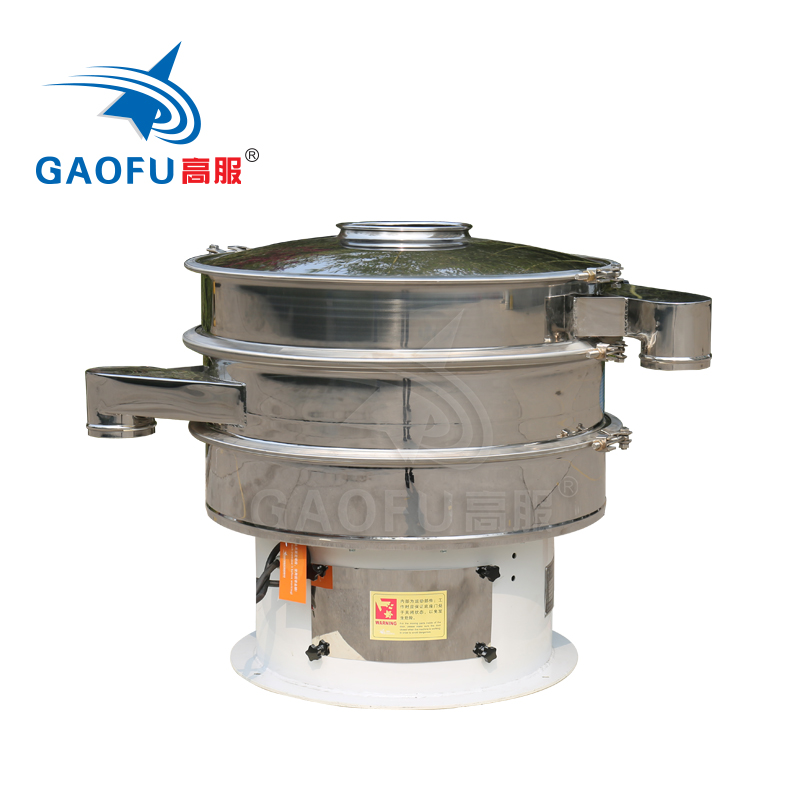
Fine salt can contain a high proportion of small particles and may require careful attention to screen selection and dust containment. Granular salt, on the other hand, generally contains larger particles that may require a different screening arrangement and material-flow path.
Understanding these differences can help processors evaluate how a Rotary vibrating sieve can be incorporated into their specific salt-processing line.
1. Fine Salt and Granular Salt Have Different Screening Characteristics
The term “salt” covers a broad range of particle conditions.
Fine salt generally consists of smaller particles with a relatively high proportion of material near the lower end of the desired size range. Granular salt contains larger crystals and may have a broader particle-size distribution depending on how it is produced and handled.
These differences can influence:
- Material movement across the screen
- Screen loading
- Dust generation
- Residence time
- Discharge behavior
- Cleaning requirements
- Mesh selection
Consequently, the same Rotary vibrating sieve configuration should not automatically be assumed to provide identical results for every salt product.
2. Screening Fine Salt
Fine salt requires a screening surface with openings appropriate to the target product specification.
During operation, the vibration of the Rotary vibrating sieve moves the fine particles across the screening surface. Particles capable of passing through the selected openings move into the lower collection area, while larger particles continue toward the discharge outlet.
A typical process may be represented as:
Fine Salt → Feeding → Fine Screening → Accepted Product + Oversize Fraction
Because fine particles can be more easily dispersed during handling, the surrounding feeding and discharge connections should also be considered.
An enclosed configuration may be considered where containment of airborne powder is required.
3. Screening Granular Salt
Granular salt generally contains larger crystals and may require a screening process for oversize removal or size classification.
The larger particles travel across the screening surface under vibration, while particles smaller than the selected opening can pass through the mesh.
A basic process can be arranged as:
Granular Salt → Screening Surface → Selected Fraction + Oversize Material
The screen opening should correspond with the intended product specification.
Where the feed contains several particle-size ranges, multiple screening decks may be considered to separate the material into different fractions.
4. How Particle Shape Influences Movement
Salt crystals are not necessarily uniform in shape.
Some may be relatively regular, while others may have irregular surfaces or fractured edges. Particle shape can influence how individual crystals contact the mesh and move across the screening surface.
This is one reason why actual material testing can be useful when developing a screening process.
A Rotary vibrating sieve should be evaluated with consideration for both particle size and particle shape rather than relying on nominal size alone.
5. Fine Salt May Require Greater Dust-Control Attention
Fine salt particles can become airborne more readily than larger granular crystals during feeding, screening, and discharge.
Where this is a concern, the screening system can be designed with suitable covers, seals, and enclosed transfer connections.
Potential dust-management measures may include:
- Enclosed screening chambers
- Sealed inlet connections
- Suitable outlet connections
- Dust-collection interfaces
- Controlled material transfer
- Appropriate cleaning procedures
The actual arrangement should be determined according to the facility and material conditions.
If combustible dust hazards are relevant, the complete installation should be assessed according to applicable regulations, material properties, and site-specific safety requirements.
6. Granular Salt Requires Attention to Mechanical Handling
Larger salt crystals can place different demands on material handling components.
During feeding and screening, larger particles may create more noticeable impacts against internal surfaces than fine particles.
Equipment construction, screen support, fasteners, and discharge arrangements should therefore be evaluated according to the actual granular salt characteristics and operating conditions.
The objective is to create a screening configuration that is mechanically appropriate for the material being processed.
7. Screen Opening Selection for Fine Salt
For fine salt, the desired separation range may be relatively narrow.
The screen opening should therefore be selected according to the required product specification.
Factors that may influence the selection include:
- Target particle size
- Feed particle-size distribution
- Moisture
- Required capacity
- Number of fractions
- Product specification
The actual screening result depends on the combination of material properties and operating conditions. A mesh opening should therefore not be considered independently from the complete screening process.
8. Screen Opening Selection for Granular Salt
Granular salt can require a different screening approach.
If the purpose is to remove large crystals, the screening opening may be selected around the maximum acceptable particle size.
If the objective is to classify granular salt into several grades, multiple screening decks with different openings can be used where appropriate.
For example:
Granular Salt Feed
↓
Coarse Screening
↓
Medium Fraction
↓
Fine Fraction
The actual mesh arrangement should be based on the desired product specifications.
9. Feeding Fine Salt Into the Screening Chamber
Fine salt can behave differently during feeding because smaller particles may be more susceptible to airborne movement and material accumulation.
A suitable feeding arrangement can help provide a controlled supply to the Rotary vibrating sieve.
The feeding system should be evaluated according to:
- Required feed rate
- Hopper or storage arrangement
- Material flow characteristics
- Enclosure requirements
- Connection dimensions
- Cleaning procedures
The objective is to create a practical transition between material storage and the screening chamber.
10. Feeding Granular Salt
Granular salt may have different feeding characteristics because larger crystals can move differently through hoppers, chutes, and conveying equipment.
The feeding arrangement should account for particle size, bulk density, capacity, and installation conditions.
Suitable transition sections can help guide material toward the screening chamber while maintaining an organized material route.
As with fine salt, the feeding system should be considered together with the Rotary vibrating sieve rather than designed independently.
11. Screening Deck Configuration
The number of screening decks can be adapted to the intended salt-processing application.
A single deck may be sufficient for applications such as:
- Oversized-particle removal
- Basic screening
- Separation of one specified fraction
Multiple decks may be considered when several size fractions are required.
For both fine and granular salt, the appropriate configuration depends on the number of required products and the characteristics of the feed material.
Adding screening decks does not automatically improve every screening process. The configuration should correspond to the actual production objective.
12. Discharge of Fine Salt
Fine screened salt should have a suitable route from the screening chamber to the next processing stage.
Depending on the production line, the discharged material may enter:
- Collection hoppers
- Conveying equipment
- Blending equipment
- Storage systems
- Packaging equipment
Because fine particles can be more easily dispersed, sealed connections and suitable downstream handling may be considered where dust containment is required.
13. Discharge of Granular Salt
Granular salt may require discharge arrangements capable of accommodating larger particles and the desired material throughput.
The outlet should provide a practical connection to downstream equipment without creating unnecessary restrictions.
Discharge design can take into account:
- Particle size
- Material volume
- Outlet dimensions
- Downstream capacity
- Collection method
- Available installation space
This helps maintain continuity between the screening and subsequent processing stages.
14. Cleaning Considerations for Fine and Granular Salt
Fine salt can leave residual particles on internal surfaces and screening components. Granular salt can also become lodged around screen frames, outlets, or connection points.
Routine inspection and cleaning procedures should therefore be established according to the facility's production and sanitation requirements.
For food-processing applications, accessible screening components and practical cleaning points can be useful considerations.
Where different products are processed on the same machine, appropriate changeover procedures should also be established to address cross-contamination risks.
15. Maintenance of the Rotary Vibrating Sieve
Regular maintenance helps operators monitor the condition of the screening equipment.
For salt applications, inspection can include:
- Screen integrity
- Screen tension or fastening
- Sealing components
- Discharge passages
- Vibration-related components
- Material accumulation
- Fasteners and structural connections
Fine and granular salt may place different demands on individual components, so maintenance procedures should reflect the actual application.
The manufacturer's operating and maintenance recommendations should be followed for the specific equipment model.
16. Comparing Fine and Granular Salt Applications
Although both materials can be processed using a Rotary vibrating sieve, their operating considerations can differ.
| Consideration | Fine Salt | Granular Salt |
|---|---|---|
| Typical particle condition | Smaller particles | Larger crystals |
| Main consideration | Fine separation and containment | Particle movement and mechanical handling |
| Dust attention | May require greater attention | Generally depends on fines content |
| Screen selection | Related to fine particle-size range | Related to desired granular fractions |
| Feeding | Controlled powder transfer | Suitable granular material supply |
| Discharge | Sealed transfer may be useful | Outlet capacity and particle passage |
| Cleaning | Fine residual particles may require attention | Crystal accumulation may require inspection |
| Configuration | Depends on target fine fraction | Depends on oversize removal or classification |
This comparison is a starting point rather than a universal equipment specification. Actual salt characteristics should be evaluated for each project.
17. Gaofu Machinery Rotary Vibrating Sieve for Salt Processing
Gaofu Machinery provides Rotary vibrating sieve equipment for powder and granular material screening applications.
For fine and granular salt, the equipment configuration can be considered according to material characteristics, particle-size requirements, processing capacity, screening objectives, feeding conditions, discharge requirements, and installation environment.
Depending on the application, Gaofu can discuss screening layers, mesh specifications, material-contact construction, inlet and outlet arrangements, and other customization requirements.
Gaofu Machinery combines equipment manufacturing, customization, installation support, and after-sales service to support customers developing screening systems for food and other processing industries.
Conclusion
Fine salt and granular salt can have different behavior during industrial screening, even though both are commonly referred to as salt.
Fine salt may require greater attention to fine-particle screening and dust containment, while granular salt can require closer consideration of particle movement, screen loading, and mechanical handling.
A Rotary vibrating sieve can be configured for different salt-processing applications, including screening, oversize removal, and particle-size classification.
The appropriate equipment arrangement should be determined according to the actual salt characteristics, target product specification, capacity, hygiene requirements, installation conditions, and applicable safety standards. A material-specific approach can help processors develop a screening process that matches their particular production requirements.