

Salt Screening Process Guide: Using a Rotary Vibrating Sieve for Different Salt Particle Sizes
Post Date: 2026-09-16
Salt products can be processed into different particle-size ranges depending on their intended use. Food manufacturers, seasoning producers, and ingredient processors may therefore need screening processes that can separate coarse crystals from smaller particles or divide a mixed salt feed into several specified fractions.
A Rotary vibrating sieve can be used as part of these screening processes. Its circular screening surface and vibratory movement allow salt to travel across the mesh while particles meeting the selected size requirements pass through the openings.
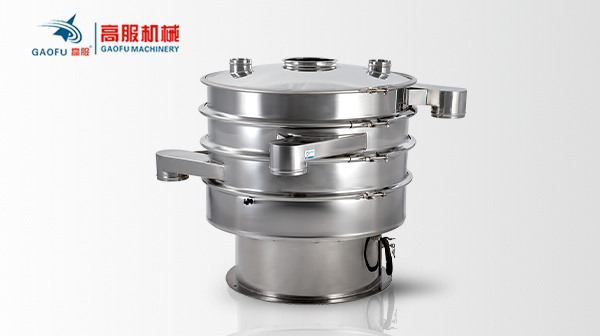
The screening process should be configured according to the actual salt product, target particle-size range, required capacity, and downstream application. This guide explains how a Rotary vibrating sieve can be incorporated into different salt screening workflows.
1. Start With the Target Salt Particle Size
Before designing the screening process, the target particle-size range should be clearly established.
Salt may be processed as:
- Coarse crystals
- Medium-sized particles
- Fine salt
- Mixed-size salt requiring classification
- Salt requiring removal of oversized particles
The target specification determines how the screening process should be arranged.
For a single-size product, one screening stage may be sufficient in some applications. When several fractions are required, multiple screening decks can be considered.
The screening objective should therefore be established before determining the machine configuration.
2. Screening Process for Coarse Salt
Coarse salt contains relatively large crystals and may require screening to remove oversized pieces or separate different coarse fractions.
A typical process can be arranged as:
Coarse Salt Feed → Rotary Vibrating Sieve → Oversize Discharge + Accepted Salt
The screen mesh is selected according to the desired product specification.
Larger particles that cannot pass through the selected opening remain above the screening surface and move toward the oversize outlet, while appropriately sized particles pass through the mesh.
This arrangement can be useful when the main objective is to remove particles outside the specified upper size range.
3. Screening Process for Medium-Size Salt
Medium-sized salt may be used in a variety of food-processing and seasoning applications.
When a feed contains a mixture of larger and smaller particles, the Rotary vibrating sieve can separate material according to a selected screening point.
A basic process may involve:
Mixed Salt → Screening Deck → Coarse Fraction + Medium/Fine Fraction
The screened material can then be transferred to the next processing stage.
If the production specification requires a narrower particle-size range, additional screening stages or screening decks may be considered.
4. Screening Process for Fine Salt
Fine salt requires closer attention to screen specifications and material handling because a greater proportion of particles may be close to the selected separation size.
A suitable Rotary vibrating sieve can provide a screening surface designed for fine-particle separation.
A simplified process is:
Fine Salt Feed → Fine-Mesh Screening → Accepted Fine Salt + Oversize Material
The actual screening result depends on the salt's particle-size distribution, moisture condition, feed rate, screen specifications, and equipment operating conditions.
For this reason, the fine-salt process should be evaluated using representative production material where practical.
5. Screening Mixed Salt Into Several Fractions
Some applications require more than one finished particle-size fraction.
A multi-layer Rotary vibrating sieve can provide sequential screening through different mesh openings.
For example:
Mixed Salt
↓
Upper Deck — Coarse Separation
↓
Middle Deck — Medium-Size Separation
↓
Lower Deck — Fine Separation
This arrangement can produce multiple fractions from one feed stream, with each fraction discharged through a corresponding outlet.
The number of screening layers should be determined according to the required product grades and the characteristics of the feed material.
6. Using Different Mesh Openings for Classification
Each screening deck can use a specific mesh opening.
For example, a process requiring three particle-size ranges may use progressively smaller openings across the screening decks.
The actual mesh specifications should be determined according to the desired particle-size distribution and the salt being processed.
It is important to distinguish between the nominal mesh opening and the final product specification. Actual separation depends on the interaction between the material and the screening system.
Therefore, mesh selection should be evaluated together with material testing and process requirements when necessary.
7. Removing Oversized Salt Particles
Not every salt screening process needs multi-size classification.
In some food-processing lines, the primary objective is simply to remove oversized crystals before the salt enters another production stage.
A Rotary vibrating sieve can be configured for this type of scalping application.
The process may be:
Salt Feed → Coarse Screening → Accepted Salt → Downstream Process
Oversized particles can be discharged separately for further handling.
This approach may be suitable where the downstream process requires salt within a defined upper particle-size limit.
8. Preparing Salt for Blending
Particle-size consistency can be relevant when salt is used as an ingredient in seasoning or other food formulations.
Screening can be positioned before the blending stage to establish a specified salt fraction.
A typical arrangement could be:
Salt Storage → Feeding → Rotary Vibrating Sieve → Classified Salt → Blender
The screening specification should correspond with the formulation requirements.
If several ingredients have significantly different particle-size characteristics, the complete blending process should also be evaluated to determine whether additional material preparation is required.
9. Screening Salt Before Packaging
Packaging equipment may also place requirements on the condition of the salt entering the packaging stage.
Oversized particles or unwanted material may need to be removed before packaging.
A Rotary vibrating sieve can be positioned upstream of the packaging equipment:
Salt Processing → Rotary Vibrating Sieve → Product Collection → Packaging
The appropriate screening specification depends on the packaged product and customer requirements.
The screening system should also be coordinated with the downstream collection equipment so that the screened salt can move smoothly into the packaging process.
10. Managing Different Salt Grades in One Facility
Some processing facilities handle several salt grades.
Rather than assuming that one fixed screening configuration will suit every product, the process can be evaluated according to the requirements of each grade.
Factors may include:
- Target particle size
- Feed particle distribution
- Moisture condition
- Required capacity
- Screening layers
- Cleaning requirements
- Product changeover procedures
Where multiple products are processed on the same equipment, cleaning and inspection procedures should be established according to the facility's food-hygiene requirements.
11. Material Feeding Before Salt Screening
The screening process begins before the salt reaches the mesh.
The Feeding system or upstream material-handling equipment should provide a suitable supply to the Rotary vibrating sieve.
If material enters in large surges, the screening condition may change. If the supply is interrupted, the machine may not operate under the intended production condition.
Therefore, the feeding arrangement should be coordinated with the screening capacity and the salt-processing requirements.
A practical process route can be represented as:
Salt Supply → Feeding System → Rotary Vibrating Sieve → Collection
The exact configuration depends on the production line and material characteristics.
12. Collection of Different Salt Fractions
When several fractions are produced, each material stream needs a suitable collection route.
For example:
- Coarse fraction → Separate collection
- Medium fraction → Product collection
- Fine fraction → Separate collection
The discharge arrangement should correspond with the downstream process.
Where the different fractions are used for different products, separate collection can help maintain product identification and reduce unnecessary material mixing.
Where fractions are intended to be recombined, the collection and conveying arrangement should be designed accordingly.
13. Cleaning Between Different Salt Products
Salt processing equipment may require routine cleaning depending on the production environment and product requirements.
This becomes particularly relevant when the same Rotary vibrating sieve is used for different salt grades or food ingredients.
Cleaning considerations can include:
- Screen removal
- Internal inspection
- Material-contact surfaces
- Sealing components
- Discharge outlets
- Areas where residual material may remain
The appropriate cleaning procedure should follow the customer's sanitation program and applicable food-processing requirements.
14. Salt Screening and Dust Management
Fine salt can generate airborne particles during feeding, screening, and discharge.
Where dust containment is required, an enclosed Rotary vibrating sieve configuration can be considered together with suitable connections and dust-collection arrangements.
The system should be evaluated as a complete installation rather than relying on the screening machine alone.
Where combustible dust hazards may be present, applicable regulations, material characteristics, and site-specific safety requirements should be assessed. Any explosion-protection measures should be determined through appropriate engineering evaluation.
15. Monitoring the Screening Process
Once a salt screening line is operating, routine monitoring can help operators understand whether the process remains within the intended operating range.
Useful observations may include:
- Feed condition
- Material accumulation
- Screen condition
- Product particle-size distribution
- Discharge condition
- Equipment vibration
- Cleaning status
If the product specification changes, the screening configuration may also need to be reassessed.
Operating records can provide useful information for identifying gradual changes in material or equipment conditions.
16. Gaofu Machinery Rotary Vibrating Sieve for Salt Screening
Gaofu Machinery provides Rotary vibrating sieve equipment for powder and granular material screening applications, including salt processing.
For different salt particle-size requirements, the equipment can be configured according to the screening objective, material characteristics, required fractions, mesh specifications, capacity, and installation conditions.
Depending on the process, Gaofu can evaluate single-layer or multi-layer screening arrangements, feeding and discharge connections, material-contact components, and other equipment details.
Gaofu Machinery also provides customization, equipment manufacturing, installation support, and after-sales service for customers developing screening systems for food and other processing industries.
Conclusion
Salt screening processes can vary considerably depending on the required particle-size range.
A Rotary vibrating sieve can be incorporated into processes for coarse salt, medium-sized salt, fine salt, mixed-size classification, oversized-particle removal, blending preparation, and pre-packaging screening.
The appropriate process should be established according to the actual salt characteristics and product specification. Mesh openings, screening layers, feeding conditions, discharge routes, cleaning procedures, and downstream equipment should be considered as parts of the complete process.
For food processors seeking a practical salt-screening solution, careful process definition provides a useful foundation for selecting and configuring a Rotary vibrating sieve that corresponds with their production requirements.