

How Feeding System Design Affects Material Distribution Before Entering a Flour Sieve
Post Date: 2026-09-11
In flour processing, the screening stage is only one part of the material-handling process. Before flour reaches a flour sieve, it must pass through a feeding stage that determines how the material enters the screening equipment. The structure and configuration of this Feeding system can influence the way powder is presented to the sieve.
If material enters the screening machine in an uneven pattern, some areas of the screening surface may receive more material than others. This can affect how effectively the available screen area is used and may influence the overall behavior of the screening process.
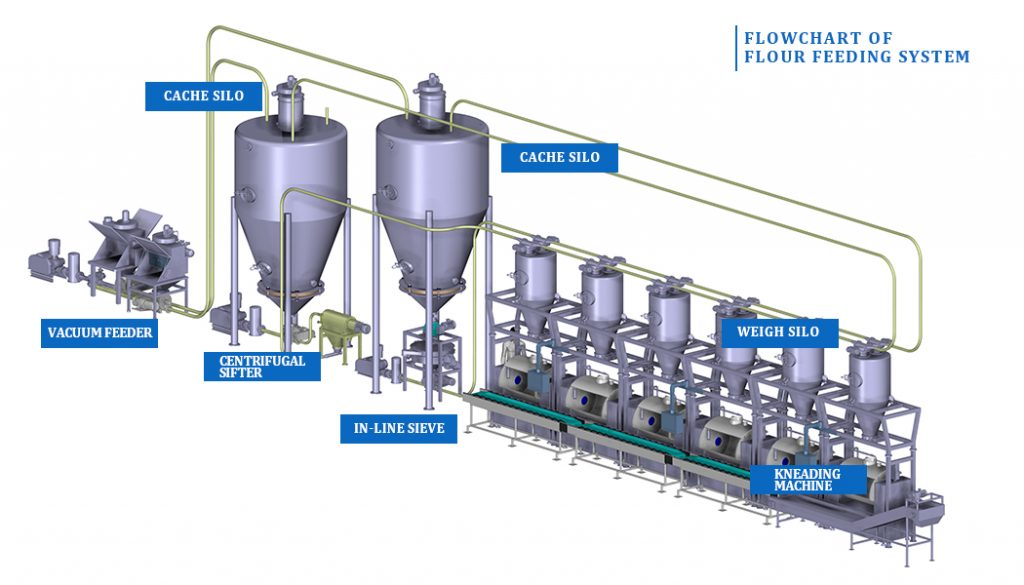
For this reason, Feeding system design should be considered not only in terms of supplying flour but also in terms of preparing an appropriate material distribution pattern before screening.
1. What Does Material Distribution Mean in a Flour Sieve System?
Material distribution refers to how incoming flour is positioned and spread as it approaches the screening surface.
A simplified process can be represented as:
Flour Supply → Feeding System → Material Distribution → Flour Sieve → Screened Material
The Feeding system serves as the transition between material supply and screening. Its design can influence the direction, concentration, and entry pattern of the flour.
Ideally, the incoming material should be presented to the screening equipment in a manner compatible with its inlet and internal structure.
However, the appropriate distribution pattern depends on factors such as flour properties, sieve dimensions, feeding capacity, screen configuration, and equipment operating conditions.
2. Why Feeding Position Matters
The position where flour enters the sieve can affect how material moves across the screening area.
If the inlet is positioned appropriately for the machine structure, incoming flour can enter the intended material path. If the feeding point is poorly matched to the sieve configuration, material may concentrate in a limited area before spreading through the screening chamber.
This is why the Feeding system and flour sieve should be evaluated as a complete process.
During equipment design, engineers may examine:
- Feeding inlet position
- Sieve inlet dimensions
- Material entry direction
- Available screening area
- Equipment inclination or orientation
- Expected material throughput
- Flour flow characteristics
These factors help determine an appropriate feeding arrangement for a particular application.
3. Hopper Geometry Can Influence Powder Discharge
The hopper is an important component in many Feeding systems. It stores material temporarily before the flour is transferred toward the sieve.
Its geometry can affect the way flour leaves the hopper.
For example, the following factors may require consideration:
- Hopper shape
- Outlet size
- Outlet position
- Wall angle
- Internal surface condition
- Material residence time
- Flour flowability
A hopper designed without considering the material's flow behavior may allow flour to accumulate in certain areas or discharge unevenly.
For fine or cohesive flour, the possibility of bridging, arching, or adhesion should be considered during system design.
The appropriate hopper structure should therefore be selected according to actual material characteristics rather than using one configuration for every flour application.
4. Transition Sections Help Shape the Material Path
The section between the Feeding system and flour sieve can also influence material movement.
A transition section may be used to connect equipment with different dimensions or elevations. Its geometry should provide a practical route for flour while avoiding unnecessary changes in direction.
Engineers may evaluate:
- Transition length
- Cross-sectional dimensions
- Direction changes
- Internal corners
- Connection height
- Material-contact surfaces
An appropriately designed transition can help establish a more predictable material path.
For food-processing applications, the transition should also be considered from the perspective of cleaning, inspection, and residue management.
5. Avoid Excessive Concentration at One Entry Point
A flour sieve has a defined screening surface. If incoming material is concentrated excessively in one area, the available screening surface may not be utilized evenly.
The Feeding system can therefore be designed to provide an entry arrangement appropriate to the sieve's internal structure.
This does not mean that every application requires a special distribution device. The actual requirement depends on the sieve design, material properties, and production conditions.
Instead, the engineering objective should be to determine whether the incoming material pattern is compatible with the screening equipment.
In some applications, a simple feeding arrangement may be sufficient. In others, additional distribution or transition components may be considered.
6. Flour Properties Affect Distribution Behavior
Feeding system design cannot be separated from flour characteristics.
Different flour materials can have different:
- Particle size distributions
- Moisture levels
- Bulk densities
- Flowability
- Cohesiveness
- Surface adhesion
- Tendency to compact
A free-flowing powder may move through a hopper differently from a fine cohesive powder.
For this reason, the same Feeding system design may not produce identical material behavior with different flour products.
When selecting equipment, manufacturers can provide information about the material being processed and, where necessary, conduct material testing to better understand its flow characteristics.
7. Control the Relationship Between Feeding and Screening
Material distribution is also related to the relationship between the Feeding system and the flour sieve.
The feeding stage introduces material into the screening process, while the sieve separates particles according to the selected screening configuration.
If the Feeding system introduces material too aggressively for the intended screening process, the incoming material may accumulate near the inlet. If the feeding arrangement does not supply enough material for the required production conditions, the screening equipment may not be used as intended.
Therefore, the Feeding system should be considered together with:
Material Properties + Feeding Conditions + Sieve Design + Screening Requirements
This approach is more practical than evaluating feeding equipment based only on its nominal capacity.
8. Distribution and Screen Surface Utilization
The available screen surface is an important resource in a flour sieve.
When material enters the screening chamber, it needs sufficient opportunity to interact with the screening surface. The way material is introduced can influence how quickly it spreads and how it travels through the machine.
Factors affecting this process may include:
- Inlet arrangement
- Material layer characteristics
- Feeding rate
- Screen dimensions
- Flour flowability
- Machine movement
- Screening mesh specification
The final material movement is determined by the combined behavior of the Feeding system and screening machine.
Consequently, improving material distribution is not simply a matter of changing the feeding device. The entire material path should be reviewed.
9. Feeding System Design for Different Production Arrangements
Different flour-processing facilities may use different material supply methods.
Bag-Based Production
A bag unloading arrangement may transfer flour into a Feeding system before screening.
Bagged Flour → Bag Unloading → Feeding System → Flour Sieve
The design should consider manual loading conditions, hopper volume, material discharge, and operator access.
Bulk Bag Processing
For large-volume powder handling, a Big Bag Feeding Station may be incorporated into the material supply stage.
Big Bag → Feeding Station → Material Transfer → Flour Sieve
The feeding arrangement should correspond to the bulk-bag discharge method and downstream screening requirements.
Enclosed Powder Transfer
Where the process requires a more enclosed material route, a conveying component may be combined with the Feeding system before the flour sieve.
Storage → Feeding System → Powder Conveying → Flour Sieve
The appropriate arrangement depends on the production environment and material-handling requirements.
10. Consider the Feeding System During Flour Sieve Layout Planning
Material distribution can be influenced by the physical arrangement of the entire line.
When planning the layout, manufacturers should consider:
- Equipment elevation
- Horizontal distance
- Transfer direction
- Available floor area
- Maintenance space
- Material inlet height
- Discharge height
- Operator access
An unnecessarily long or complicated transfer route may create additional material-handling considerations.
A more straightforward layout can make the material path easier to understand and may also simplify inspection and maintenance.
For retrofit projects, the existing flour sieve, storage equipment, and surrounding machinery should be measured before finalizing the Feeding system configuration.
11. Dust Management Should Be Considered Along the Material Path
Fine flour can become airborne during loading, transfer, and discharge.
Feeding system design can incorporate appropriate covers, seals, enclosed transfer sections, and connections to dust-collection equipment where required.
However, dust management is a complete-system consideration. It may involve:
- Equipment enclosure
- Sealing
- Ventilation
- Dust collection
- Grounding
- Electrical equipment
- Cleaning procedures
- Operating practices
Where flour dust may present a combustible-dust hazard, the complete installation should be assessed according to applicable regulations, site risk assessments, and relevant safety requirements.
No single Feeding system component should be presented as eliminating all dust-related risks.
12. Cleaning and Material Changeover
The Feeding system is part of the product-contact route, so cleaning considerations should be incorporated into its design.
This can be particularly important when a facility processes multiple flour grades or other powdered ingredients.
Engineers may consider:
- Accessible contact surfaces
- Internal corners
- Removable components
- Inspection openings
- Residue-prone areas
- Cleaning frequency
- Product changeover procedures
A design that allows operators to inspect and clean relevant areas can support the plant's established sanitation procedures.
The specific cleaning method should be determined according to the material, production environment, and applicable food-processing requirements.
13. How Gaofu Machinery Develops Feeding System Solutions
Gaofu Machinery provides Feeding system solutions for powder and bulk-material processing applications. For flour sieve projects, the Feeding system can be configured according to material characteristics, production conditions, equipment layout, and screening requirements.
The engineering evaluation may include:
- Flour characteristics
- Required throughput
- Feeding method
- Hopper configuration
- Material transfer route
- Sieve inlet arrangement
- Installation dimensions
- Cleaning requirements
- Dust-management considerations
Depending on the project, the solution may incorporate feeding, conveying, bulk-bag discharge, and screening equipment into a coordinated material-handling arrangement.
The final configuration should be confirmed according to actual material behavior, production conditions, equipment specifications, and applicable standards.
Conclusion
The Feeding system plays an important role before flour enters a screening machine. Its hopper geometry, outlet arrangement, transition design, feeding position, and material path can all influence how flour is presented to the sieve.
Rather than evaluating the Feeding system as an independent machine, flour processors can consider the complete relationship between material characteristics, feeding design, material distribution, and screening equipment.
A well-planned system should be developed around the actual flour properties and production requirements. This approach can help manufacturers create a practical material path while also considering maintenance, cleaning, dust management, and overall plant layout.
For flour-processing projects, Gaofu Machinery can provide Feeding system configurations based on specific material and process conditions, supporting the development of customized powder-handling and screening solutions.