

Mitigating Dust Explosion Risks During Protein Powder Handling: Explosion-Proof Features and Compliance Factors in Industrial Feeding Station Units
Post Date: 2026-11-02
In industrial food processing, fine organic powders such as whey, casein, soy, and pea protein isolates present an often-underestimated hazard: combustible dust. When high concentrations of fine protein particles become suspended in an enclosed space alongside an ignition source, the conditions for a dust deflagration or explosion are established. The dumping and initial intake stage is one of the highest-risk operational zones due to rapid particulate dispersion and potential static electricity accumulation.
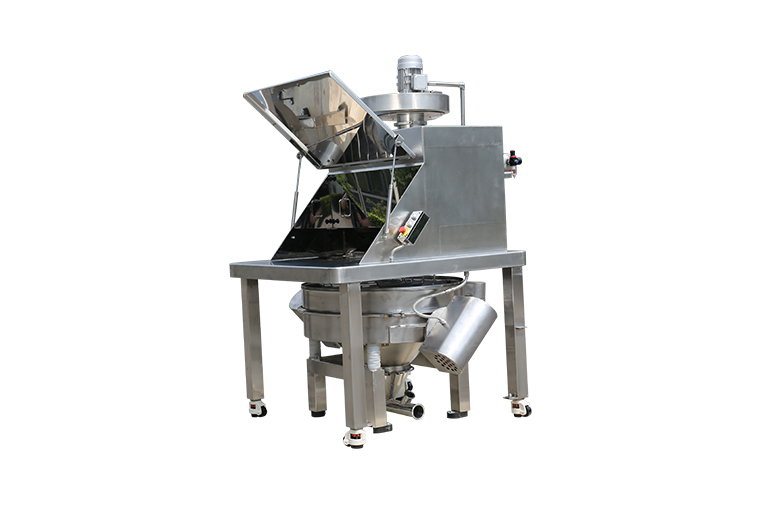
Engineering a safe bulk intake process requires specialized equipment designed to prevent ignition, isolate pressures, and safely discharge dust clouds. The Gaofu feeding station incorporates comprehensive explosion-proof features and compliance factors to safeguard personnel, maintain regulatory adherence, and protect processing infrastructure.
1. Understanding Combustible Dust Hazards in Protein Processing
Dust explosions depend on five factors (the "Dust Explosion Pentagon"): combustible dust, ignition source, oxygen, dispersion, and confinement. Protein powders possess specific deflagration parameters ($K_{st}$ and $P_{max}$ values) that classify them as Class ST-1 combustible dusts.
- Dispersion during Unloading: Slitting and dumping 25 kg bags creates localized airborne clouds within the hopper, fulfilling the dispersion requirement.
- Static Charge Accumulation: The friction of dry powder pouring across ungrounded surfaces or synthetic filter media generates high electrostatic charges, creating potential spark hazards.
- Confined Enclosures: The internal volume of an intake hopper or dust collection hood supplies the confinement necessary for pressure buildup during an ignition event.
2. Key Explosion-Proof Engineering Features of the Gaofu Feeding Station
To neutralize potential ignition sources and manage pressure safety, Gaofu feeding stations incorporate multi-layered safety engineering:
[ Static Dissipation ] ➔ [ Ignition Prevention ] ➔ [ Pressure Relief & Isolation ]
  • Bonded grounding lugs   • ATEX/EX-rated motors   • Explosion venting panels
• Anti-static filter media • Non-sparking alloys • Heavy-duty reinforced shell- Complete Electrostatic Grounding: All structural components, quick-release clamps, hatch hinges, and internal screen decks feature dedicated copper grounding straps and equipotential bonding. Static electricity generated during bag dumping drains continuously to earth ground.
- Anti-Static (Conductive) Filter Media: Integrated dust cartridges incorporate stainless steel fiber weaves or aluminized conductive membranes, preventing high-voltage surface charges from accumulating on filter surfaces during pulse-jet cleaning.
- ATEX / EX-Certified Electrical Components: Exhaust fan blowers, vibratory motors, solenoid valves, and local control boxes are fully explosion-proof (rated for Zone 22 / Zone 21 hazardous dust atmospheres), eliminating electrical arcing or surface overheating.
- Non-Sparking Mechanical Construction: Critical contact areas utilize non-sparking alloys or polished stainless steel surfaces, eliminating mechanical spark risks during bag placement or maintenance.
3. Pressure Mitigation and System Isolation Options
For processing environments requiring heightened containment, the Gaofu feeding station can be configured with active and passive explosion protection hardware:
- Explosion Venting Panels: Precision-calibrated rupture discs or burst panels vent deflagration pressures safely out of the processing building via dedicated ductwork, preventing structural failure of the feeder shell.
- Explosion Isolation Valves: Downstream discharge chutes can be fitted with fast-acting flap valves or chemical suppression barriers, preventing flame propagation into downstream pneumatic conveying lines or storage silos.
- Reinforced Enclosure Integrity: The heavy-gauge stainless steel housing is engineered to withstand internal pressure spikes during controlled relief scenarios.
4. Regulatory Compliance and Safety Standards
| Safety Regulation / Standard | Compliance Implementation in Gaofu Feeding Stations |
|---|---|
| ATEX Directive 2014/34/EU | Certified electrical drives, motors, and conductive filter elements for dust zones |
| NFPA 652 / NFPA 654 | Standard on Combustible Dust Fundamentals; features source capture, grounding, and relief options |
| NFPA 68 / NFPA 69 | Explosion venting design guidelines and explosion prevention system integration |
| OSHA Combustible Dust Directives | Direct reduction of fugitive dust accumulation on elevated plant surfaces |
Conclusion
Mitigating dust explosion risks during raw material intake demands specialized containment, rigorous grounding, and ATEX/NFPA-compliant design. By integrating an explosion-proof Gaofu feeding station into protein powder intake lines, food and nutraceutical manufacturers ensure worker safety, satisfy regulatory requirements, and achieve reliable, dust-free material handling.