

Integrating Sieving Systems with the Protein Powder Feeding Station: A Comprehensive Approach to Agglomerate Reduction and Foreign Material Interception
Post Date: 2026-11-02
Ensuring absolute product purity and consistent bulk density is a primary goal in protein powder manufacturing. Powdered raw materials—such as whey protein concentrates, plant-based protein isolates, and milk powders—frequently form agglomerates during storage, transport, or exposure to ambient humidity. Furthermore, manual bag slitting introduces risks of foreign material ingress, including bag fibers, liner fragments, or packaging debris.
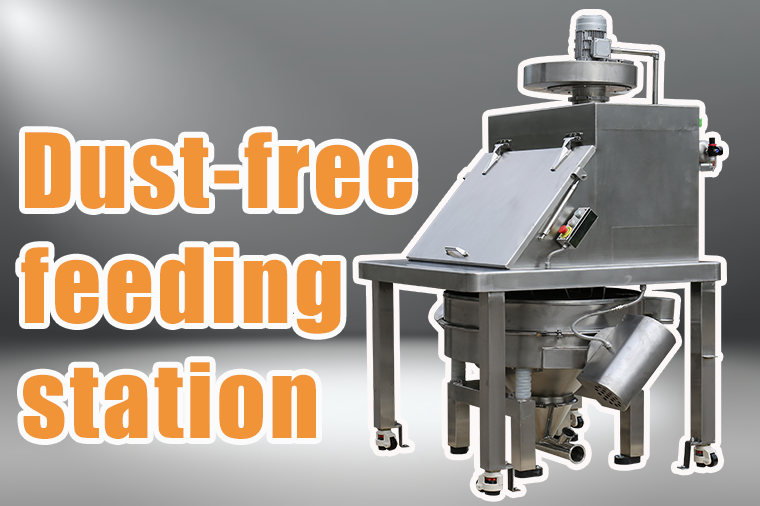
Integrating a dedicated vibratory sieving system directly within the Gaofu feeding station creates an all-in-one intake node that conditions material, removes clumps, and intercepts contaminants in a single operation.
1. Dual-Action Processing: De-Lumping and Quality Protection
Combining powder dumping and sieving into a unified housing streamlines material conditioning prior to downstream blending, storage, or conveying.
- Immediate Agglomerate Reduction: Soft powder clumps that form during shipping or compaction drop directly onto the internal vibrating screen deck. High-frequency three-dimensional vibration breaks down soft agglomerates instantly, restoring the powder to a uniform, free-flowing state without degrading delicate protein structures.
- Positive Foreign Material Interception: Any non-conforming solids—such as paper fragments from multi-wall bags, plastic string, or stray packaging materials—are immediately retained on the screen surface, preventing downstream valve damage, nozzle clogging, or batch contamination.
2. Structural Mechanics of the Integrated Sifting Module
The integrated sieving mechanism within the Gaofu feeding station is engineered for seamless operation, low maintenance, and total dust containment:
- Direct-Coupled Vibratory Motor Drive: Out-of-balance heavy-duty vibratory motors drive the screen frame directly, imparting precise horizontal and vertical accelerations to maximize throughput while minimizing overall equipment footprint.
- Tool-Free Quick-Release Clamping: The sifting chamber is secured using ergonomic, food-grade quick-release v-band clamps. Operators can access, inspect, or exchange mesh screens in minutes without using specialized hand tools, shortening product changeover times.
- Ultrasonic Deblinding Compatibility: For extremely fine or cohesive protein fractions (e.g., micro-milled soy isolates), the screening deck can be equipped with an ultrasonic deblinding system. High-frequency low-amplitude wave excitation prevents screen blinding and maintains steady throughput rates.
3. Operational Workflow: From Raw Bag to Conditioned Feed
[ Bag Dumping ] ➔ [ Negative-Pressure Dust Extraction ] ➔ [ Vibratory De-Lumping & Screening ] ➔ [ Conditioned Discharge ]
- Bag Opening: The operator slits the sack over the heavy-duty intake shelf while local negative pressure draws fine dust clouds away into the filtration chamber.
- Coarse Retainage & Breakup: Powder falls onto the screen deck; vibratory motion quickly separates agglomerates from oversized tramp material.
- Conditioned Material Transfer: Pure, uniform protein powder passes through the mesh aperture into the lower discharge hopper, feeding downstream rotary valves, screw feeders, or pneumatic lines at a consistent bulk density.
Technical Specifications: Integrated Sieving Options
| Feature | Technical Standard / Configuration |
| Screen Diameters | $400\text{ mm}$ to $1000\text{ mm}$ integrated mesh decks |
| Mesh Aperture Range | 10 mesh ($2000\ \mu\text{m}$) down to 200 mesh ($74\ \mu\text{m}$) options |
| Mesh Attachment | Food-grade epoxy bonded or laser-welded stainless rings |
| Vibratory Drive | IP65/IP66 enclosed dual-vibration motor design |
| Material Contact | SUS304 / SUS316L with continuous polished welds |
Conclusion
Combining raw material dumping with targeted inline sieving turns the intake station into an effective quality control gate. By specifying an integrated Gaofu feeding station with screen conditioning, protein powder manufacturers protect product purity, safeguard downstream processing equipment, and deliver uniform powder consistency across every production run.