

Three-Dimensional Vibration Dynamics: Particle Sizing Efficiency of a Feed Vibro Separator
Post Date: 2026-10-19
Introduction
In animal feed manufacturing, particle size consistency plays an important role in ingredient handling, mixing, conditioning, and pellet production. Materials such as ground corn, soybean meal, bran, protein ingredients, and mineral additives may contain particles of different sizes, even when they originate from the same batch. Managing this variation can help feed producers maintain more consistent material specifications and improve control over subsequent processing stages.
A Rotary Vibrating Sieve offers a mechanical approach to particle sizing by using a vibrating screen surface to separate material according to particle dimensions. Unlike a screening process that relies only on a stationary mesh, a rotary vibro separator generates compound motion that continuously moves material across the screen.
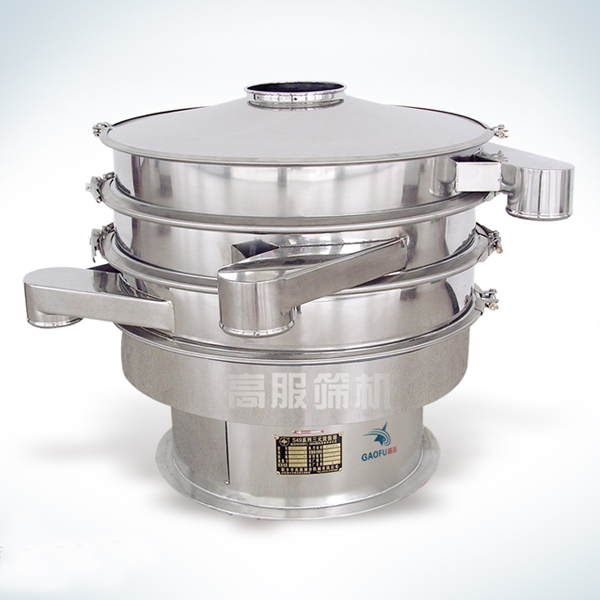
For feed manufacturers, understanding the relationship between three-dimensional vibration and particle behavior is essential when selecting equipment and establishing operating parameters. Gaofu Machinery's Rotary Vibrating Sieve uses a vertical vibration motor with eccentric weights at the upper and lower ends to generate horizontal, vertical, and inclined motion. The phase-angle relationship between these weights influences the material's movement trajectory across the screen. Learn more about Gaofu's Rotary Vibrating Screen.
1. Understanding Three-Dimensional Vibration Dynamics
Three-dimensional vibration is a central feature of the rotary vibrating sieve's working principle. It describes the combined movement transmitted to the screen surface rather than a single straight-line motion.
In Gaofu's design, a vertical vibration motor acts as the excitation source. Eccentric weights installed at the upper and lower ends of the motor generate a compound movement that includes horizontal, vertical, and inclined components. By adjusting their relative phase angles according to the machine's operating procedure, the movement trajectory of the material can be changed.
This motion influences several aspects of screening:
- Material distribution: Movement across the screen helps spread incoming feed over the available screening area.
- Particle presentation: Particles repeatedly encounter the mesh as they travel across the screen surface.
- Particle movement: The combined motion affects how quickly particles move, change direction, and remain in contact with the screen.
- Screen utilization: Material distribution influences how much of the available screen area participates in the separation process.
- Residence time: The movement pattern affects the time material spends on the screen before reaching the discharge.
These effects are interconnected. Faster material movement may support higher throughput in some applications, but it can also reduce the time available for particles to encounter suitable openings. The appropriate operating condition therefore depends on the material, screen specification, and required separation result.
2. How Vibration Supports Particle Size Separation
The basic principle of screening is straightforward: particles smaller than the effective screen openings may pass through, while particles that cannot pass remain above the screen and move toward the oversize discharge.
Actual separation is more complex because particle size alone does not determine behavior. Shape, density, moisture, surface properties, and the way particles interact with one another also affect passage through the mesh.
Three-dimensional vibration supports the process by repeatedly changing particle position and orientation. As feed moves across the screen, smaller particles may reach available openings and pass through to the lower collection area. Larger particles generally remain on the upper surface until they reach the discharge or are otherwise removed.
The process involves two important mechanisms:
Particle redistribution. Incoming material forms a bed on the screen. Movement can help distribute this bed and expose particles that would otherwise remain buried beneath other material.
Particle passage through the mesh. Once particles reach the screen surface and encounter suitable openings, their dimensions and orientation determine whether they can pass through.
Research into vibratory screening identifies particle stratification and passage through screen apertures as key mechanisms in separation. It also highlights the influence of vibration mode, particle-size distribution, and feed rate on screening behavior. Read research on particle stratification in vibratory screening.
For feed processing, these mechanisms explain why a well-matched vibration pattern and screen configuration can matter as much as the nominal screen opening.
3. The Relationship Between Vibration Trajectory and Screening Efficiency
Screening efficiency should not be evaluated by vibration intensity alone. The movement trajectory must suit the material and the target particle-size range.
When material moves too slowly, it may accumulate in certain areas of the screen, reducing the effective use of the screening surface. If movement is too aggressive for the application, particles may travel quickly or bounce excessively, limiting effective contact with the mesh.
The goal is to establish a balanced operating condition that supports material distribution, adequate screen contact, and the required throughput.
Horizontal movement
The horizontal component helps transport material across the screen surface. Its effect on screening depends on the direction and pattern of movement, the feed rate, and the geometry of the screen deck.
Vertical movement
The vertical component helps lift and redistribute particles. This can change the way particles interact with the screen surface and one another, potentially creating additional opportunities for smaller particles to reach openings.
Inclined or rotational movement
The inclined component contributes to the compound trajectory that moves material along the screen. Its relationship with the other movement components affects the material's path and residence time.
These components operate together. Adjusting the eccentric-weight phase angles changes the combined motion rather than independently controlling each direction in isolation. Operators should follow the manufacturer's guidance and assess the resulting screening behavior using the actual feed material.
4. Selecting the Screen Aperture for Feed Ingredients
The screen aperture defines the nominal opening through which particles can pass. Selecting the correct opening is essential to obtaining the desired particle-size distribution.
For example, a feed producer may want to remove coarse particles from ground ingredients or separate a material stream into different size fractions before mixing. The required aperture depends on the target specification and the range of particle sizes already present in the material.
Several factors should be considered:
- Target cut size: Establish the intended boundary between the material fractions.
- Particle-size distribution: Determine how much material is smaller than, close to, or larger than the selected opening.
- Particle shape: Elongated, flat, or irregular particles may pass differently from spherical particles with similar dimensions.
- Screen open area: The proportion of the surface available for passage influences the potential screening capacity.
- Mesh condition: Wear, deformation, or damage can change the effective opening and compromise separation.
- Material properties: Moisture, cohesion, fat content, and surface characteristics may affect particle movement and mesh passage.
Particles close to the aperture size can be especially challenging because their passage depends on repeated contact, orientation, and the availability of open mesh. A nominal aperture therefore should not be treated as a guarantee that every particle above or below a particular size will be separated perfectly.
For this reason, feed manufacturers should validate the selected screen using representative samples and the intended operating conditions.
5. Feed Rate and Screen Loading: Finding the Right Balance
Feed rate directly influences the depth of material on the screen. When the material layer becomes too deep, particles near the top may have fewer opportunities to reach the mesh. This can reduce the proportion of material that passes through within the available residence time.
At a lower feed rate, particles may have more opportunity to contact the screen, but the production target may not be met. The correct operating point balances throughput against the required separation quality.
A practical evaluation should consider:
- Incoming material consistency: Changes in particle size or moisture may alter screening behavior.
- Feed distribution: Material should enter the screen in a way that supports effective use of the available area.
- Screen loading: The depth and distribution of material should be monitored during operation.
- Discharge behavior: Accumulation at the oversize outlet may indicate that feed rate, material flow, or screen configuration requires review.
- Measured results: Screened samples should be compared with the required particle-size specification.
If the feed rate increases, the screen may require a different operating setting or configuration to maintain the desired result. However, changing vibration settings alone will not compensate for every limitation in screen area, mesh selection, or material behavior.
6. How Moisture and Cohesion Influence Particle Movement
Feed ingredients are not always free-flowing. Changes in moisture, fat content, storage conditions, or material composition can affect how particles move over the screen.
Moisture may promote agglomeration in some powders and fine granular ingredients. When particles adhere to one another, their effective size can increase, changing the way they pass through the mesh. Cohesive material may also accumulate on the screen surface, reducing the available open area.
The resulting screening behavior may differ even when the same screen aperture and vibration settings are used.
For a feed vibro separator, material evaluation should include:
- Moisture content and its variation during production.
- The tendency of particles to form agglomerates.
- Bulk density and flow characteristics.
- The presence of oils, fats, or other components that affect adhesion.
- The suitability of screen-cleaning arrangements for the material.
Where material properties change significantly, operators should investigate the cause before modifying the vibration settings. A screening test using representative material can help determine whether a different aperture, feed rate, screen-cleaning method, or equipment configuration is appropriate.
7. Multi-Layer Screening for Different Particle Fractions
Some feed-processing applications require more than a single separation cut. A multi-layer Rotary Vibrating Sieve can be configured to separate a material stream into multiple size fractions, subject to the machine model, screen arrangement, and application requirements.
In a multi-layer configuration, the screen apertures are arranged to retain or pass different particle sizes at successive stages. The resulting fractions may be collected through separate outlets.
Potential applications include classifying granular ingredients, separating coarse material from finer fractions, or controlling the particle-size distribution of a prepared feed component.
When planning a multi-layer installation, manufacturers should assess:
- The number of required fractions.
- The aperture and arrangement of each screen layer.
- The expected volume and size distribution of each fraction.
- The space available for each discharge connection.
- Cleaning and inspection requirements between production batches.
- The risk of unwanted material carryover between fractions.
More screen layers do not automatically produce a better result. Each additional separation stage must support a defined process requirement and be compatible with the material's flow characteristics.
Gaofu lists rotary vibrating screen configurations with multiple screen layers for grading and classification applications. The suitable number of layers should be confirmed against the required output fractions and the selected model. Gaofu Rotary Vibrating Screen product information.
8. Evaluating Particle Sizing Performance with Practical Tests
A reliable screening evaluation should use measured results rather than relying only on the appearance of the material or the machine's operating sound.
Feed manufacturers can assess performance through representative sampling and particle-size analysis. Samples should be taken from the incoming material and the relevant discharge streams under stable operating conditions.
A practical evaluation can include the following steps:
Step 1: Define the target specification. Determine the acceptable particle-size range and the proportion of each fraction required by the production process.
Step 2: Characterize the incoming material. Measure or estimate the particle-size distribution, moisture, and other properties that may influence screening.
Step 3: Select the screen configuration. Choose an aperture and screen arrangement suitable for the target separation.
Step 4: Establish operating conditions. Set the feed rate and vibration configuration in accordance with the equipment manufacturer's instructions.
Step 5: Collect representative samples. Take samples from the feed and discharge streams using a consistent procedure.
Step 6: Compare results. Evaluate the particle-size distribution of each stream against the required specification, including the amount of material that has reported to the wrong fraction.
Step 7: Adjust and verify. If the result is outside the target range, investigate screen selection, feed distribution, loading, material condition, and vibration settings before confirming the revised operating point.
This approach helps distinguish a machine-selection issue from a material-variation or operating-condition issue.
9. Maintaining Consistent Screening Conditions
Even a suitable screening configuration can deliver variable results if the screen surface or drive system is not maintained correctly.
Routine inspection should include screen integrity, mesh tension, fastening points, sealing components, motor condition, and the cleanliness of the material-contact areas. Any damaged mesh should be assessed and replaced as appropriate before it affects the separation result.
Operators should also record changes in throughput, material characteristics, and particle-size measurements. Comparing these records can help identify trends that may otherwise be overlooked.
For feed applications, cleaning procedures should be appropriate for the material and the required hygiene standards. Where production involves multiple formulations, changeover procedures should be designed to reduce unintended carryover and maintain product traceability.
A consistent maintenance and sampling program provides a practical basis for determining whether the screening process continues to meet the plant's requirements.
10. Gaofu Machinery Rotary Vibrating Sieve for Feed Processing
Gaofu Machinery provides rotary vibrating screening equipment for powder and granular material applications. Its Rotary Vibrating Sieve uses a vertical vibration motor and upper and lower eccentric weights to generate three-dimensional movement, with the movement trajectory influenced by the relative phase angles of the weights.
For feed manufacturers, this operating principle can be evaluated for particle sizing, grading, and impurity-removal applications where the material is suitable for screen-based separation.
When specifying a machine, Gaofu's technical team should be provided with information about the ingredient type, target particle-size range, required throughput, number of fractions, moisture characteristics, installation space, and cleaning requirements. These details help establish whether the proposed screen configuration matches the actual process.
The final equipment selection should be based on application data and, where appropriate, screening tests. Performance depends on the feed material, screen specification, operating conditions, and overall process design.
Explore the Gaofu Rotary Vibrating Screen to learn more about its design and potential applications.
Conclusion
Three-dimensional vibration is more than a mechanical feature of a Rotary Vibrating Sieve. It influences how feed particles spread across the screen, encounter mesh openings, and move toward their respective discharge points.
For animal feed manufacturers, particle sizing efficiency depends on the interaction between vibration trajectory, aperture size, feed rate, particle characteristics, moisture, and screen condition. A suitable configuration should therefore be selected through application analysis and verified with representative material tests.
Gaofu Machinery's Rotary Vibrating Sieve offers a screening option for feed-processing applications that require size-based classification or impurity removal. By combining appropriate equipment selection with controlled operating conditions, systematic sampling, and routine maintenance, manufacturers can better manage particle-size variation and support consistent downstream processing.